
BPC-157 for Hair and Scalp Health: Can This Repair Peptide Support Follicle Recovery?

Written bySpartan Research Team
BPC-157 (Body Protection Compound 157) is one of the most extensively researched repair peptides in the laboratory science community, with a broad profile of studied effects spanning gastrointestinal tissue, musculoskeletal repair, vascular biology, and neurological function. Among the less-discussed but scientifically compelling areas of BPC-157 research is its potential relevance to dermal and follicular biology — specifically, what laboratory findings suggest about this peptide’s mechanisms in the context of scalp tissue health and hair follicle research.
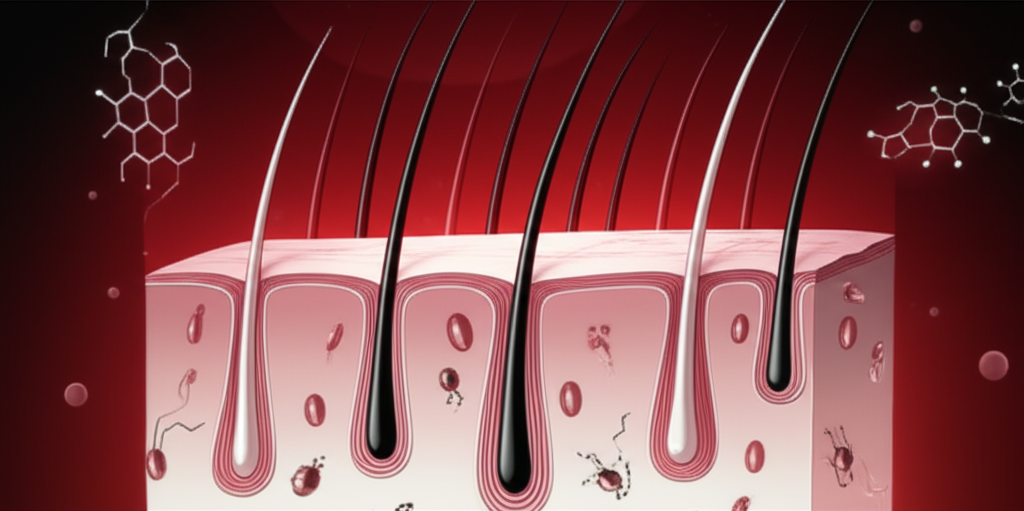
This article examines the biological mechanisms through which BPC-157 has been studied in skin and vascular tissue, and how those mechanisms intersect with the complex biology of hair follicle function and scalp tissue research. As with all BPC-157 research content, findings described here derive from peer-reviewed studies and laboratory investigations; no content constitutes medical guidance or encouragement of human use.
BPC-157: Background and Core Research Mechanisms
BPC-157 is a synthetic pentadecapeptide (15 amino acids) derived from a protective protein found in gastric juice. Originally studied for its gastroprotective properties, research has expanded dramatically to characterize BPC-157’s activities across multiple biological systems. For a comprehensive overview of BPC-157’s mechanisms and full research profile, our BPC-157 complete research guide provides an extensive foundation.
The mechanisms most relevant to hair and scalp biology research include BPC-157’s well-documented effects on:
- Angiogenesis — the formation of new blood vessels
- VEGF (Vascular Endothelial Growth Factor) upregulation
- Wound healing acceleration in dermal tissue models
- Nitric oxide (NO) pathway modulation
- Anti-inflammatory signaling in tissue injury models
- Fibroblast activation and collagen production
Each of these mechanisms has independently documented relevance to hair follicle biology and scalp tissue physiology, making BPC-157 a scientifically plausible subject for dedicated hair follicle research investigation.
The Biology of Hair Follicles: Why Vascularization and Repair Matter in Research
Before examining BPC-157’s specific research relevance, it is important to establish the biological context of hair follicle function. Hair follicles are among the most metabolically active structures in the body, requiring robust vascular supply to maintain the rapid cellular proliferation that drives the hair growth cycle. The dermal papilla — the specialized mesenchymal cell cluster at the follicle base — is the primary signaling hub governing follicle activity, and its function is critically dependent on adequate microvascular support.
Research has established that impaired scalp vascularization correlates with compromised follicle function in multiple models. Reduced capillary density in the dermal papilla region is associated with follicle miniaturization — the progressive reduction in follicle size and hair fiber caliber that characterizes several patterns of hair loss. This vascular dimension of follicle biology is precisely where BPC-157’s angiogenic research profile becomes most relevant for investigation.
Additionally, the scalp’s dermal layer — like all dermal tissue — depends on healthy extracellular matrix maintenance, fibroblast activity, and controlled inflammatory responses. Disruptions in these processes, whether from chronic inflammation, oxidative stress, or tissue damage, can impair the follicular microenvironment in ways that laboratory researchers study using peptide tools like BPC-157.
BPC-157 and VEGF: Angiogenic Research with Follicle Implications
VEGF Upregulation in BPC-157 Research
Among the most consistently replicated findings in BPC-157 research is its ability to upregulate VEGF (Vascular Endothelial Growth Factor) expression in injured tissue. VEGF is the primary signaling protein driving angiogenesis — the sprouting and formation of new capillaries from existing vessels. Multiple studies have demonstrated that BPC-157 administration in animal wound models is associated with significantly elevated VEGF expression at wound sites, alongside accelerated capillary network formation and reduced healing times.
This VEGF-upregulating property has profound theoretical relevance to follicle biology research. VEGF is not only a wound healing mediator — it is a critical regulator of hair follicle vascularization. Research has specifically demonstrated that VEGF expression in the dermal papilla correlates with follicle size and hair fiber production, and that VEGF upregulation can extend the anagen (active growth) phase of the hair cycle in animal models. Laboratory research examining BPC-157’s VEGF effects in scalp tissue contexts would therefore represent a biologically coherent extension of existing wound healing research.
Nitric Oxide Pathway Research
BPC-157’s influence on the nitric oxide (NO) signaling pathway is another mechanistically relevant area for hair biology research. Nitric oxide is a key vasodilatory mediator and has been independently studied in the context of scalp microcirculation and follicle function. Research on BPC-157 has demonstrated that it modulates eNOS (endothelial nitric oxide synthase) activity, contributing to vasodilation and improved local blood flow in tissue injury models.
The NO connection links BPC-157’s vascular research findings to the scalp microcirculation context, where adequate blood flow to follicular units is a prerequisite for normal hair cycle function. Research investigating BPC-157’s NO pathway effects specifically within scalp tissue represents an emerging direction that builds logically from established BPC-157 vascular biology.
BPC-157 and Wound Healing in Dermal Research
Skin Wound Healing Studies
The most directly applicable body of research connecting BPC-157 to skin biology involves dermal wound healing studies. Multiple animal model investigations have demonstrated that BPC-157 significantly accelerates skin wound closure compared to controls, with researchers observing enhanced fibroblast migration to wound sites, increased collagen deposition, and improved wound tensile strength in treated subjects.
Research using full-thickness skin wound models in rats demonstrated that BPC-157-treated subjects showed measurably faster epithelialization, more organized collagen fiber architecture in healed tissue, and greater granulation tissue formation compared to saline-treated controls. These findings in dermal wound models are directly relevant to scalp tissue research, as the scalp shares the same basic tissue architecture as other skin regions.
Fibroblast Activation and the Follicular Microenvironment
BPC-157’s research-documented ability to activate fibroblasts — the primary cells responsible for collagen and extracellular matrix production in connective tissue — is particularly relevant to follicular microenvironment research. The dermal papilla cells that regulate follicle function are themselves fibroblast-like in character; research suggests that dermal papilla function and signaling capacity can be influenced by the quality and composition of the surrounding extracellular matrix.
In the context of hair follicle research, the hypothesis being investigated is whether BPC-157’s fibroblast-activating and ECM-supporting properties could influence the follicular microenvironment in ways that support dermal papilla function. This is a biologically coherent research question that emerges naturally from the existing wound healing literature.
Anti-Inflammatory Research: Reducing the Inflammatory Burden on Follicles
Chronic scalp inflammation is associated with follicular dysfunction in numerous research models. Inflammatory cytokines, including IL-1β and TNF-α, have been shown in research settings to impair dermal papilla signaling, shorten the anagen growth phase, and promote premature follicle regression. This inflammatory dimension of follicle biology is a focus of active research interest.
BPC-157’s anti-inflammatory properties are among its most studied characteristics. Research has documented that BPC-157 modulates multiple inflammatory signaling pathways, including NF-κB suppression and reduction of pro-inflammatory cytokine expression (TNF-α, IL-6, IL-1β) in tissue injury models. For researchers investigating inflammatory hair follicle biology, BPC-157’s characterized anti-inflammatory mechanisms represent a scientifically grounded research tool for examining the relationship between inflammation and follicular function.
For a complementary perspective on BPC-157’s broader safety and tolerability research profile, our examination of BPC-157 side effects research provides relevant context for laboratory protocol design. The Wolverine stack — combining BPC-157 with TB-500 — has also generated research interest in comprehensive tissue repair models; see the Wolverine Protocol overview for details.
Comparing Hair Follicle Research Peptides
BPC-157 is not the only peptide under laboratory investigation in the context of dermal and follicular biology. Researchers in this space frequently examine multiple peptide mechanisms in parallel to understand which pathways most effectively support follicular research objectives. BPC-157’s profile is distinguished by its VEGF/angiogenic focus, wound healing depth of evidence, and anti-inflammatory characterization — mechanisms that complement but differ from growth factor-focused approaches studied with other research peptides.
TB-500 (Thymosin Beta-4), which shares some overlap with BPC-157 in angiogenic and anti-inflammatory research, has separately been studied for its actin regulation effects on dermal cell migration. Researchers investigating the follicular biology question may find the comparative mechanistic framework in our BPC-157 complete research guide and the TB-500 overview useful for protocol design.
BPC-157 is available for research through Spartan Peptides. Researchers working with BPC-157 in laboratory settings should review our guide on peptide reconstitution protocols for technical preparation guidance.
Current State of Hair Follicle Peptide Research
It is important to contextualize BPC-157 hair follicle research within the broader scientific landscape. While the mechanistic rationale for studying BPC-157 in follicular biology contexts is strong — particularly through its VEGF, NO, and wound healing pathways — dedicated hair follicle-specific research on BPC-157 remains an emerging area. The majority of existing BPC-157 evidence comes from GI, musculoskeletal, and general wound healing models.
The research opportunity lies in applying BPC-157’s well-characterized mechanisms to follicular biology models that have independently established the importance of the same pathways (VEGF, vascularization, inflammation control, ECM health). This type of mechanistic bridge research — applying established biology to new tissue contexts — represents standard practice in translational peptide science, and BPC-157’s follicular biology application is a logical direction for rigorous laboratory investigation.
Frequently Asked Questions: BPC-157 Hair and Scalp Research
Q: What is the research basis for studying BPC-157 in the context of hair follicles?
The research basis derives from BPC-157’s documented effects on VEGF upregulation and angiogenesis, anti-inflammatory signaling, fibroblast activation and ECM support, and nitric oxide pathway modulation — all processes independently established as critical to hair follicle function in separate research programs. These mechanisms, characterized in wound healing and tissue repair models, provide a scientifically coherent basis for investigating BPC-157 in follicular biology research.
Q: What role does VEGF play in hair follicle biology research?
Research demonstrates that VEGF expression in the dermal papilla correlates with follicle size and hair fiber production, and that VEGF upregulation can extend the anagen growth phase in animal models. Because BPC-157 has been documented to significantly upregulate VEGF in wound healing research, its study in scalp vascularization and follicle biology contexts represents a mechanistically grounded research direction.
Q: Has BPC-157 been directly studied in hair follicle models?
Direct hair follicle-specific research on BPC-157 is emerging. The majority of BPC-157’s evidence base comes from gastrointestinal, musculoskeletal, and general dermal wound healing models. Dedicated follicular research represents a logical next step in translational BPC-157 science, given the established importance of its documented mechanisms in follicular biology.
Q: How does BPC-157’s anti-inflammatory activity relate to hair follicle research?
Chronic scalp inflammation impairs dermal papilla function and can shorten the anagen growth phase. Pro-inflammatory cytokines including TNF-α and IL-1β, both of which BPC-157 suppresses in tissue injury models, are independently documented to disrupt follicular signaling — providing a mechanistic bridge to follicle biology research programs.
Q: Where can researchers source BPC-157 for laboratory research?
BPC-157 is available for laboratory research through Spartan Peptides. The compound is intended strictly for in vitro and laboratory research use and is not for human consumption.
This article is for educational and research purposes only. Spartan Peptides products are intended for laboratory research use only and are not for human consumption. Always consult qualified professionals before making any decisions related to peptide research.
⚠️ Research Use Only — Not for Human Consumption
The peptides discussed in this article are intended for laboratory and research purposes only. They are not intended for human consumption. All information presented is based on published preclinical research and is provided for educational purposes only.
Written by the Spartan Research Team
The Spartan Peptides Research Team consists of scientists, biochemists, and health researchers dedicated to providing accurate, evidence-based information about peptide research. Our content is reviewed for scientific accuracy and updated regularly to reflect the latest findings in peptide science.