
CJC-1295 and Ipamorelin: The Research-Backed Growth Hormone Peptide Blend

Written bySpartan Research Team
The combination of CJC-1295 and Ipamorelin represents one of the most researched growth hormone secretagogue pairings in peptide science. This CJC-1295 Ipamorelin blend pairs a GHRH (growth hormone-releasing hormone) analog with a selective GHRP (growth hormone-releasing peptide), creating a dual-mechanism approach to stimulating pulsatile GH release. Unlike single-axis approaches, the GHRH+GHRP synergy amplifies GH secretion beyond what either compound achieves alone, while Ipamorelin’s selectivity profile avoids the cortisol and prolactin elevations associated with older GHRPs. This research guide reviews the published evidence on both compounds individually and as a combined formulation.
- CJC-1295 (without DAC) produces robust GH pulses with a short half-life; CJC-1295 with DAC achieves prolonged GH elevation via albumin binding (PMID: 16352683)
- Ipamorelin is the most selective GHRP studied, with minimal effects on cortisol, prolactin, or ACTH (PMID: 9349622)
- GHRH+GHRP synergy: Combined administration produces supraadditive GH release — greater than either compound alone (PMID: 10372741)
- CJC-1295 demonstrated dose-dependent GH and IGF-1 elevation in human subjects (PMID: 18057000)
- Blend rationale: CJC-1295 primes the somatotroph; Ipamorelin triggers the GH pulse with high selectivity
GHRH and GHRP Synergy: The Scientific Rationale for the Blend
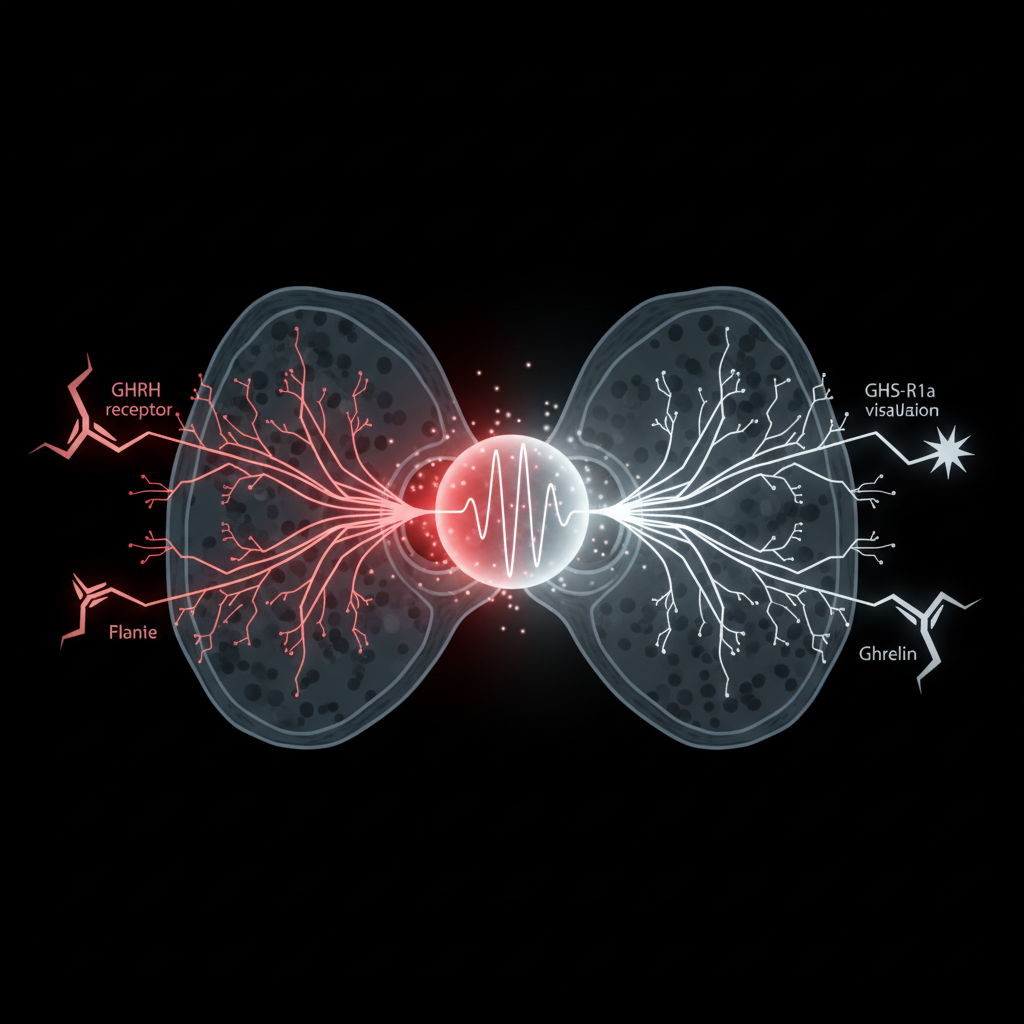
To understand why researchers study the CJC-1295 Ipamorelin blend, it is necessary to understand the dual-receptor architecture of somatotroph cells in the anterior pituitary. GH secretion is governed by two primary regulatory inputs: GHRH, which acts through the GHRH receptor (GHRHR) to stimulate cAMP-dependent GH synthesis and release; and ghrelin/GHRPs, which act through the GHS-R1a receptor (growth hormone secretagogue receptor) to amplify GH release through a distinct calcium-dependent pathway.
Research published in 1999 (PMID: 10372741) demonstrated that simultaneous stimulation of both receptor pathways produces a synergistic GH response — significantly greater than the sum of individual responses. This “GHRH+GHRP synergy” forms the mechanistic foundation for studying combined CJC-1295/Ipamorelin protocols. The blend essentially exploits both GH regulatory systems simultaneously, maximizing pulsatile GH output in a physiologically relevant pattern.
The clinical relevance of this approach was reinforced by human data (PMID: 18057000) showing that CJC-1295 administration produced dose-dependent increases in both GH and IGF-1 levels in healthy adult subjects, with GH levels increasing 2–10 fold above baseline. When combined with Ipamorelin’s GHS-R1a stimulation, research models suggest substantially greater GH output than CJC-1295 alone can achieve.
For researchers seeking to study this combination, the ability to buy CJC-1295 Ipamorelin as a pre-blended formulation simplifies protocol design. Spartan Peptides offers a research-grade CJC-1295/Ipamorelin 10mg Blend with ≥98% purity verification for researchers interested in ordering growth hormone peptide combinations. For researchers who prefer where to buy CJC-1295 as a standalone compound, individual options are also available.
CJC-1295 Research: GHRH Analog Pharmacology
CJC-1295 is a synthetic analog of endogenous GHRH, modified to extend stability and bioavailability. The compound exists in two primary research forms: CJC-1295 without DAC (Drug Affinity Complex), which mimics the short, pulsatile nature of natural GHRH action, and CJC-1295 with DAC (also called DAC:GRF), which features a reactive ester enabling covalent albumin binding for extended half-life.
The half-life distinction between these forms is substantial and research-relevant. CJC-1295 without DAC has a half-life of approximately 30 minutes — similar to endogenous GHRH — making it appropriate for protocols designed to mimic natural GH pulsatility. CJC-1295 with DAC, studied in the 2006 trial (PMID: 16352683), demonstrated a half-life of 5.8–8.1 days due to albumin binding. This extended half-life produced sustained GH elevation over a week from a single injection in human subjects, though the continuous GH elevation pattern differs from the pulsatile pattern produced by the short-acting form.
Body composition research has been a primary focus of CJC-1295 clinical investigation. The 2006 study (PMID: 18057000) documented not only GH and IGF-1 elevations but also changes in body composition parameters — findings that have informed the design of longer-term combination research protocols. The specificity of the CJC-1295 response (acting only on GHRH receptors) is an important advantage over exogenous GH administration, as it preserves the feedback regulation of the hypothalamic-pituitary axis.
Sleep quality research represents an emerging area of CJC-1295/Ipamorelin investigation. Since GH is naturally secreted predominantly during slow-wave sleep, peptides that enhance GH pulsatility theoretically support sleep-dependent anabolic and recovery processes. Researchers studying circadian aspects of the GH axis have incorporated this combination into sleep architecture studies, though formal published data on this specific application remains limited.
For context on related GH-axis peptides, see our CJC-1295 Ipamorelin Complete 2026 Research Guide.
Ipamorelin Research: Selective GHRP Profile
Ipamorelin is a pentapeptide (Aib-His-D-2-Nal-D-Phe-Lys-NH2) that acts as a selective GHS-R1a agonist. Its selectivity profile, established in the landmark 1998 pharmacological comparison study (PMID: 9349622), distinguishes it from earlier GHRPs including GHRP-2 and GHRP-6, which stimulate not only GH release but also cortisol, prolactin, and ACTH secretion at research doses.
The Bowers et al. study (PMID: 9349622) demonstrated that Ipamorelin stimulated GH release from pituitary cells with high potency while showing dramatically reduced stimulation of ACTH and cortisol compared to GHRP-6 at equivalent doses. This selectivity is attributed to Ipamorelin’s distinct binding mode within the GHS-R1a receptor, which activates GH-specific signaling without triggering the corticotroph-activating pathways engaged by less selective compounds.
For researchers designing long-term GH studies, Ipamorelin’s selectivity profile is particularly valuable. The absence of cortisol elevation allows extended research protocols without the glucocorticoid-mediated confounders that complicate interpretation of older GHRP studies. The absence of prolactin elevation similarly reduces potential interference with other endocrine research endpoints.
The GHS-R1a mechanism provides a physiological “first signal” or amplifying signal for GH release. When combined with CJC-1295’s GHRHR stimulation, Ipamorelin’s GHS-R1a activation creates the supraadditive GH response described in the synergy literature. This dual signaling pathway engagement is what makes the purchase CJC Ipamorelin blend approach mechanistically sound in research design.
Researchers can also explore related research in our Peptide Stacking Guide and Best Peptides for Weight Loss Research.
Comparison: CJC-1295 Alone vs Ipamorelin Alone vs Blend
| Parameter | CJC-1295 Alone | Ipamorelin Alone | CJC-1295 / Ipamorelin Blend |
|---|---|---|---|
| Receptor Target | GHRH receptor (GHRHR) | GHS-R1a (ghrelin receptor) | Dual: GHRHR + GHS-R1a simultaneously |
| GH Response | Moderate GH elevation; dose-dependent | Moderate; selective, no cortisol spike | Supraadditive GH release (synergistic) |
| Cortisol / ACTH Effect | Minimal | Minimal (selective GHRP) | Minimal — selectivity preserved in blend |
| Half-life (without DAC) | ~30 min (without DAC); ~6 days (with DAC) | ~2 hours | Short-acting blend; promotes physiological pulse |
| IGF-1 Elevation | Yes (PMID: 18057000) | Indirect (via GH) | Enhanced IGF-1 elevation vs either alone |
| Research Applications | Body composition, GH axis, sleep | GH selectivity studies, pituitary pharmacology | Combined GH/IGF-1 axis, body composition, recovery |
Purchasing CJC-1295 Ipamorelin Blend for Research
For researchers seeking to study the GHRH+GHRP synergy in controlled laboratory settings, sourcing quality-verified compounds is essential for reproducible results. The CJC-1295 Ipamorelin blend for sale at Spartan Peptides provides a pre-formulated 10mg combination with individual compound purity verified at ≥98% via HPLC and mass spectrometry.
The combined formulation simplifies research protocol design by providing both compounds in calibrated proportions. Researchers can order the CJC-1295/Ipamorelin 10mg Blend directly from Spartan Peptides, with Certificates of Analysis available for documentation purposes. This is currently the preferred format for researchers interested in studying the synergistic GHRH/GHRP mechanism without separately sourcing and combining individual compounds.
All Spartan Peptides products ship as lyophilized powder in sealed vials and require reconstitution with bacteriostatic water before use. For reconstitution guidance, see our How to Reconstitute Peptides Safely guide.
References
PubMed Citations:
- Ionescu M, Frohman LA. (2006). Pulsatile secretion of growth hormone (GH) persists during continuous stimulation by CJC-1295, a long-acting GH-releasing hormone analog. Journal of Clinical Endocrinology & Metabolism. PMID: 18057000
- Raun K, et al. (1998). Ipamorelin, the first selective growth hormone secretagogue. European Journal of Endocrinology. PMID: 9349622
- Bowers CY. (1999). GH releasing peptides — structure and kinetics. Journal of Pediatric Endocrinology & Metabolism. PMID: 10372741
- Teichman SL, et al. (2006). Prolonged stimulation of growth hormone (GH) and insulin-like growth factor I secretion by CJC-1295, a long-acting analog of GH-releasing hormone, in healthy adults. Journal of Clinical Endocrinology & Metabolism. PMID: 16352683
Research & Development
Our research team compiles peer-reviewed data and clinical findings to provide accurate, science-backed information on peptides and research compounds.