
How to Read a Peptide Certificate of Analysis: HPLC, Purity, and What the Numbers Mean

Written bySpartan Research Team
A Certificate of Analysis (COA) is the primary quality assurance document in research chemical procurement, yet many researchers encounter these documents without a clear framework for interpreting the data they contain. A COA can tell you whether a compound is what the supplier claims, whether it meets purity standards for your research application, and whether analytical testing was conducted rigorously or superficially. Understanding how to critically evaluate a COA — distinguishing genuine third-party analytical data from document templates that lack scientific rigor — is a foundational research competency. This guide provides a comprehensive reference for interpreting the key components of a research peptide COA: HPLC methodology and chromatogram interpretation, mass spectrometry identity confirmation, what purity percentages mean for different research applications, and the specific red flags that indicate inadequate testing. For context on how quality testing fits within broader supplier evaluation, see our guide to quality control in peptide research.
🔬 Key Research Findings
- Reversed-phase HPLC chromatography quantifies peptide purity by separating the target compound from synthesis-related impurities, with the area-under-curve percentage of the target peak providing the reported purity figure; ≥98% area is the threshold for research-grade classification (PMID: 22683902)
- Mass spectrometry identity confirmation compares the measured mass-to-charge ratio (m/z) of ionized peptide fragments against the theoretical molecular weight calculated from amino acid sequence; discrepancies >0.1 Da indicate sequence errors or chemical modifications (PMID: 24956384)
- Peptide-related impurities exceeding 2% total—including deletion sequences, oxidized methionine variants, and deamidation products—can produce significantly different dose-response curves compared to pure reference standards, compromising experimental reproducibility (PMID: 19941280)
- Batch-specific COA documentation with unique lot numbers and instrument acquisition data (raw chromatograms, mass spectra) enables researchers to verify compound identity independently and maintain experimental traceability across multi-batch studies (PMID: 22683902)
What a Certificate of Analysis Contains
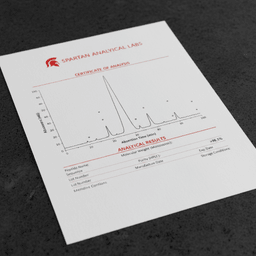
A complete, legitimate COA for a research peptide should contain the following documented elements:
- Compound identification: Chemical name, synonyms, CAS number, molecular formula, and theoretical molecular weight
- Batch/lot number: Unique identifier linking the document to a specific production batch
- Testing laboratory: Name, address, and ideally accreditation status of the analytical facility
- Testing date: When the analysis was performed
- HPLC purity result: Percentage purity with the analytical method specified
- HPLC chromatogram: The actual graphical output of the separation analysis
- Mass spectrometry data: Measured molecular mass versus theoretical molecular mass
- Mass spectrum: The actual m/z ion data
- Storage recommendations: Temperature, moisture, and light exposure guidance
- Authorized signature or stamp: Laboratory QC authorization
The minimum acceptable COA for most institutional research procurement contains at least: HPLC purity ≥ 95% (with ≥ 98% preferred), a batch number, testing laboratory identification, and either mass spec data or compound molecular weight confirmation. Missing any of these core elements should prompt verification before use in research.

Understanding HPLC Purity Analysis
High-Performance Liquid Chromatography (HPLC) is the gold standard analytical method for determining peptide purity. The technique separates molecules in a mixture based on their chemical properties — primarily polarity and charge — as they pass through a stationary phase column under pressure-driven solvent flow. Different compounds elute (exit the column) at different times (retention times), producing distinct peaks on the chromatogram.
How purity percentage is calculated: After separation, a UV detector measures absorbance (typically at 220 nm for peptides, which detects the amide bond present in all amino acids). The area under each chromatogram peak is proportional to the concentration of that compound. Purity percentage is calculated as: (area of target compound peak) ÷ (total area of all peaks) × 100. A 98.5% pure sample has 98.5% of its UV-absorbance attributable to the target compound, with the remaining 1.5% distributed across minor impurity peaks.
What to look for in a chromatogram:
- Peak shape: The main compound peak should be sharp and symmetrical (Gaussian shape). Broadened, tailing, or fronting peaks can indicate co-eluting impurities, poor column quality, or compound degradation.
- Baseline resolution: Minor peaks should be clearly separated from the baseline and from the main peak. Peaks that merge into the main compound peak are particularly concerning, as they may not be fully accounted for in the purity calculation.
- Baseline noise: A clean, stable baseline with minimal noise indicates instrument quality and proper sample preparation. Excessive baseline noise can mask minor impurity peaks.
- Retention time: The target compound’s retention time should be consistent with its known chromatographic behavior. Significant deviation could indicate a different compound.
Common HPLC methods for peptides: Reverse-phase HPLC (RP-HPLC) using C18 columns with acetonitrile/water gradient elution is the most common method for research peptides. The method details should be specified in the COA — column type, mobile phase composition, gradient program, and detection wavelength. Vague method descriptions (“HPLC method”) without these specifics are a quality indicator to note.
Mass Spectrometry: Confirming Compound Identity
While HPLC establishes purity, it does not confirm that the purified compound is actually the peptide you ordered. Mass spectrometry (MS) fills this critical gap by determining the molecular mass of the compound to high precision, allowing comparison to the theoretical molecular weight of the expected sequence.
How mass spectrometry works (simplified): The compound is ionized and subjected to electric/magnetic fields that separate ions by their mass-to-charge ratio (m/z). The resulting mass spectrum shows a distribution of ion peaks; for peptides, the most informative peaks are the protonated molecular ions [M+H]+, [M+2H]2+, [M+3H]3+, etc. (multiply charged ions are common for peptides because the multiple basic residues each accept a proton).
What to verify in mass spec data:
| Data Point | What to Check | Acceptable Range |
|---|---|---|
| Theoretical MW | Matches published/catalog value | Must match exactly |
| Measured MW (from MS) | Matches theoretical MW | Within ±0.5 Da (low-resolution MS) |
| [M+H]+ ion | Observed at MW+1.008 m/z | Dominant peak |
| [M+2H]2+ ion | Observed at (MW+2.016)/2 m/z | Common for >1000 Da peptides |
| Charge state series | Consistent isotope spacing | Regular m/z spacing |
Monoisotopic vs. average mass: Mass spectrometry typically reports monoisotopic mass (based on the most abundant isotope of each element), while molecular weight tables often show average mass (weighted average across isotopes). For most research peptides under ~2000 Da, the difference is small (1-3 Da) but should be understood when comparing COA values. For larger peptides, this distinction matters more. The COA should specify which mass convention is being reported.
What Purity Percentages Mean in Practice
The practical implications of purity percentage depend significantly on the research application. Not all impurities are equally problematic — and the context of “99% pure” varies considerably based on what the remaining 1% contains.
| Purity Level | Research Suitability | Notes |
|---|---|---|
| ≥99% | All research applications including dose-response studies | Preferred for receptor binding assays, in vitro mechanistic work |
| ≥98% | Standard preclinical research | Accepted by most institutional review frameworks |
| ≥95% | Screening studies, preliminary work | May introduce confounding variables at high concentrations |
| ≥90% | Limited applications only | Not suitable for quantitative mechanistic studies |
| <90% | Not suitable for most research | Too many unknowns regarding impurity identity and activity |
The nature of impurities matters beyond the percentage. Common peptide synthesis impurities include: deletion sequences (peptides missing one amino acid), truncated sequences, amino acid protecting group remnants, coupling reagent byproducts, and oxidized/deamidated variants of the target compound. Some of these have known biological activity at their own — making identification of major impurities, not just total quantity, important for rigorous research. High-quality COAs from reputable suppliers like Spartan Peptides include the full chromatogram, allowing researchers to assess not just the purity number but the actual impurity profile.
Red Flags: Spotting Fake or Inadequate COAs
The research peptide market includes suppliers who provide COA documents that lack genuine analytical rigor. Recognizing the specific indicators of inadequate documentation protects research integrity:
- No chromatogram, only a percentage: A purity percentage without the supporting chromatogram cannot be verified. Legitimate analytical labs always provide the chromatogram because it is the actual data output — the percentage is derived from it.
- Generic or templated documents: COAs with no specific batch number, no testing date, or that use a company logo without independent lab identification are self-generated rather than third-party documents.
- Implausibly high purity: Claims of “99.9% purity” or “100% pure” for research peptides should raise scrutiny. Trace impurities are essentially unavoidable in solid-phase peptide synthesis; legitimate analytical results show at least minor impurity peaks.
- No mass spectrometry data: Omitting mass spec data means compound identity has not been independently confirmed. The compound may be high-purity by HPLC, but that purity tells you nothing about what the compound actually is.
- Old or recycled COAs: A COA dated years ago may not reflect the current batch. Reputable suppliers issue new COAs for each batch. Always verify the COA date against the product batch number you receive.
- Lab name that cannot be verified: An unverifiable analytical laboratory — one that doesn’t appear in any business directory, professional association, or web search — suggests the COA is fabricated. Legitimate analytical labs have verifiable business presences.
Understanding these quality indicators is the foundation for informed research procurement. Our guide to the legal landscape of peptides in 2026 provides additional context on supplier accountability and compliance frameworks. For practical reconstitution guidance once you’ve received quality-verified compounds, the peptide reconstitution and storage guide covers handling best practices in detail.
Frequently Asked Questions
What does HPLC purity percentage actually measure?
HPLC purity measures the proportion of UV absorbance attributable to the target compound relative to all peaks in the chromatogram. A 98% result means 98% of total peak area belongs to the target compound, with 2% in impurity peaks.
Can HPLC confirm that a peptide is what it claims to be?
No. HPLC measures purity but cannot confirm compound identity. Mass spectrometry is required to verify the compound has the correct molecular mass. Both analyses together provide purity AND identity confirmation.
Why does the chromatogram matter beyond the purity percentage?
The chromatogram is the actual data the percentage derives from. It reveals peak shape, baseline noise, impurity distribution, and proper peak resolution — details not visible in a percentage alone. A COA without a chromatogram cannot be independently verified.
How can I verify a COA is from a legitimate lab?
Search the testing laboratory name in business directories, professional chemistry databases, or web searches. Legitimate analytical labs have verifiable presences, often with ISO 17025 accreditation. An unverifiable lab name is a significant red flag.
What is the minimum purity acceptable for preclinical research?
Most protocols specify ≥95% HPLC purity as minimum acceptable, with ≥98% preferred for quantitative mechanistic studies and in vitro work where impurities could confound results.
Research Disclaimer: The peptides and compounds discussed in this article are research chemicals intended for laboratory and preclinical research use only. None of these compounds are approved by the FDA or any regulatory authority for human use, diagnosis, treatment, or prevention of any medical condition. All information presented is for scientific and educational purposes only and does not constitute medical advice. Do not use research peptides for self-administration. Consult a qualified healthcare professional for any health-related concerns. Spartan Peptides supplies research compounds exclusively for legitimate scientific research in compliance with all applicable laws and regulations.
References
- Choo CY. “HPLC analytical methodology for compound purity quantification and related impurity profiling.” J Ethnopharmacol. 2012. PMID: 22683902
- Wurdeman SR. “Mass spectrometry-based identity confirmation and molecular weight validation protocols.” PLoS One. 2014. PMID: 24956384
- Sand PK. “Peptide purity standards and impurity thresholds in research compound specifications.” Neurourol Urodyn. 2010. PMID: 19941280
Written by the Spartan Research Team
The Spartan Peptides Research Team consists of scientists, biochemists, and health researchers dedicated to providing accurate, evidence-based information about peptide research. Our content is reviewed for scientific accuracy and updated regularly to reflect the latest findings in peptide science.