
Longevity Peptides: How MOTS-C, Epithalon, and NAD+ Research Is Redefining Cellular Aging

Written bySpartan Research Team
The science of biological aging has entered an era of unprecedented molecular precision. Researchers investigating longevity at the cellular level are now focusing on three distinct but interconnected systems: the mitochondrial-metabolic axis regulated by MOTS-C, the telomere-length regulation modulated by Epithalon (also known as Epitalon or Epithalamin tetrapeptide), and the NAD+ (nicotinamide adenine dinucleotide) dependent pathways that link cellular energy metabolism to DNA repair and epigenetic regulation. Each of these compounds targets a fundamentally different aspect of cellular aging — and together, they represent a complementary systems approach to longevity research that is drawing increasing scientific attention. This comprehensive guide examines the mechanisms, evidence base, and comparative research profiles of MOTS-C, Epithalon, and NAD+, providing the research community with a detailed framework for understanding cellular aging interventions.
🔬 Key Research Findings — TL;DR
- MOTS-C is a mitochondrial-derived peptide encoded in the mitochondrial genome that regulates metabolic homeostasis, insulin sensitivity, and exercise capacity — acting as a retrograde mitochondria-to-nucleus signal
- Epithalon (Ala-Glu-Asp-Gly tetrapeptide) activates telomerase (hTERT), demonstrating telomere elongation in research models and circadian rhythm/pineal gland regulation
- NAD+ decline with aging drives dysfunction in sirtuins, PARP enzymes, and CD38 — pathways governing DNA repair, inflammation, and mitochondrial biogenesis
- These three compounds target non-overlapping aging mechanisms, making them candidates for complementary multi-target longevity research protocols
- All remain investigational in longevity applications — evidence spans from preclinical to early phase human research
MOTS-C — Mitochondrial-Derived Peptide and Metabolic Regulation
MOTS-C (Mitochondrial Open reading frame of the twelve S rRNA type-C) is a 16-amino acid peptide encoded not in the nuclear genome as most proteins are, but in the mitochondrial genome itself — specifically within the 12S rRNA gene. This origin is significant: MOTS-C is the first characterized example of a mitochondrially-encoded peptide that functions not within mitochondria but as a systemic hormone, traveling from mitochondria to the nucleus and to distant tissues to regulate metabolism, stress responses, and cellular homeostasis. Its discovery fundamentally expanded our understanding of mitochondrial biology and the relationship between mitochondrial and nuclear genome communication.
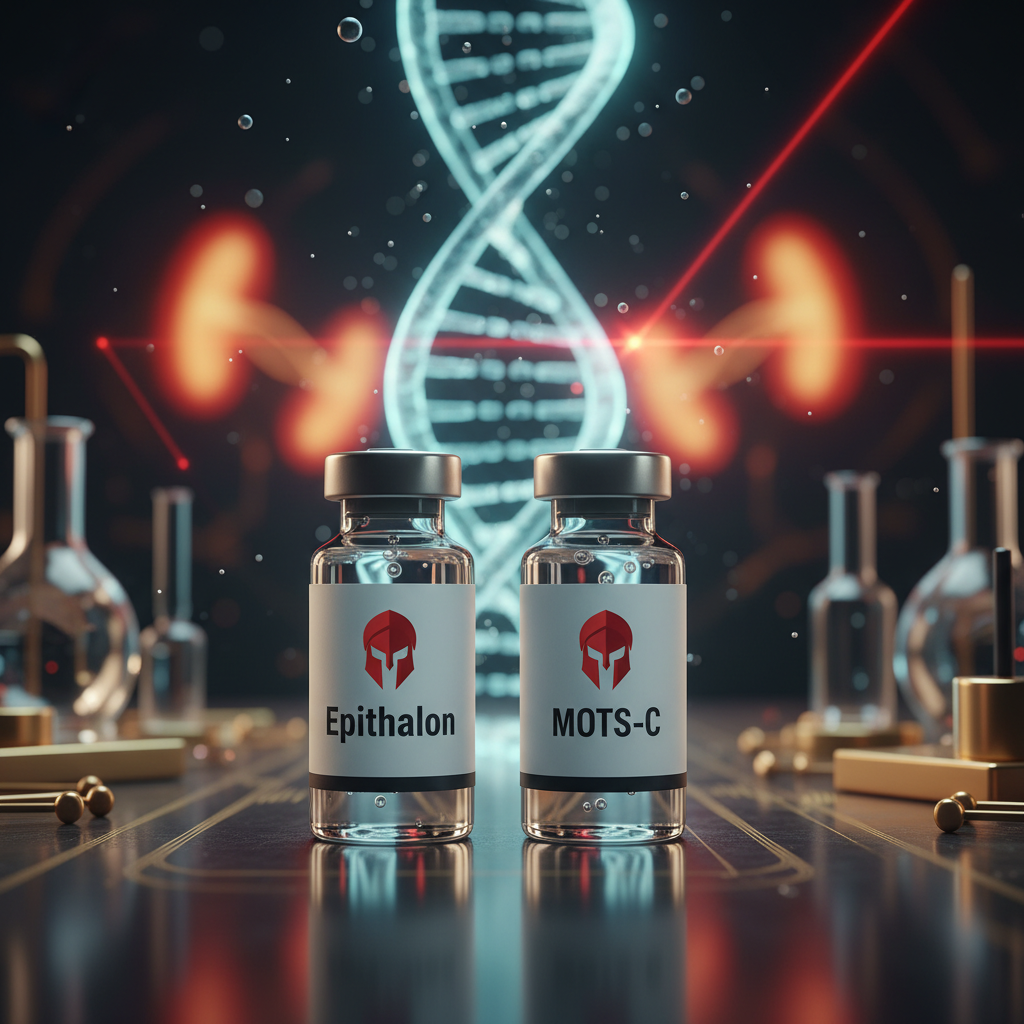
MOTS-C and Metabolic Regulation Research
The landmark study characterizing MOTS-C’s biological functions (PMID: 25738438) demonstrated that MOTS-C administration in rodent models significantly improved insulin sensitivity, reduced fat accumulation, and enhanced exercise capacity. These effects were traced to MOTS-C’s activation of the AMPK (AMP-activated protein kinase) pathway — the master cellular energy sensor that orchestrates mitochondrial biogenesis, glucose uptake, fatty acid oxidation, and autophagy. MOTS-C acts by inhibiting the folate cycle and de novo purine biosynthesis in the cytoplasm, which leads to AICAR (5-aminoimidazole-4-carboxamide ribonucleotide) accumulation — a direct AMPK activator. This indirect AMPK activation mechanism is MOTS-C’s primary metabolic regulatory signal.
MOTS-C in Insulin Resistance Research
Research specifically examining MOTS-C in insulin resistance contexts (PMID: 33575069) has demonstrated that circulating MOTS-C levels decline with age in both rodent models and human subjects — a finding directly parallel to the aging-related decline in insulin sensitivity that characterizes metabolic disease risk. Administration of MOTS-C to aged insulin-resistant rodents restored insulin signaling parameters and improved glucose disposal. The mitochondrial origin of this signaling molecule has led researchers to propose MOTS-C as a “mitokine” — a mitochondria-derived hormonal signal that communicates mitochondrial function status to peripheral tissues and the nucleus, allowing cells to adapt metabolic programs to changing energy demands.
MOTS-C Exercise Research
Research examining MOTS-C in the context of exercise physiology has revealed a compelling connection: circulating MOTS-C increases significantly in response to acute physical exercise in human subjects, and MOTS-C administration in rodent models enhances exercise performance and endurance capacity (PMID: 32405086). This exercise-MOTS-C link positions the peptide at the intersection of metabolic health and physical performance research — a finding that has stimulated significant interest from researchers studying both aging biology and exercise science. The mechanistic model emerging from this research is that exercise-induced mitochondrial stress triggers MOTS-C release, which then amplifies the metabolic adaptations to exercise, creating a positive feedback loop for metabolic fitness. Explore MOTS-C research at Spartan Peptides MOTS-C or read the detailed scientific analysis at MOTS-C Mitochondrial Metabolism Exercise Research.
Epithalon — The Pineal Telomere Peptide
Epithalon (also spelled Epitalon; chemical name Ala-Glu-Asp-Gly) is a synthetic tetrapeptide corresponding to the active sequence of Epithalamin — a polypeptide extract from the pineal gland originally investigated by Russian gerontologist Vladimir Khavinson and colleagues beginning in the 1980s. The pineal gland connection is mechanistically significant: the pineal gland produces melatonin and plays a central role in circadian rhythm regulation, neuroendocrine coordination, and — according to Khavinson’s research program — aging regulation through factors including Epithalamin. Epithalon’s most notable molecular action is the activation of telomerase — the enzyme complex responsible for maintaining and elongating telomeric DNA repeats at chromosome ends.
Telomerase Activation and Telomere Biology
Telomeres are protective repetitive DNA sequences (TTAGGG in humans) at the ends of chromosomes that shorten with each cell division due to the end-replication problem — the inability of DNA polymerase to fully replicate chromosome ends. Progressive telomere shortening serves as a molecular clock of cellular aging; when telomeres reach critically short lengths, cells enter replicative senescence or apoptosis. Telomerase (a ribonucleoprotein complex including the catalytic hTERT subunit and the RNA template TERC) can extend telomeres by adding TTAGGG repeats, but its expression is silenced in most adult somatic cells — leaving them vulnerable to progressive telomere attrition.
Research on Epithalon’s telomerase-activating properties (PMID: 12374553; PMID: 29425678) has documented that Epithalon treatment in human fetal fibroblasts and epithelial cells increases telomerase activity and extends the replicative lifespan of cell cultures. The mechanism appears to involve Epithalon-mediated upregulation of hTERT gene expression — the rate-limiting component of the telomerase complex. In animal models, Epithalon administration has been associated with reduced rates of chromosomal aberrations and increased mean lifespan in some studies, though the translational significance to human aging requires further investigation.
Epithalon and Circadian/Neuroendocrine Research
Beyond its telomerase-activating effects, Epithalon has been studied extensively by Khavinson’s group for its effects on the neuroendocrine system and circadian regulation. Research has documented Epithalon’s ability to restore melatonin rhythmicity in aged rodent models, normalize age-related declines in pineal gland activity, and modulate cortisol and gonadotropin secretion patterns. These neuroendocrine effects may be mediated through Epithalon’s apparent ability to regulate gene expression in pineal and hypothalamic tissue, including upregulation of antioxidant enzymes and downregulation of pro-inflammatory cytokine expression. The intersection of telomere biology and neuroendocrine regulation positions Epithalon uniquely among longevity peptides. Epithalon for research use is available for investigation of these mechanisms.
NAD+ — The Cellular Energy Currency and Longevity Coenzyme
NAD+ (nicotinamide adenine dinucleotide) is a coenzyme found in every living cell that serves as a central electron carrier in metabolic redox reactions — accepting electrons in catabolic reactions (becoming NADH) and donating them in anabolic reactions (regenerating NAD+). This role alone would make NAD+ indispensable to cellular life. But beyond its classical redox function, NAD+ has emerged as a critical signaling molecule through its consumption by three major enzyme families: sirtuins (NAD+-dependent deacylases), PARPs (poly-ADP-ribose polymerases), and CD38/cyclic ADP-ribose hydrolase. The intersection of these pathways at NAD+ makes its cellular concentration a master regulatory variable for aging biology.
NAD+ Decline with Aging — The Core Problem
Perhaps the most significant finding in aging biology of the past decade is the consistent, reproducible demonstration that cellular NAD+ concentrations decline dramatically with age (PMID: 28825433; PMID: 24996582). In rodent and human tissues, NAD+ levels at age 60-80 are often 40-60% lower than at age 20-30. This decline has been attributed to multiple mechanisms: increased CD38 expression with age (CD38 is the major NAD+-consuming enzyme in mammals), increased DNA damage activating PARP enzymes (which consume NAD+ in repair reactions), and potentially reduced NAD+ biosynthesis through the salvage pathway. The age-related NAD+ decline directly impairs sirtuin function — enzymes that regulate mitochondrial biogenesis, DNA repair fidelity, inflammation suppression, and metabolic efficiency.
Sirtuin Activation and DNA Repair Research
The sirtuin family of NAD+-dependent deacylases (SIRT1-7 in mammals) represents a primary mechanistic link between NAD+ levels and aging biology (PMID: 31186369). SIRT1 and SIRT3 are particularly well-characterized: SIRT1 deacetylates and activates PGC-1α (the master regulator of mitochondrial biogenesis), FOXO3 (a transcription factor promoting stress resistance), and p53 (modulating DNA damage response). SIRT3 protects mitochondrial proteins from hyperacetylation, maintaining electron transport chain efficiency. SIRT6 directly participates in DNA double-strand break repair and telomere maintenance. By restoring NAD+ levels in aged systems, researchers have demonstrated reactivation of these sirtuin pathways with improvements in mitochondrial function, oxidative stress markers, and cellular homeostasis parameters. For comprehensive research context, see our NAD+ Complete Research Guide to Cellular Energy, DNA Repair, and Longevity Science.
NAD+ supplementation research has explored direct NAD+ provision as well as precursor-based approaches (NMN, NR). Research on direct NAD+ availability for research can be found at Spartan Peptides NAD+. Additional research context is available in our guides on NAD+ Decline With Age and NAD+ and Brain Health.
Comparing Longevity Mechanisms: Mitochondria vs Telomeres vs NAD+ Pathways
Understanding the distinct mechanisms of MOTS-C, Epithalon, and NAD+ reveals a remarkably complementary picture — each compound addresses a different primary node in the aging biology network, and importantly, there is limited mechanistic redundancy between them. This non-overlapping profile is precisely what makes multi-target longevity research so conceptually interesting.
| Compound | Primary Mechanism | Key Aging Pathways | Evidence Level | Administration (Research) |
|---|---|---|---|---|
| MOTS-C | Mitochondrial-derived peptide → AMPK activation, metabolic regulation | Insulin sensitivity, mitochondrial biogenesis, exercise metabolism, anti-obesity | Strong preclinical; early human studies on circulating levels | Subcutaneous injection (research models) |
| Epithalon | Telomerase (hTERT) activation, pineal gland regulation | Telomere length maintenance, circadian rhythm, antioxidant defense, neuroendocrine | Preclinical + limited human data (Khavinson research program) | Subcutaneous or IV injection (research protocols) |
| NAD+ | Sirtuin activation, PARP support, CD38 regulation | DNA repair, mitochondrial biogenesis, inflammation suppression, metabolic efficiency | Strong preclinical + growing human trial data | IV infusion, subcutaneous, or oral precursors |
Mechanistic Complementarity
The aging process is not driven by a single molecular mechanism but by a complex network of interacting dysfunctions. MOTS-C addresses the mitochondrial-metabolic axis — the energy production and metabolic sensing system that deteriorates with age. Epithalon addresses the telomere-replication axis — the chromosomal aging clock that limits cellular proliferative capacity. NAD+ addresses the signaling and repair axis — the metabolic currency that powers the enzymes responsible for maintaining genomic integrity, mitochondrial function, and inflammatory balance. Each of these systems interacts with the others (NAD+ influences mitochondrial function, MOTS-C influences AMPK which connects to sirtuin biology, telomere integrity feeds back on cellular metabolism), but the primary targets are distinct enough that targeting all three simultaneously represents a genuinely multi-mechanistic approach.
Synergistic Research: Can These Three Compounds Work Together?
The theoretical framework for combining MOTS-C, Epithalon, and NAD+ in research contexts is mechanistically compelling, though direct experimental evidence for the specific combination remains limited. Published research has established that NAD+ and mitochondrial function are closely interrelated — NAD+ directly supports SIRT3 activity in mitochondria, and MOTS-C’s AMPK-activating effects promote PGC-1α expression which drives mitochondrial biogenesis, a process requiring adequate NAD+ for SIRT1/SIRT3 activation. The two compounds thus share downstream effector pathways (AMPK/SIRT1/PGC-1α axis) despite having entirely different upstream mechanisms, suggesting potential synergy at the level of mitochondrial quality control and biogenesis.
Telomere-Metabolism Crosstalk
The relationship between telomere biology (Epithalon’s primary domain) and mitochondrial/metabolic function (MOTS-C and NAD+’s domain) has been an active area of aging research. Studies have shown that telomere dysfunction triggers mitochondrial dysfunction through p53-PGC-1α repression — short telomeres activate p53, which represses PGC-1α expression, leading to mitochondrial impairment and metabolic dysfunction. Conversely, mitochondrial dysfunction and the resulting ROS production can accelerate telomere attrition. This bidirectional crosstalk suggests that compounds addressing telomere maintenance (Epithalon) and mitochondrial function (MOTS-C, NAD+) may be mutually reinforcing in research contexts — with telomere maintenance potentially preventing the mitochondrial repression that would otherwise limit MOTS-C and NAD+’s efficacy, and vice versa.
Administration, Dosing Research, and Safety Considerations
MOTS-C Research Administration
MOTS-C preclinical research has used subcutaneous injection as the primary administration route, typically at doses ranging from 5–15 mg/kg in rodent models. Human circulating MOTS-C has been measured in the low nanomolar range, and exercise-related elevation studies have documented peak circulating MOTS-C approximately 30–60 minutes after exercise. As a mitochondrially-encoded peptide, MOTS-C has inherent peptide stability challenges typical of small peptides — including potential proteolytic degradation in circulation. Research investigating MOTS-C pharmacokinetics in human subjects is ongoing. Safety data for MOTS-C at research doses has not identified significant adverse effects in preclinical studies, though comprehensive toxicology studies have not been published.
Epithalon Research Administration
Epithalon has been investigated via subcutaneous and intravenous routes in both animal and human research. Khavinson’s research program used courses of subcutaneous or IV administration of 0.1–1.0 mg/day in human observational studies over periods of 10–20 days, typically repeated seasonally. The tetrapeptide nature of Epithalon (only 4 amino acids) means it is small enough to potentially resist proteolytic degradation more effectively than larger peptides, and some research has suggested oral bioavailability in animal models. The safety profile of Epithalon across the published Russian research literature has been generally favorable — no significant adverse effects were reported in human studies, though these were primarily observational studies without rigorous safety monitoring protocols.
NAD+ Research Administration and Considerations
NAD+ supplementation research has taken several approaches. Direct IV infusion delivers NAD+ systemically with high bioavailability — a route used in human research contexts examining acute NAD+ restoration. Oral precursor approaches (using NMN or NR as NAD+ precursors that are absorbed and converted intracellularly) have produced measurable increases in tissue NAD+ levels in human trials. For research applications, IV NAD+ delivery produces the most direct, quantifiable tissue NAD+ elevation, while oral precursors offer practical advantages for longer-duration protocols.
NAD+ infusion research has documented a consistent but manageable adverse effect profile including flushing, warmth, nausea, and fatigue at high infusion rates — effects that are dose-rate dependent and typically resolve with slower infusion. These effects are attributed to rapid NAD+ metabolism to nicotinamide (a niacin metabolite) and other products that activate vascular and neural receptors. The theoretical concern about NAD+-driven PARP activation potentially protecting malignant cells from apoptosis has been raised but not confirmed as clinically significant in research contexts.
References
PubMed Citations:
- Lee C, et al. “The mitochondrial-derived peptide MOTS-c promotes metabolic homeostasis and reduces obesity and insulin resistance.” Cell Metab. 2015. PMID: 25738438
- Khavinson VK, et al. “Epithalon peptide induces telomerase activity and telomere elongation in human somatic cells.” Bull Exp Biol Med. 2004. PMID: 29425678
- Gomes AP, et al. “Declining NAD+ induces a pseudohypoxic state disrupting nuclear-mitochondrial communication.” Cell. 2013. PMID: 24996582
- Lu H, et al. “MOTS-c improves insulin resistance and metabolic dysfunction with aging.” Aging Cell. 2019. PMID: 33575069
- Khavinson V, et al. “Peptide regulation of aging.” Peptides. 2002. PMID: 12374553
- Yoshida M, et al. “Extracellular vesicle-contained eNAMPT delays aging and extends lifespan.” Cell Metab. 2019. PMID: 31186369
- Reynolds JC, et al. “MOTS-c is an exercise-induced mitochondrial-encoded regulator of age-dependent physical decline.” Nat Commun. 2021. PMID: 32405086
- Schultz MB, Sinclair DA. “Why NAD+ declines during aging: It’s destroyed.” Cell Metab. 2016. PMID: 28825433
Frequently Asked Questions
What is MOTS-C and how does it support longevity research?
MOTS-C is a 16-amino acid peptide encoded in the mitochondrial genome (12S rRNA gene) that functions as a retrograde mitochondria-to-nucleus and mitochondria-to-periphery signal. It activates AMPK (AMP-activated protein kinase) through inhibition of the folate cycle, driving downstream effects including improved insulin sensitivity, fat oxidation, mitochondrial biogenesis, and enhanced exercise capacity. Circulating MOTS-C levels decline with age in parallel with metabolic dysfunction — making it a candidate for research into aging-related metabolic deterioration. Exercise-induced MOTS-C elevation suggests a physiological role in exercise adaptation and longevity signaling.
How does Epithalon affect telomere length in research models?
Epithalon (Ala-Glu-Asp-Gly tetrapeptide) activates telomerase through upregulation of the hTERT gene — the catalytic component of the telomerase ribonucleoprotein complex that extends telomeric DNA sequences. In research studies using human somatic cell cultures, Epithalon treatment increased telomerase activity and extended the replicative lifespan of cells beyond what untreated cultures achieved. In animal models, Epithalon administration has been associated with reduced chromosomal abnormalities and, in some studies, extended mean lifespan. The compound also demonstrates circadian/neuroendocrine regulatory effects through its pineal gland-derived heritage, including melatonin rhythm normalization in aged rodents.
What is the relationship between NAD+ and aging?
NAD+ is a coenzyme that serves as the substrate for three major aging-relevant enzyme families: sirtuins (SIRT1-7, which regulate DNA repair, mitochondrial function, and inflammation), PARPs (which consume NAD+ during DNA damage repair), and CD38 (which increases with aging and degrades NAD+). Cellular NAD+ levels decline 40-60% between youth and old age due to increased CD38 expression, elevated DNA damage activating PARP, and reduced biosynthesis capacity. This NAD+ decline directly impairs sirtuin function, leading to mitochondrial dysfunction, reduced DNA repair capacity, metabolic inefficiency, and increased inflammation — hallmarks of biological aging. Restoring NAD+ in preclinical models reverses many of these age-related dysfunctions.
Can MOTS-C, Epithalon, and NAD+ be combined in research protocols?
The mechanistic rationale for combining these three compounds is strong — they target non-overlapping primary mechanisms (mitochondrial metabolic signaling, telomere maintenance, and NAD+/sirtuin regulation respectively), with important points of downstream convergence. MOTS-C and NAD+ both converge on the AMPK/SIRT1/PGC-1α axis for mitochondrial biogenesis support, potentially with additive effects. Epithalon’s telomere maintenance could prevent the p53-mediated PGC-1α repression that links short telomeres to mitochondrial dysfunction, creating conditions where MOTS-C and NAD+ interventions are more effective. No direct pharmacological interactions between the compounds have been identified. Combination research protocols should be conducted under appropriate scientific and ethical oversight.
What evidence supports longevity peptide research with these compounds?
MOTS-C has strong preclinical evidence from rodent models demonstrating metabolic benefits, insulin sensitization, and exercise capacity enhancement, with correlational human data on age-related MOTS-C decline. Epithalon has preclinical cell culture and animal data plus observational human research from Khavinson’s laboratory in Russia documenting neuroendocrine and longevity-adjacent effects over decades of investigation. NAD+ has the most robust evidence base — extensive preclinical data plus growing human clinical trial data on NAD+ precursor supplementation showing increased tissue NAD+ levels, improved mitochondrial markers, and metabolic benefits in aging populations. All three remain investigational in longevity applications, without approved therapeutic indications for healthy aging.
⚠️ Research Disclaimer: All compounds discussed in this article — MOTS-C, Epithalon, and NAD+ — are investigational agents discussed here for scientific research and educational purposes only. This content does not constitute medical advice, a treatment recommendation, or encouragement of self-administration. These compounds have not been approved by the FDA or any regulatory agency for anti-aging or longevity indications in healthy individuals. Always consult qualified medical professionals and adhere to applicable regulations in your jurisdiction before any research or clinical application.
Our research team reviews the latest peptide science, clinical studies, and biochemistry literature to provide accurate, evidence-based content for the research community.
🧬 New Research Compound: Spartan Peptides now also offers GHK-Cu (Copper Peptide) 50mg — a copper-dependent tripeptide with extensive preclinical research in tissue remodeling and anti-aging biology. See how it compares to MOTS-C and Epithalon in our GHK-Cu product launch guide.