
NAD+ Decline With Age: What the Research Shows About Cellular Aging

Written bySpartan Research Team
The Age-Related NAD+ Decline: What the Research Actually Shows
Of all the molecular changes that accompany aging, few are as consistently documented — or as mechanistically consequential — as the decline in cellular NAD+ levels. Across multiple species, multiple tissues, and multiple research groups, the data converge on the same conclusion: NAD+ abundance falls substantially as organisms age, and this decline is causally linked to a cascade of cellular dysfunctions that define the aging phenotype.
This article examines the research on NAD+ decline with age in detail — the quantitative data, the mechanisms driving the decline, and the downstream consequences for cellular function.
The Quantitative Evidence: How Much Does NAD+ Fall?
The magnitude of age-related NAD+ decline varies by tissue, but the direction is consistent. Studies in rodents have documented NAD+ reductions of 40–60% in skeletal muscle, liver, and brain between young adulthood and midlife. In some tissues, including cardiac muscle and adipose tissue, declines can be even steeper.
Human data, while harder to obtain than rodent data, support similar trends. Analysis of blood samples from human cohorts has revealed declining NAD+ levels in peripheral blood mononuclear cells with advancing age. Skeletal muscle biopsies from older adults show substantially lower NAD+ concentrations than those from younger subjects.
Shin-ichiro Imai’s 2014 landmark study in Cell Metabolism (Yoshino et al.) demonstrated that aging mice showed significant reductions in NAD+ across multiple tissues, and that restoring NAD+ levels with NMN supplementation reversed age-associated physiological decline in these animals — providing some of the most compelling early evidence that NAD+ depletion is not simply a biomarker of aging but a potential driver of it.

Three Mechanisms Driving the Decline
The age-related drop in NAD+ is not caused by a single process. Research has identified at least three major contributing mechanisms, each of which compounds the others.
1. CD38 Upregulation: The Major Consumer
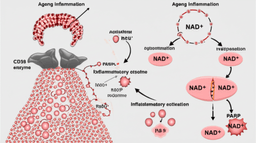
CD38 is an ectoenzyme and intracellular enzyme that catabolizes NAD+ into cyclic ADP-ribose and ADP-ribose — calcium-mobilizing second messengers. What makes CD38 particularly significant in the context of aging is that it is both a highly inefficient NAD+ consumer and one whose expression increases dramatically with age.
The 2016 study by Camacho-Pereira et al. published in Cell Metabolism was pivotal. The researchers demonstrated that CD38 expression increases substantially with age in mouse tissues, and that this increase could account for a major fraction of the observed NAD+ decline. Crucially, mice genetically lacking CD38 maintained higher NAD+ levels throughout their lifespan and showed preserved mitochondrial function and metabolic health compared to wild-type aged controls.
The Camacho-Pereira study also identified a positive feedback loop: aging leads to sterile inflammation (sometimes called “inflammaging”), which upregulates CD38 expression in macrophages and other immune cells, which further depletes NAD+, which impairs NAD+-dependent anti-inflammatory pathways (particularly sirtuin-mediated NF-κB repression), which drives further inflammation. This cycle may be one reason why the NAD+ decline accelerates in tissues with significant immune cell infiltration as animals age.
Subsequent work by Eduardo Chini and colleagues (Chini 2017, published in Cell Metabolism) extended this picture, showing that CD38 is expressed not only on the cell surface but in intracellular compartments including the nucleus and mitochondria, where it can access NAD+ pools that were previously thought to be insulated from extracellular CD38 activity. This study also identified flavonoids including apigenin and quercetin as competitive inhibitors of CD38, providing a potential pharmacological handle on this pathway.
2. PARP Overactivation: The DNA Damage Debt
Poly(ADP-ribose) polymerases — particularly PARP1 and PARP2 — are activated by DNA strand breaks and base lesions. When DNA damage occurs, PARP1 binds the break, becomes catalytically active, and synthesizes poly(ADP-ribose) chains using NAD+ as the substrate. These chains recruit and coordinate the DNA repair machinery.
The problem is that DNA damage accumulates inexorably with age. Replication errors, oxidative lesions, UV damage, and spontaneous base depurination all add to the damage burden over decades. As the cumulative load of DNA lesions increases, the amount of NAD+ consumed by PARP activation increases in parallel — even if individual repair responses are well-regulated.
Experimental evidence supports this model. PARP inhibitors, when administered to aged animals, partially restore NAD+ levels, suggesting that constitutive PARP activation is a meaningful consumer of NAD+ in aged tissues. Conversely, overexpression of PARP1 in young animals accelerates NAD+ depletion and produces phenotypes resembling premature aging.
The interplay between DNA damage, PARP activity, and NAD+ availability creates a vicious cycle: aging-associated DNA damage activates PARPs, which deplete NAD+, which impairs SIRT6 (an NAD+-dependent DNA repair enzyme), which allows further DNA damage to accumulate. This molecular ratchet may contribute to the accelerating nature of genomic instability observed in aging tissues.
3. NAMPT Decline: The Supply-Side Problem
NAMPT (nicotinamide phosphoribosyltransferase) is the rate-limiting enzyme in the NAD+ salvage pathway — the dominant route by which cells recycle nicotinamide back into NAD+. In several tissue types, NAMPT expression and activity decline with age, reducing the cell’s capacity to replenish its NAD+ pool.
The decline in NAMPT is particularly significant because the salvage pathway is the primary source of NAD+ in metabolically active tissues. When both the demand for NAD+ is increasing (due to CD38 upregulation and PARP activation) and the supply is decreasing (due to NAMPT reduction), the net effect on cellular NAD+ availability is multiplicative rather than additive.
Circadian regulation of NAMPT adds another layer of complexity. NAMPT expression oscillates with the circadian clock — a finding with implications for how the age-associated disruption of circadian rhythms might contribute to NAD+ depletion. Imai and colleagues demonstrated that SIRT1 activates CLOCK:BMAL1, which drives NAMPT transcription, creating a positive feedback loop between NAD+ levels and the circadian machinery. When this loop breaks down — as it does in aged tissues — both circadian rhythmicity and NAD+ homeostasis deteriorate together.
Downstream Consequences: The Mitochondrial Dysfunction Cascade
The consequences of NAD+ decline do not occur in isolation. Because NAD+ is simultaneously required for energy production, sirtuin-mediated gene regulation, and DNA repair, its depletion initiates a cascade of secondary dysfunctions that span cellular physiology.
Impaired Mitochondrial Function
Mitochondria are among the most sensitive downstream targets of NAD+ depletion. The electron transport chain requires continuous NAD+ regeneration to sustain NADH oxidation at Complex I. Additionally, the mitochondrial sirtuins SIRT3, SIRT4, and SIRT5 require NAD+ to maintain the acetylation state of metabolic enzymes and antioxidant proteins within the mitochondrial matrix.
When NAD+ falls, SIRT3 activity decreases. This leads to hyperacetylation of its targets — including electron transport chain subunits, the TCA cycle enzyme isocitrate dehydrogenase 2, and the antioxidant enzyme SOD2. Hyperacetylated SOD2 is less active, increasing mitochondrial reactive oxygen species (ROS) production. Elevated ROS further damages mitochondrial DNA, proteins, and lipids, impairing respiratory function and reducing the mitochondrial membrane potential.
The end result is a mitochondrion that is less efficient, generates more free radicals, and has reduced capacity for ATP synthesis and quality control. This mitochondrial decline is a hallmark of aging across species and is directly linked, mechanistically, to the fall in NAD+ levels that precedes it.
Reduced Sirtuin-Mediated Regulation
The fall in NAD+ depresses sirtuin activity across all seven family members, with wide-ranging consequences. SIRT1 activity reduction leads to increased NF-κB-driven inflammation, impaired autophagy, reduced PGC-1α-driven mitochondrial biogenesis, and dysregulation of multiple metabolic pathways. SIRT6 reduction impairs genomic stability and promotes telomere shortening. SIRT3 reduction impairs mitochondrial function as described above.
Together, these effects contribute to the characteristic features of aged cells: increased inflammatory signaling, impaired proteostasis, accumulating genomic damage, and declining metabolic efficiency.
Impaired DNA Repair
The simultaneous increase in DNA damage load (from accumulating oxidative and replicative errors) and decrease in NAD+ availability (impairing both PARP activity and SIRT6-mediated repair) creates conditions in which DNA damage accumulates faster than it can be repaired. This progressive genomic instability is a central hallmark of aging and has been proposed as a primary driver of age-related tissue dysfunction and cancer risk.
Restoration of NAD+: Preclinical Evidence
If NAD+ depletion is a driver — rather than merely a consequence — of aging-associated dysfunction, then restoring NAD+ in aged tissues should reverse at least some of those dysfunctions. The preclinical evidence is consistent with this prediction.
Studies using NAD+ precursors including NMN and NR have demonstrated remarkable effects in aged animal models. Yoshino et al. (2011, 2021) showed that NMN supplementation restored NAD+ levels to near-youthful concentrations in aged mice and reversed age-associated declines in physical activity, insulin sensitivity, and gene expression signatures of aging. Gariani et al. (2016) demonstrated that NR supplementation in aged mice improved mitochondrial function in skeletal muscle and activated SIRT1 and SIRT3. Fang et al. (2019) showed that NR supplementation extended lifespan in C. elegans and improved cognitive function in a mouse model of Alzheimer’s disease.
Human trials of NAD+ precursors have confirmed that oral supplementation can raise blood NAD+ levels, and early data suggest improvements in some biomarkers associated with metabolic and cardiovascular health. Larger, longer-duration trials are underway to characterize the extent and durability of these effects.
Research Applications
The mechanistic understanding of NAD+ decline has created substantial interest in research compounds that can modulate NAD+ levels in experimental settings. Spartan Peptides offers NAD+ 750mg for use in licensed research contexts, enabling investigators to study the effects of NAD+ supplementation on aging-related cellular endpoints in both cell culture and in vivo models.
Frequently Asked Questions
How much does NAD+ decline with age?
Research in rodents and humans consistently shows NAD+ levels declining by 40–60% in multiple tissues between young adulthood and middle age. Some tissues, including cardiac muscle and adipose tissue, show even steeper declines. The decline is progressive and correlates with the accumulation of age-associated functional impairments.
What causes NAD+ to decline with age?
Three main mechanisms drive the age-related decline in NAD+: (1) upregulation of CD38, an enzyme that degrades NAD+ and whose expression increases substantially with age and inflammation; (2) increased PARP activation secondary to accumulated DNA damage, which consumes large quantities of NAD+; and (3) declining NAMPT activity, the rate-limiting enzyme in the NAD+ salvage pathway that recycles nicotinamide back to NAD+. These mechanisms compound each other, creating a self-reinforcing decline.
What did Camacho-Pereira 2016 find about CD38 and NAD+ aging?
Camacho-Pereira et al. (2016, Cell Metabolism) demonstrated that CD38 expression increases significantly with age in mouse tissues and is a major driver of age-related NAD+ decline. Mice lacking CD38 maintained higher NAD+ levels throughout aging and preserved mitochondrial function and metabolic health. The study also identified a feedback loop between CD38-driven NAD+ depletion and age-associated inflammation that accelerates the decline.
What is the mitochondrial dysfunction cascade caused by NAD+ decline?
When NAD+ falls, the mitochondrial sirtuin SIRT3 becomes less active, leading to hyperacetylation of electron transport chain subunits and antioxidant enzymes like SOD2. This increases mitochondrial ROS production, damages mitochondrial components, reduces membrane potential and ATP synthesis efficiency, and impairs mitochondrial quality control. The result is a progressively dysfunctional mitochondrial network in aged tissues.
Can NAD+ levels be restored in aged tissues?
Preclinical research indicates that supplementation with NAD+ precursors (NMN, NR) or direct NAD+ can restore tissue NAD+ levels toward youthful concentrations in aged animals, reversing several aging-associated phenotypes including mitochondrial dysfunction, metabolic impairment, and physical decline. Human trials have confirmed that precursor supplementation raises blood NAD+ levels, though the full functional significance in humans remains under active investigation.
Research Disclaimer: The information presented in this article is intended for educational and research purposes only. NAD+ compounds discussed on this page are intended for use in licensed laboratory and research settings by qualified professionals. They are not approved for human consumption, are not dietary supplements, and are not intended to diagnose, treat, cure, or prevent any disease or medical condition. All research involving these compounds must be conducted in compliance with applicable laws, regulations, and institutional guidelines. Spartan Peptides makes no claims regarding the safety or efficacy of these compounds in humans.
Written by the Spartan Research Team
The Spartan Peptides Research Team consists of scientists, biochemists, and health researchers dedicated to providing accurate, evidence-based information about peptide research. Our content is reviewed for scientific accuracy and updated regularly to reflect the latest findings in peptide science.