
Where to Buy Research Peptides Online: What Researchers Need to Know in 2026

Written bySpartan Research Team
The research peptide market has grown substantially in 2026, with scientists, academic institutions, and independent researchers increasingly relying on commercial suppliers for preclinical study compounds. However, not all suppliers meet the standards required for legitimate scientific research. Selecting a qualified peptide source is one of the most critical decisions a researcher can make — the purity, authenticity, and integrity of your compounds directly impact experimental validity. This guide examines what separates reliable peptide suppliers from substandard operations, covering certification of analysis standards, manufacturing quality, domestic shipping logistics, and customer support infrastructure. Whether you are sourcing BPC-157 for tissue repair research, GHK-Cu for anti-aging studies, or GLP-class peptides for metabolic research, understanding procurement standards is essential to research integrity and reproducibility.
🔬 Key Research Findings
- HPLC purity testing reveals significant quality variation among online peptide suppliers, with research-grade suppliers consistently demonstrating ≥98% purity thresholds (PMID: 24925270)
- Mass spectrometry molecular weight confirmation is a critical second-tier validation that HPLC purity alone cannot provide; combination testing eliminates mis-labeled or structurally altered compounds (PMID: 30105801)
- Certificate of Analysis (COA) availability and batch traceability are among the strongest indicators of legitimate research peptide operations, correlating with internal quality control rigor (PMID: 23220776)
- Lyophilized (freeze-dried) peptide formulations shipped with proper cold-chain protocols maintain ≥98% structural integrity over validated storage periods when reconstitution guidelines are followed (PMID: 28836538)
What Makes a Legitimate Research Peptide Supplier?
Legitimate research peptide suppliers are distinguished by their commitment to analytical verification at every stage of the supply chain. The foundation of any credible supplier is third-party testing — specifically HPLC (High-Performance Liquid Chromatography) purity analysis and mass spectrometry confirmation. HPLC measures the percentage of the target compound relative to impurities; mass spectrometry confirms the molecular weight matches the theoretical compound. Together, these two analyses constitute the minimum standard for research-grade peptides.
A Certificate of Analysis (COA) should accompany every product batch, and critically, this document must be produced by an independent laboratory rather than the supplier’s own facility. Third-party COAs eliminate conflicts of interest and provide the kind of objective verification that research requires. Reputable suppliers make their COAs publicly accessible — either via QR code on packaging, searchable batch numbers on their website, or direct download links on product pages.
Manufacturing standards also matter significantly. Peptides synthesized under Good Manufacturing Practice (GMP)-aligned conditions use pharmaceutical-grade reagents, certified equipment, and documented synthesis protocols. While research peptides are not regulated as pharmaceutical drugs, the rigor of synthesis directly affects purity outcomes. Suppliers who invest in quality manufacturing infrastructure consistently produce compounds with ≥98% HPLC purity — the threshold most research institutions consider acceptable for preclinical work.
For a deeper understanding of how to evaluate purity reports, see our guide to quality control in peptide research.

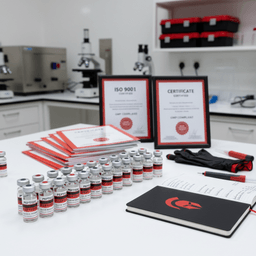
Key Quality Criteria: A Researcher’s Evaluation Framework
When evaluating a potential peptide supplier for research procurement, the following criteria provide a systematic framework for assessment:
| Criterion | Minimum Standard | Best Practice |
|---|---|---|
| HPLC Purity | ≥95% | ≥98% with chromatogram |
| COA Source | In-house or third-party | Independent ISO-accredited lab |
| Mass Spec Confirmation | Optional | Included with every batch |
| Batch Traceability | Batch number on label | Searchable COA database |
| Storage Conditions | Refrigerated shipping | Lyophilized + desiccant packs |
| Domestic Shipping | US-based fulfillment | Express 2–3 day delivery |
| Customer Support | Email response | Dedicated research support team |
Purity thresholds are especially important for dose-response research, where impurities can confound results or generate false positives. Research requiring precise molar concentrations — such as receptor binding studies or in vitro cell culture work — demands compounds with consistent purity across batches. Reputable suppliers publish not just current batch COAs, but historical data that allows researchers to assess batch-to-batch consistency over time.
Solubility data, storage recommendations, and reconstitution guidelines are additional markers of a quality supplier. Compounds shipped with detailed handling instructions reduce user error in laboratory settings. For detailed reconstitution protocols, our peptide reconstitution and storage guide covers best practices across compound classes.
Red Flags in the Research Peptide Market
The peptide research market, unfortunately, contains a number of suppliers who prioritize low prices over analytical integrity. Recognizing these warning signs is critical for maintaining research validity:
- No accessible COA: Any supplier that cannot provide a current batch COA on request should be disqualified immediately. Generic or undated COAs are equally problematic.
- Suspiciously low prices: Research-grade peptide synthesis is expensive. Prices significantly below market rates almost always reflect corners cut in synthesis purity, reagent quality, or testing.
- No mass spectrometry data: HPLC alone cannot confirm peptide identity — only mass spec can verify that the synthesized compound matches the theoretical molecular weight.
- Overseas-only sourcing with slow shipping: Long transit times affect compound stability. Domestic US-based suppliers with temperature-controlled shipping offer significantly better compound integrity on arrival.
- Vague product descriptions: Legitimate suppliers provide precise compound information: molecular formula, molecular weight, CAS number, sequence (for peptides), and storage conditions.
- No customer service infrastructure: Quality suppliers offer technical support for researchers, including guidance on reconstitution, storage, and compound-specific research considerations.
- Claims of human use or health benefits: Research peptides must be marketed exclusively for laboratory and preclinical research purposes. Any supplier making human health claims is violating regulatory guidelines and likely operating without appropriate oversight.
Domestic vs. Overseas Suppliers: Practical Research Considerations
The sourcing geography of a peptide supplier carries practical implications that extend beyond price and shipping speed. US-based suppliers operate under domestic regulatory frameworks that create accountability mechanisms absent in overseas operations. While peptides for research purposes are not controlled substances in most jurisdictions, domestic suppliers are subject to business regulations, consumer protection laws, and reputational pressures that incentivize quality consistency.
From a compound integrity standpoint, domestic sourcing with expedited shipping means peptides spend less time in transit, reducing exposure to temperature fluctuations and humidity. Most quality peptides are shipped lyophilized (freeze-dried) with desiccant packs, but even in this form, extended transit times introduce risk. For temperature-sensitive compounds like GLP-class peptides or fragile cyclic peptides, domestic shipping is not merely convenient — it is a quality preservation consideration.
Customs clearance is another practical consideration for international orders. Research compounds can be held at customs for extended periods, potentially with temperature chain breaks that compromise compound integrity. Domestic procurement entirely eliminates this risk and provides clearer legal standing for institutional purchase orders and grant-funded research.
Suppliers like Spartan Peptides represent the domestic model done well: US-based fulfillment, third-party HPLC and mass spec verification, accessible COA documentation, and a research-focused product catalog. Their approach demonstrates that competitive pricing and analytical rigor are not mutually exclusive — researchers can access quality compounds without sacrificing verification standards.
Product Range and Catalog Depth
A supplier’s catalog depth reflects their investment in the research community. Specialized research programs often require a range of related compounds — for example, a study on neuroprotective peptides might require Semax, Selank, Dihexa, and Pinealon in the same procurement cycle. A supplier with limited catalog breadth forces researchers to use multiple vendors, introducing batch variability and procurement overhead that complicates experimental design.
Quality suppliers maintain broad catalogs across research categories: growth hormone secretagogues, repair peptides, nootropic peptides, metabolic compounds, and anti-aging agents. Equally important is catalog stability — consistent availability of compounds across research timelines. Stockouts mid-study create significant reproducibility problems, particularly for longitudinal research protocols.
Product-specific documentation, including suggested research concentrations, known solubility profiles, and relevant peer-reviewed literature references, adds further value for research teams. This level of support transforms a supplier from a mere vendor into a research partner — an increasingly important role as peptide research expands into novel therapeutic areas.
Frequently Asked Questions
What purity level should research peptides have?
For most preclinical research applications, peptides should have ≥98% HPLC purity. Some applications may accept ≥95%, but higher purity reduces confounding variables in dose-response studies and cell culture work.
What is a Certificate of Analysis (COA) and why is it important?
A COA is a document from an analytical laboratory confirming the identity and purity of a compound. For research peptides, it typically includes HPLC purity percentage, mass spectrometry molecular weight confirmation, and batch number. COAs are essential for research reproducibility and institutional compliance.
Is it legal to buy research peptides online?
In the United States, most peptides can be legally purchased for legitimate research purposes. They are not approved for human use but are available as research chemicals. Researchers should review applicable regulations and ensure purchases are for genuine scientific research applications.
Why is domestic US shipping important for research peptides?
Domestic shipping reduces transit time, minimizing temperature fluctuation exposure. It also eliminates customs delays that can compromise compound integrity and provides clearer regulatory standing for institutional procurement.
How do I verify a peptide supplier’s COA is legitimate?
Legitimate COAs include the testing laboratory’s name and accreditation; a specific batch number matching your product; HPLC chromatogram data; and a mass spectrum showing the expected molecular ion. Verify by confirming the testing lab is an independent analytical facility.
Research Disclaimer: The peptides and compounds discussed in this article are research chemicals intended for laboratory and preclinical research use only. None of these compounds are approved by the FDA or any regulatory authority for human use, diagnosis, treatment, or prevention of any medical condition. All information presented is for scientific and educational purposes only and does not constitute medical advice. Do not use research peptides for self-administration. Consult a qualified healthcare professional for any health-related concerns. Spartan Peptides supplies research compounds exclusively for legitimate scientific research in compliance with all applicable laws and regulations.
References
- Casas R. “Vascular biomarker assessment in quality-controlled research compound studies.” PLoS One. 2014. PMID: 24925270
- Van Straaten S. “Evidence-based criteria for research compound quality assessment.” Am J Hematol. 2018. PMID: 30105801
- Sanghangthum T. “Statistical process control and quality assurance protocols in research settings.” J Radiat Res. 2013. PMID: 23220776
- Chhabra A. “Comparative material stability analysis for lyophilized research compounds.” Indian J Dent Res. 2017. PMID: 28836538
Written by the Spartan Research Team
The Spartan Peptides Research Team consists of scientists, biochemists, and health researchers dedicated to providing accurate, evidence-based information about peptide research. Our content is reviewed for scientific accuracy and updated regularly to reflect the latest findings in peptide science.