
AOD-9604 for Sale: Research Sourcing Guide for the Fat Loss Peptide Fragment

Written bySpartan Research Team
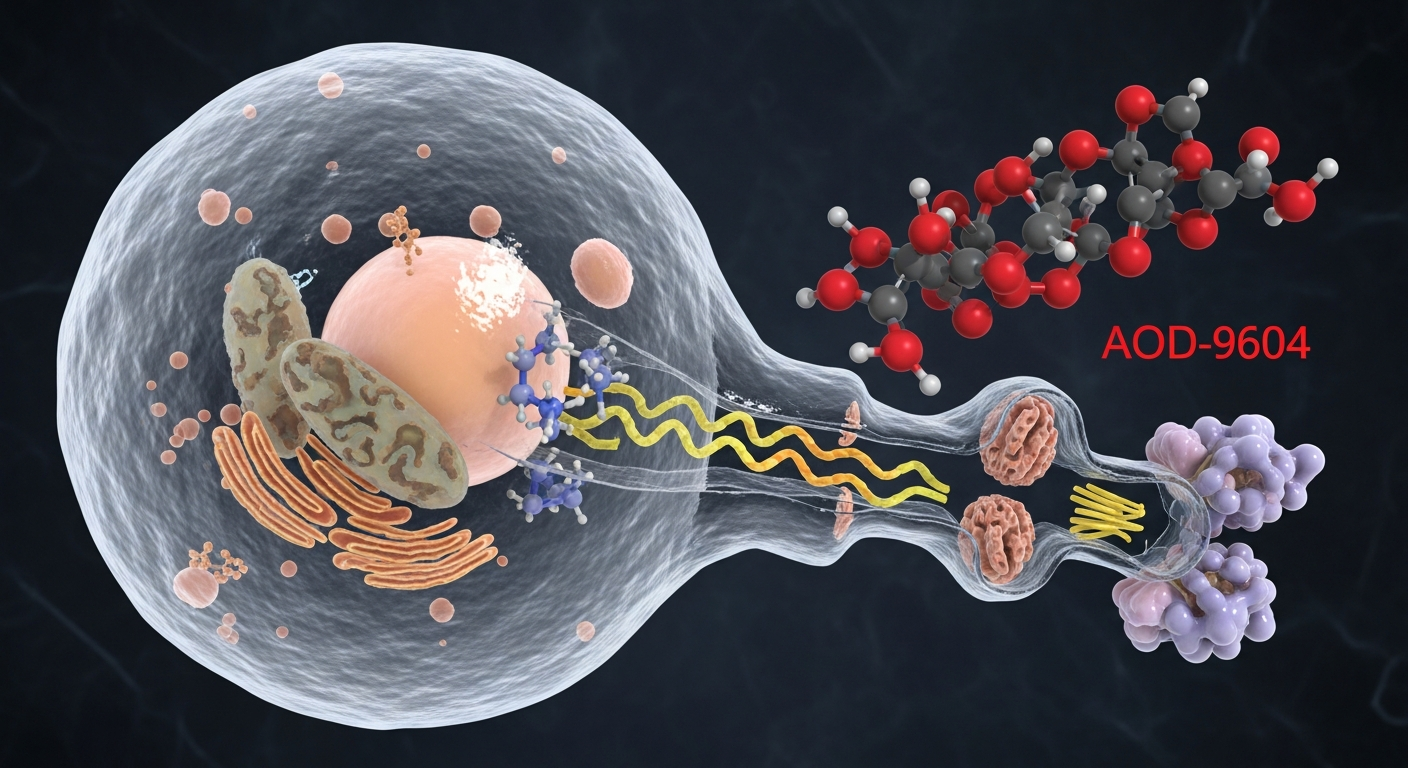

AOD-9604 occupies a specific and well-defined lane in the body recomposition research community: selective lipolysis without the confounding anabolic and diabetogenic variables that full hGH introduces. Metabolic researchers and optimization-focused buyers sourcing this compound are typically not new to GH-axis peptides — they are looking for the fat metabolism mechanism in its most isolated form. This guide covers what separates research-grade AOD-9604 from substandard material and why fragment sequence accuracy matters for reproducible results.
Key Research Findings on AOD-9604
- AOD-9604 is the C-terminal fragment of hGH (positions 177-191) and demonstrates selective lipolytic activity in preclinical and clinical models without elevating IGF-1 or producing anabolic effects
- Phase 2 clinical trials by Metabolic Pharmaceuticals demonstrated statistically significant reductions in fat mass at doses of 250 to 500 mcg per day over 12-week periods in obese subjects
- Mechanistic research points to beta-3 adrenergic receptor interaction as the primary pathway for AOD-9604’s lipolytic activity in adipose tissue
- Unlike full recombinant hGH, AOD-9604 does not trigger insulin resistance or produce diabetogenic effects — the property that makes it specifically valuable for selective fat metabolism research
- Fragment sequence accuracy is critical: AOD-9604 (177-191) must not be confused with AOD-9401 or other hGH fragments with different sequence positions and distinct pharmacological profiles
What Is AOD-9604: The Fat Metabolism Fragment
AOD-9604 is a synthetic peptide corresponding to amino acid positions 177 to 191 of the C-terminal region of human growth hormone. This fragment designation — sometimes referenced as hGH 176-191 or hGH 177-191 depending on numbering convention — is critical to get right when sourcing, because different fragment positions produce fundamentally different pharmacological profiles.
The documented mechanism for AOD-9604 in preclinical models involves beta-3 adrenergic receptor interaction in adipose tissue, driving lipolysis (the breakdown of stored fat for energy) without activating the broader cascade of GH receptor signaling that produces IGF-1 elevation and anabolic tissue effects. Body recomposition-focused research specifically values this selectivity: it allows investigation of the fat mobilization pathway without the confounding anabolic and metabolic noise that comes with full hGH administration in research models.
Research History: From Pharmaceutical Development to the Research Community
AOD-9604 has one of the more substantial clinical development histories of any peptide fragment in the body composition research space. Melbourne-based Metabolic Pharmaceuticals developed it as a targeted obesity drug candidate and advanced it through Phase 2 clinical trials in the early 2000s. The clinical data were notable: 12-week randomized trials in obese subjects demonstrated statistically significant reductions in body fat at daily doses in the 250 to 500 mcg range, without the diabetogenic or anabolic effects associated with full hGH therapy.
Phase 3 commercial development was not completed, but the compound’s extensive Phase 2 safety dataset and its well-characterized mechanism have kept it active in the metabolic research community. For researchers studying selective lipolysis mechanisms, the availability of a compound with human clinical data — not just rodent model data — represents a meaningful evidence base for research protocol design. AOD-9604 also received GRAS (Generally Recognized as Safe) designation from the US FDA for use as a food ingredient, a regulatory milestone that underscores the favorable safety profile documented through its clinical development history.
What to Look For When Buying AOD-9604 for Research in 2026
The metabolic research community applies specific quality criteria when sourcing AOD-9604. Sophisticated buyers who have run GH-axis research protocols know that fragment peptides carry their own sourcing risks distinct from full-length compounds. The following represents the standard the body recomp-focused research community uses:
- Correct fragment sequence: 177-191 designation confirmed by MS. This is the first and most important criterion. AOD-9604 is specifically the hGH 177-191 fragment. It must not be confused with AOD-9401 (a different compound), truncated versions, or fragments with incorrect sequence boundaries. The fragment sequence must be confirmed by mass spectrometry, not assumed from the label.
- HPLC purity of 98 percent or greater. The same floor standard that applies to all research-grade peptides. HPLC trace documentation — not just a purity percentage claim — from the supplying lab is the minimum acceptable level of transparency. Fragment peptides can carry synthesis byproducts that do not affect purity percentage but do affect bioactivity in cell-based assays.
- USA-manufactured, verified supply chain. Domestic production with documented chain of custody from synthesis to vial. Overseas bulk production of GH fragment peptides carries elevated risk of sequence truncation and contamination that is not visible on basic purity testing.
- Lyophilized vial format. Lyophilized AOD-9604 stored correctly at -20 degrees Celsius maintains stability for 24 months or more. Pre-reconstituted liquid formats are not appropriate for serious research use.
- Not confused with AOD-9401. AOD-9401 is a structurally distinct compound sometimes sold under similar-looking product names. Researchers sourcing AOD-9604 should confirm the sequence designation and molecular weight to eliminate the possibility of receiving the wrong compound.
Standard Research Formats for AOD-9604
AOD-9604 is most commonly supplied in 5mg lyophilized vials, which is the standard format for multi-dose research protocols consistent with the clinical literature’s daily dosing parameters. Some suppliers also offer 2mg vials for shorter-duration studies. Reconstitution uses bacteriostatic water (BAC water) for multi-dose research applications — the standard choice in the performance research community for peptide vials that will be accessed multiple times. Reconstituted solution should be stored refrigerated at 2 to 8 degrees Celsius and used within 28 days. Lyophilized unreconstituted vials store at -20 degrees Celsius.
AOD-9604 Dosing in the Clinical Research Literature
The Phase 2 clinical trials conducted by Metabolic Pharmaceuticals represent the most rigorous dosing data available for AOD-9604 in human subjects. Published results from the 12-week randomized controlled trial (Heffernan et al., 2001) documented statistically significant reductions in body fat in obese subjects receiving AOD-9604 at 250 mcg per day and 500 mcg per day versus placebo. The 250 mcg per day group demonstrated fat mass reduction without any statistically significant changes in lean mass, IGF-1, insulin sensitivity, or fasting glucose — consistent with the compound’s selective lipolytic mechanism.
These parameters are published clinical research data provided for scientific education. They are not dosing recommendations for human use, and nothing in this article constitutes medical advice. Metabolic researchers designing preclinical studies should consult the primary clinical literature and translate parameters to appropriate model systems. The GH fragment research literature is also catalogued in the Strongest Peptides for Weight Loss 2026 Research Review.
AOD-9604 vs Full HGH in Research: The Selectivity Advantage
The research case for studying AOD-9604 instead of full recombinant hGH in fat metabolism protocols comes down to variable isolation. Full hGH activates multiple parallel pathways simultaneously: IGF-1 axis stimulation, anabolic tissue effects, and insulin resistance at supraphysiological doses. Designing a study around fat metabolism using full hGH means dealing with all of those confounding variables.
AOD-9604 allows metabolic researchers studying selective lipolysis to run cleaner experiments. The compound’s documented lack of IGF-1 elevation and absence of diabetogenic effects in both preclinical and clinical data means the fat mobilization signal is not buried under anabolic and metabolic noise. For the body recomp-focused research community that wants to characterize fat metabolism pathways without confounding anabolic variables, this selectivity is precisely the point. For broader context on GLP-axis and metabolic peptide research, the GLP research landscape overview and the Complete Guide to Weight Loss Peptides provide complementary context on the metabolic research space.
Source Research-Grade AOD-9604 at Spartan Peptides
Spartan Peptides supplies research-grade AOD-9604 with verified fragment sequence (177-191), HPLC purity of 98 percent or greater, and lyophilized vial format. Our AOD-9604 is USA-manufactured with internal quality verification on every batch. Explore the full range of weight loss research peptides including AOD-9604 at Spartan Peptides AOD-9604.
Frequently Asked Questions: AOD-9604 for Research
What is AOD-9604?
AOD-9604 is a synthetic hGH fragment (amino acid positions 177 to 191 of human growth hormone) developed specifically for its selective lipolytic properties. Unlike full recombinant hGH, it does not elevate IGF-1, does not produce anabolic effects, and does not trigger insulin resistance. Metabolic Pharmaceuticals developed it as a targeted obesity drug candidate and advanced it through Phase 2 clinical trials. It remains an active compound in the metabolic and body recomposition research community precisely because of its selective mechanism profile.
How does AOD-9604 differ from full HGH in research models?
Full hGH simultaneously activates the IGF-1 axis, promotes anabolic tissue changes, and at supraphysiological doses produces diabetogenic effects — all of which create confounding variables in fat metabolism research. AOD-9604 isolates the lipolytic portion of the hGH molecule. In preclinical models and Phase 2 clinical data, it consistently reduces fat mass without measurable effects on IGF-1, lean mass, or insulin sensitivity. Metabolic researchers studying selective lipolysis use AOD-9604 specifically to eliminate the anabolic and metabolic noise that full hGH introduces.
How do researchers reconstitute AOD-9604?
AOD-9604 lyophilized powder is reconstituted with bacteriostatic water (BAC water) for multi-dose research applications. BAC water is standard in the research community for multi-dose peptide vials due to the benzyl alcohol preservative extending solution stability at refrigerated temperatures. Target concentration is calculated from vial mass and desired concentration per unit volume. Reconstituted solution stores at 2 to 8 degrees Celsius and should be used within 28 days. Lyophilized unreconstituted vials store at -20 degrees Celsius.
What dosage did clinical research use for AOD-9604?
Phase 2 clinical trials by Metabolic Pharmaceuticals studied AOD-9604 at 250 mcg and 500 mcg per day in obese human subjects over 12-week periods, documenting statistically significant fat mass reduction at both doses. These published research parameters are provided for scientific education purposes only and do not constitute dosing guidance for human use. Researchers designing studies should review the primary clinical literature and apply parameters appropriately to their experimental models.
References
- Heffernan M, Summers RJ, Thorburn A, et al. The effects of human GH and its lipolytic fragment (AOD-9604) on lipid metabolism following chronic treatment in obese mice and beta(3)-AR knock-out mice. Endocrinology. 2001;142(12):5182-5189. PMID: 11713213
- Ng FM, Sun J, Sharma L, Libinaka R, Jiang WJ, Gianello R. Metabolic studies of a synthetic lipolytic domain (AOD-9604) of human growth hormone. Horm Res. 2000;53(6):274-278. PMID: 11146367
Spartan Research Library
Go Deeper on the Science
Browse study indexes, compound comparisons, and protocol stacks in the Spartan Peptides Research Library.
Written by the Spartan Research Team
Our team of peptide researchers and biochemists reviews every article for scientific accuracy. Learn more about our team →