
GLP-1 Sema vs GLP-2 Tirz: Research Mechanisms Compared

Written bySpartan Research Team
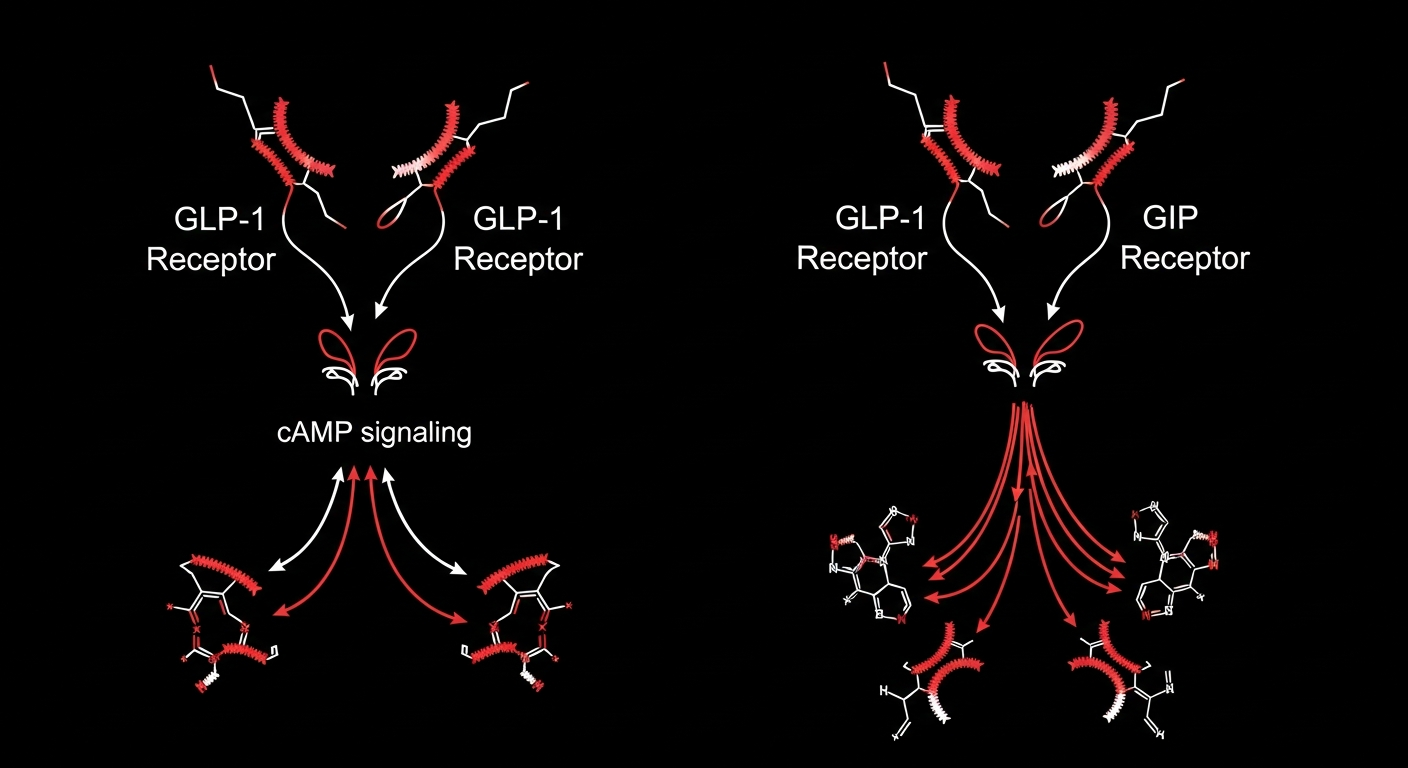
Two peptide compounds have reshaped metabolic research over the last decade. GLP-1 Sema and GLP-2 Tirz share a common target, the GLP-1 receptor, but they aren’t the same molecule and they don’t produce the same downstream effects. The SURPASS-2 trial published in 2021 showed GLP-2 Tirz outperformed GLP-1 Sema on glycemic control across every dose tested. That’s not a subtle difference. Understanding why requires getting into receptor-level biology.
This guide breaks down the receptor binding profiles, metabolic signaling pathways, and clinical trial data for both compounds. We’ll cover what makes each one distinct, where the research sits today, and what the mechanistic differences mean for study design. If you’re comparing these two compounds for a research protocol, this is the mechanistic foundation you need.
- GLP-1 Sema binds exclusively to the GLP-1R; GLP-2 Tirz engages both GLP-1R and GIPR simultaneously through a single molecule
- Dual agonism in GLP-2 Tirz produces additive effects on insulin secretion, glucagon suppression, and central appetite signaling
- SURPASS-2 (2021) documented greater HbA1c reduction with GLP-2 Tirz at all doses versus GLP-1 Sema
- SURMOUNT-1 (Jastreboff et al., 2022) showed up to 22.5% mean body weight reduction in GLP-2 Tirz high-dose groups over 72 weeks
- Both compounds share a weekly half-life through fatty acid conjugation, with GLP-1 Sema at approximately 165-184 hours
- GIP receptor activation in the CNS adds a distinct appetite-modulating pathway not engaged by GLP-1 Sema

GLP-1 Receptor Biology: The Shared Foundation
Both compounds start at the same receptor. The GLP-1 receptor (GLP-1R) is a class B G protein-coupled receptor expressed in pancreatic beta cells, the hypothalamus, the nucleus tractus solitarius, cardiac muscle, kidney, and gastrointestinal tissue. When GLP-1 or a GLP-1R agonist binds, the receptor couples with Gs proteins and activates adenylyl cyclase, increasing intracellular cAMP. In beta cells, this amplifies glucose-stimulated insulin secretion (GSIS) and suppresses glucagon release from alpha cells. That’s the core mechanism both compounds exploit.
What makes GLP-1R particularly valuable as a research target is its expression in the brain. The arcuate nucleus, the ventromedial hypothalamus, and the brainstem all express GLP-1R. Drucker et al. (2006) established that central GLP-1R activation drives satiety signaling through POMC/CART neuron stimulation and AgRP/NPY inhibition. Gastric emptying also slows via vagal pathways. These central and peripheral effects combine to produce the appetite suppression that makes both compounds valuable in obesity research models.
GLP-1 itself has a plasma half-life of about 2 minutes due to rapid DPP-4 degradation. That’s why research-grade analogs are engineered with extended stability.
GLP-1 Sema: Structure, Half-Life, and Selective Receptor Targeting
GLP-1 Sema is a 34-amino acid GLP-1 analog with two structural modifications that extend its half-life. First, an Arg to Lys substitution at position 34 and an Aib (alpha-aminoisobutyric acid) substitution at position 8 make it resistant to DPP-4 cleavage. Second, a C18 fatty diacid chain is attached at position 26 via a linker, enabling reversible albumin binding in plasma. Albumin binding slows renal clearance and reduces the free fraction available for degradation, extending the effective half-life to approximately 165 to 184 hours (Nauck et al., 2021). That’s close enough to 7 days that once-weekly protocols are well-supported.
Selectivity for GLP-1R is its defining characteristic. GLP-1 Sema doesn’t meaningfully engage the GIPR, glucagon receptor, or other class B GPCRs at physiological concentrations. This selectivity has advantages for mechanistic research: effects can be attributed cleanly to GLP-1R signaling without confounding from secondary receptor activation.
In type 2 diabetes models, GLP-1R agonism with GLP-1 Sema reduces HbA1c by approximately 1.5 to 1.8 percentage points versus placebo in major trials. Weight reductions of 12 to 15% have been documented in obesity research protocols over 68 weeks (STEP trials, 2021). The central appetite suppression pathway is considered the primary driver of weight-related outcomes, with GIP-independent mechanisms accounting for all effects.
GLP-2 Tirz: Dual Agonism and the GIP Receptor Addition
GLP-2 Tirz is a 39-amino acid synthetic peptide designed as a dual agonist at both the GLP-1R and the glucose-dependent insulinotropic polypeptide receptor (GIPR). It’s based on a GIP scaffold with modifications that allow balanced engagement of both receptors. The compound carries a C20 fatty diacid modification that enables albumin binding, producing a half-life of approximately 120 to 150 hours. Close enough to once-weekly use, but structurally distinct from GLP-1 Sema’s conjugation strategy.
The GIPR addition is what makes GLP-2 Tirz mechanistically different. GIP receptor activation is glucose-dependent (it only stimulates insulin release when blood glucose is elevated), and GIPR is expressed in pancreatic beta cells, adipose tissue, bone, and the CNS. Müller et al. (2019) documented that GIPR engagement in the hypothalamus adds to the anorexigenic signal through distinct neural circuits from those activated by GLP-1R. So you get appetite suppression from two converging but non-identical pathways.
Worth noting: the relative contribution of GLP-1R versus GIPR to any given effect isn’t always cleanly separable in vivo. Some researchers have debated whether GIPR activation in isolation is orexigenic or anorexigenic, and the dual agonist context may produce emergent effects not predictable from single receptor data. Frías et al. (2021) described this complexity in their Phase 2 mechanistic analysis. The short version: dual agonism is more complicated to study than selective agonism, and that complexity is part of what makes GLP-2 Tirz an interesting research tool.

Metabolic Pathway Differences: What Dual Agonism Changes
The core metabolic difference comes down to breadth. GLP-1 Sema drives insulin secretion, glucagon suppression, gastric slowing, and central satiety via one receptor. GLP-2 Tirz does all of that plus adds GIP-mediated effects on:
- Insulin secretion: additive glucose-dependent stimulation through separate cAMP cascades in beta cells
- Adipose tissue: GIPR on fat cells modulates lipid storage and lipolysis, with context-dependent directionality
- Bone metabolism: GIP receptor expression in osteoblasts suggests a role in bone turnover (less studied in this context)
- CNS appetite: GIPR in the hypothalamus adds a second anorexigenic signal distinct from GLP-1R-driven POMC activation
In pancreatic beta cells, both receptors use Gs/cAMP/PKA signaling, so their insulin-secretory effects are additive at the second messenger level. That additivity is probably why GLP-2 Tirz consistently outperforms GLP-1 selective agonists on glycemic endpoints in head-to-head comparisons.
The adipose tissue picture is more complicated. GIPR stimulation has been shown to promote fat storage under some conditions and increase lipolysis under others, depending on the energy status of the cell. Some researchers initially worried that GIPR activation would counteract the weight-loss effects of GLP-1R engagement. The clinical trial data don’t support that concern, which suggests the CNS anorexigenic effect of dual agonism dominates the net metabolic outcome.
Clinical Trial Data Overview
| Trial | Compound | Duration | Key Endpoint | Result |
|---|---|---|---|---|
| STEP-1 (2021) | GLP-1 Sema | 68 weeks | Body weight reduction | Mean 14.9% reduction |
| SURMOUNT-1 (2022) | GLP-2 Tirz | 72 weeks | Body weight reduction | Mean 22.5% reduction (high dose) |
| SURPASS-2 (2021) | GLP-2 Tirz vs GLP-1 Sema | 40 weeks | HbA1c reduction | GLP-2 Tirz superior at all doses |
| SURPASS-5 (2021) | GLP-2 Tirz | 40 weeks | HbA1c reduction on insulin | 2.1pp reduction (high dose) |
| STEP-5 (2022) | GLP-1 Sema | 104 weeks | Sustained weight reduction | 15.2% reduction maintained at 2 years |
The SURPASS-2 data is probably the most directly relevant for researchers comparing these two compounds. It was the first head-to-head study (Frías et al., 2021, PMID: 33979977) to put both molecules in the same trial design at equivalent protocol durations. GLP-2 Tirz outperformed at every dose arm studied, with the magnitude of difference increasing at higher concentrations. Whether that reflects additive receptor engagement, dose-response differences, or both remains an active research question.
Appetite Suppression: Central Mechanisms Compared
Appetite suppression is where the mechanistic differences get most interesting. Both compounds work centrally, but through overlapping rather than identical circuits.
GLP-1 Sema’s appetite suppression is primarily mediated through GLP-1R in the arcuate nucleus (ARC) of the hypothalamus and the nucleus tractus solitarius (NTS) in the brainstem. In the ARC, GLP-1R activation stimulates POMC neurons (which produce the satiety signal alpha-MSH) and inhibits AgRP/NPY neurons (which drive hunger). The NTS receives satiety signals from vagal afferents carrying gastric distension and nutrient information, and GLP-1R activation there amplifies the “stop eating” signal. Drucker’s work in 2006 laid out most of this circuitry clearly.
GLP-2 Tirz adds GIPR activation in the hypothalamus. Müller et al. (2019, PMID: 31521049) documented GIPR expression in hypothalamic regions overlapping with but distinct from GLP-1R expression zones. GIPR activation in the CNS reduces food intake in rodent models independent of GLP-1R signaling. So dual agonism doesn’t just double the GLP-1 signal; it adds a second, mechanistically distinct anorexigenic pathway. That’s probably the best mechanistic explanation for why GLP-2 Tirz shows greater weight reductions than GLP-1 Sema at comparable doses.
The peripheral appetite contribution is also worth noting. Both compounds slow gastric emptying, but GLP-2 Tirz may affect gastric motility through both GLP-1R and GIP-related mechanisms in the gut wall. The research on GIP’s role in gastrointestinal motility is less mature than the central CNS data, so this remains an area of active investigation.
Half-Life, Stability, and Research Protocol Considerations
For research use, the pharmacokinetic profiles matter a lot. Both GLP-1 Sema and GLP-2 Tirz are designed for once-weekly administration in clinical research, and their half-lives support that. But they aren’t identical compounds, and the stability characteristics differ in ways that matter at the bench.
GLP-1 Sema’s albumin binding is strong and consistent across plasma concentrations, producing predictable pharmacokinetics with minimal inter-individual variation in protein binding. Its fatty diacid chain is a C18 structure with a flexible linker that keeps the albumin-binding portion away from the receptor-binding domain, preserving potency.
GLP-2 Tirz uses a C20 fatty diacid modification with a slightly different linker architecture. Its albumin affinity is similar, producing the 120 to 150-hour half-life range. One structural difference worth noting: because GLP-2 Tirz must bind two structurally distinct receptors (GLP-1R and GIPR), its three-dimensional architecture is more complex than a selective agonist. This doesn’t affect stability under standard lyophilized storage conditions, but it’s relevant for researchers thinking about reconstitution, freeze-thaw cycles, and long-term solution stability. See our peptide storage guide for practical storage protocol details.
What the Research Suggests Going Forward
The data so far make a pretty clear case that dual agonism produces larger glycemic and weight-related changes than selective GLP-1 agonism. But the scientific questions that remain are genuinely interesting. The GIPR’s role in fat tissue is still contested. Some groups argue GIPR agonism on adipocytes enhances insulin sensitivity; others have shown context-dependent lipogenic effects. How these play out against the CNS anorexigenic effects in different model systems isn’t fully resolved.
Combination research is also emerging. Some protocols are exploring GLP-1R agonism plus GIPR agonism plus glucagon receptor partial agonism (triple agonism), essentially extending the logic of GLP-2 Tirz further. The research trajectory suggests that receptor combination strategies will dominate metabolic research for the foreseeable future.
For labs studying metabolic signaling, GLP-1 Sema remains valuable precisely because of its selectivity. Clean attribution of effects to GLP-1R is easier with a single-receptor compound. GLP-2 Tirz is the better model for studying dual incretin physiology, but untangling the relative contributions of each receptor requires careful study design. Both compounds are available through our GLP-1 Sema product page and GLP-2 Tirz product page for qualified research applications.
PubMed Citations
- Nauck MA et al. (2021). “GLP-1 receptor agonists in the treatment of type 2 diabetes.” Lancet Diabetes Endocrinol. PMID: 33441470
- Frías JP et al. (2021). “GLP-2 Tirz versus GLP-1 Sema once weekly in patients with type 2 diabetes (SURPASS-2).” N Engl J Med. PMID: 33979977
- Drucker DJ (2006). “The biology of incretin hormones.” Cell Metab. PMID: 16456080
- Müller TD et al. (2019). “Glucagon-like peptide 1 (GLP-1).” Mol Metab. PMID: 31521049
- Jastreboff AM et al. (2022). “GLP-2 Tirz once weekly for the treatment of obesity (SURMOUNT-1).” N Engl J Med. PMID: 35658024
Research Disclaimer: All products sold by Spartan Peptides are intended for laboratory and in vitro research purposes only. Not for human consumption. These statements have not been evaluated by the Food and Drug Administration. Products are not intended to diagnose, treat, cure, or prevent any disease. For research use only.
Written by the Spartan Research Team
Our team of peptide researchers and biochemists reviews every article for scientific accuracy. Learn more about our team →