
GLP-3 Research Peptide 2026: Availability, Sourcing Standards, and What Researchers Need to Know

Written bySpartan Research Team
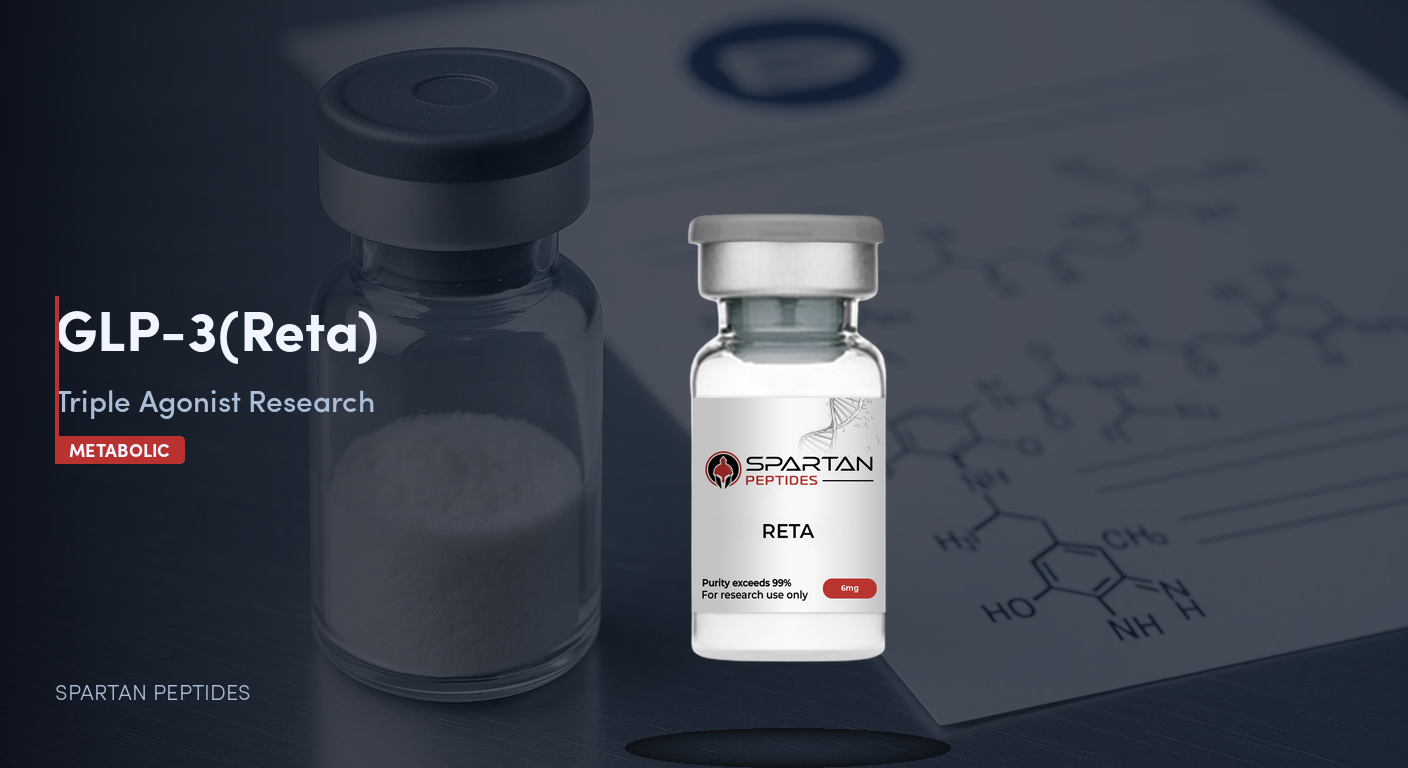
The GLP receptor agonist research class has expanded rapidly over the past decade, moving from single-receptor compounds to increasingly sophisticated multi-target molecules. GLP-3 represents the most advanced entry in this class to date — a triple agonist engaging the GIP, GLP-1, and glucagon receptors in a single compound. While GLP-1 analogs have generated extensive Phase 2 and Phase 3 clinical trial literature, and dual GIP+GLP-1 compounds have reached regulatory approval in the therapeutic space, GLP-3 (Reta) remains an active research compound with a distinct mechanistic profile that has drawn significant scientific interest in 2025 and into 2026.
🔬 Key Research Findings
- GLP-3 (Reta) acts as a triple receptor agonist targeting GIP, GLP-1, and glucagon receptors simultaneously — a broader mechanism than single-pathway GLP-1 analogs.
- Triple agonism adds hepatic fat oxidation and increased energy expenditure via glucagon receptor engagement, pathways not accessible through GLP-1 agonism alone.
- Research-grade GLP-3 should meet ≥98% HPLC-verified purity standards; sourcing from suppliers with independent third-party testing documentation is the benchmark.
- GLP-3 availability as a research compound has increased significantly in 2026 as synthesis protocols have matured following preclinical study publication.
This guide is written for researchers and laboratory professionals working with GLP-3 peptide. It covers the compound’s receptor mechanism, the current state of GLP-3 research, sourcing quality standards, and how GLP-3 compares to earlier-generation compounds in the same class. Sourcing decisions for newer research compounds carry greater consequence than for well-characterized molecules — and this guide explains why.
What Is GLP-3?
GLP-3 is a synthetic peptide designed as a triple receptor agonist — simultaneously activating three distinct metabolic receptor pathways: the GIP receptor (glucose-dependent insulinotropic polypeptide), the GLP-1 receptor (glucagon-like peptide-1), and the glucagon receptor (GcgR). Each of these pathways contributes a functionally different component to the compound’s overall metabolic research profile.
- GIP receptor activation enhances insulin secretion in a glucose-dependent manner and has been associated with improved insulin sensitivity in adipose tissue.
- GLP-1 receptor activation reduces appetite signaling, slows gastric emptying, and promotes satiety — the mechanism common to the entire GLP-1 agonist class.
- Glucagon receptor activation drives hepatic fat oxidation and increases basal energy expenditure — a pathway not engaged by GLP-1 or dual GIP+GLP-1 compounds.
The combination of all three pathways gives GLP-3 the broadest metabolic receptor coverage of any compound in this research class. The mechanism has been characterized in peer-reviewed literature, including Coskun et al. (2022), which documented the triple agonist profile of LY3437943 across GIP, GLP-1, and glucagon receptor systems (PMID: 37385105).
For researchers building out a metabolic peptide research program, GLP-3 (Reta) offers a research tool that captures all three mechanistic arms in a single compound — making it particularly relevant for studies examining the intersection of appetite regulation, insulin dynamics, and hepatic lipid metabolism.
The GLP-3 Research Landscape in 2026
Research interest in GLP-3 has grown substantially as the broader GLP receptor agonist literature has matured. The Phase 2 and Phase 3 clinical trial literature for GLP-1 (Sema) analogs established foundational mechanistic knowledge about appetite regulation and insulin secretion through GLP-1R engagement. Dual GIP+GLP-1 compounds subsequently demonstrated that adding a second receptor target could amplify metabolic outcomes beyond what single-receptor agonism could achieve.
GLP-3 builds directly on this mechanistic progression. The key differentiator is the addition of glucagon receptor agonism. Unlike GLP-1 and dual GIP+GLP-1 compounds, glucagon receptor engagement adds a hepatic component to the metabolic research profile — specifically, hepatic fat oxidation and an increase in basal energy expenditure that operates independently of appetite suppression pathways. This distinction is significant for researchers studying hepatic lipid metabolism, body composition endpoints, and energy balance.
The principal research endpoints being investigated with GLP-3 peptide in 2026 include:
- Body composition: lean mass retention relative to fat mass reduction under metabolic stress models
- Insulin sensitivity: downstream effects of simultaneous GIP and GLP-1 receptor engagement on insulin dynamics
- Hepatic lipid metabolism: glucagon receptor-mediated effects on liver fat accumulation and oxidation rates
- Energy expenditure: thermogenic and basal metabolic rate effects attributable to GcgR engagement
An overview of GLP receptor agonist mechanisms and their expanding research applications — covering the transition from mono- to multi-receptor compounds — was published in 2023 and remains a useful reference for contextualizing where GLP-3 fits in the research progression (PMID: 37534818).
It is important to note that GLP-3 (Reta) is not approved for human use by any regulatory authority. It is available exclusively as a research compound for laboratory and preclinical investigation by qualified researchers and institutions.
Sourcing Standards for GLP-3 Research
Purity standards carry greater consequence for newer research compounds than for well-characterized molecules with decades of reference data. When a compound has an extensive published literature, anomalous results can often be contextualized against known benchmarks. For GLP-3 — a compound still accumulating its research dataset — contaminants or impurities are more difficult to identify as confounding variables, and their effects on experimental outcomes are less well understood. This makes supplier quality selection a methodologically significant decision, not merely a procurement preference.
HPLC Purity Verification
High-performance liquid chromatography (HPLC) is the standard analytical method for peptide purity verification. For GLP-3 research applications, ≥98% HPLC purity is the accepted minimum threshold. Suppliers should provide batch-specific HPLC chromatograms — not general purity claims — as part of their certificate of analysis (CoA). Any supplier unable to produce analytical data at the batch level should not be considered for research-grade procurement.
Mass Spectrometry Confirmation
HPLC confirms purity — it does not confirm molecular identity. Mass spectrometry (MS) verification provides a molecular weight fingerprint that confirms the peptide is structurally what it is represented to be. For GLP-3 peptide, where the structural complexity of a triple agonist means more potential synthesis failure modes, MS confirmation is a meaningful addition to the quality documentation package.
Supplier Evaluation Criteria
- Third-party testing: Independent analytical verification, not in-house QC only
- US-based synthesis: Domestic production allows traceability and reduces cross-border contamination risk
- Documented QC process: Transparent synthesis and testing protocols available to researchers
- Lyophilized format: Lyophilized (freeze-dried) peptides maintain stability significantly longer than liquid preparations
Spartan Peptides provides GLP-3 peptide synthesized in the US with in-house HPLC and mass spectrometry verification, along with batch-specific certificates of analysis. Details on quality standards are available on the Quality Assurance page; additional compounds are listed in the research peptide catalog.
GLP-3 vs GLP-1 vs GLP-2: Research Comparison
Understanding where GLP-3 sits relative to earlier-generation compounds in the same class helps researchers select the appropriate tool for their experimental question. The three generations of GLP receptor agonists represent a clear mechanistic progression, each adding receptor coverage and broadening the metabolic research profile.
| Compound | Receptor Targets | Key Research Pathway | Evidence Stage |
|---|---|---|---|
| GLP-1 (Sema) | GLP-1R | Appetite regulation + gastric emptying | Extensive clinical data |
| GLP-2 (Tirz) | GIP + GLP-1R | Dual satiety + insulin sensitization | Phase 3 clinical data |
| GLP-3 (Reta) | GIP + GLP-1R + GcgR | Triple metabolic pathway coverage | Active research phase |
GLP-1 (Sema) provides the most well-documented research foundation in the class, with extensive published data on appetite, gastric motility, and glycemic regulation. GLP-2 (Tirz) adds GIP receptor co-activation, which has demonstrated amplified insulin sensitization and enhanced weight-loss outcomes in clinical trials. GLP-3 (Reta) extends the dual-receptor mechanism further by engaging the glucagon receptor, making it the most comprehensive metabolic research compound currently available in this class.
For researchers whose experimental questions center specifically on hepatic fat metabolism or energy expenditure pathways, GLP-3 provides receptor coverage that GLP-1 and GLP-2 compounds structurally cannot offer.
Research Considerations for GLP-3 Peptide
Proper handling and storage protocols are essential for maintaining GLP-3 peptide integrity across the research timeline. Lyophilized peptides are stable at the recommended storage temperature, but several variables can accelerate degradation and compromise experimental validity.
Storage
Lyophilized GLP-3 peptide should be stored at −20°C in a sealed, desiccated container. Long-term archival storage at −80°C is preferred when the compound will not be used within 30 days of receipt. Repeated freeze-thaw cycles degrade peptide structure; researchers should aliquot stock material prior to first use to avoid this. Light exposure and humidity are secondary degradation factors — amber vials and desiccant packs are standard protective measures.
Reconstitution
GLP-3 peptide is reconstituted using sterile bacteriostatic water (0.9% benzyl alcohol). Bacteriostatic water extends the stability window of the reconstituted solution to approximately 28 days when stored at 4°C (refrigerated, not frozen). Standard reconstitution practice is slow addition of diluent to the peptide vial with gentle swirling — agitation or vortexing should be avoided, as mechanical stress can disrupt peptide tertiary structure. Reconstituted solutions should be visually inspected for particulate matter or cloudiness before use; either observation is grounds for discarding the preparation.
Stability Window
Reconstituted GLP-3 peptide is stable for approximately 28 days at 4°C under ideal conditions. Researchers planning longer experimental timelines should maintain lyophilized stock and reconstitute only the volume needed for each experimental period. Beyond the 28-day window, peptide degradation products may accumulate and introduce uncontrolled variables into assay results.
Frequently Asked Questions: GLP-3 Research
What is GLP-3 and how does it differ from GLP-1?
GLP-3 is a triple receptor agonist targeting the GIP, GLP-1, and glucagon receptors simultaneously. GLP-1 analogs act on a single receptor pathway, primarily regulating appetite and gastric emptying. GLP-3 adds glucagon receptor engagement, which contributes hepatic fat oxidation and increased energy expenditure — metabolic pathways not accessible through GLP-1 agonism alone.
Is GLP-3 approved for human use?
No. GLP-3 (Reta) is not approved by the FDA or any regulatory agency for human use, therapeutic application, or veterinary use. It is classified strictly as a research compound and is available only for laboratory and preclinical research purposes by qualified researchers and institutions.
What purity should research-grade GLP-3 have?
Research-grade GLP-3 peptide should meet a minimum purity threshold of ≥98% as verified by HPLC. Mass spectrometry confirmation is also recommended to verify molecular identity independently of purity. Suppliers should provide third-party certificates of analysis at the batch level.
How does GLP-3 compare to GLP-2 (GLP-2 (Tirz) analog) in research?
GLP-2 (dual GIP+GLP-1 receptor agonist) has extensive Phase 3 clinical trial data demonstrating significant metabolic effects. GLP-3 extends this dual mechanism by additionally engaging the glucagon receptor, adding hepatic lipid metabolism and energy expenditure pathways. This makes GLP-3 a broader-spectrum metabolic research tool, though its evidence base is currently in the active research phase compared to GLP-2’s clinical trial dataset.
Where can researchers source GLP-3 peptide?
Research-grade GLP-3 peptide is available through Spartan Peptides at spartanpeptides.com/products/glp-3reta/. Spartan provides HPLC-verified, US-synthesized GLP-3 with mass spectrometry confirmation and batch-specific certificates of analysis. All compounds are sold exclusively for research purposes to verified researchers and institutions.
This content is intended for research and educational purposes only. All compounds discussed are not approved for human consumption. This information is not medical advice.
Written by the Spartan Research Team
Our team of peptide researchers and biochemists reviews every article for scientific accuracy. Learn more about our team →