
Gonadorelin Research Guide: GnRH Peptide and Gonadotropin Axis

Written bySpartan Research Team
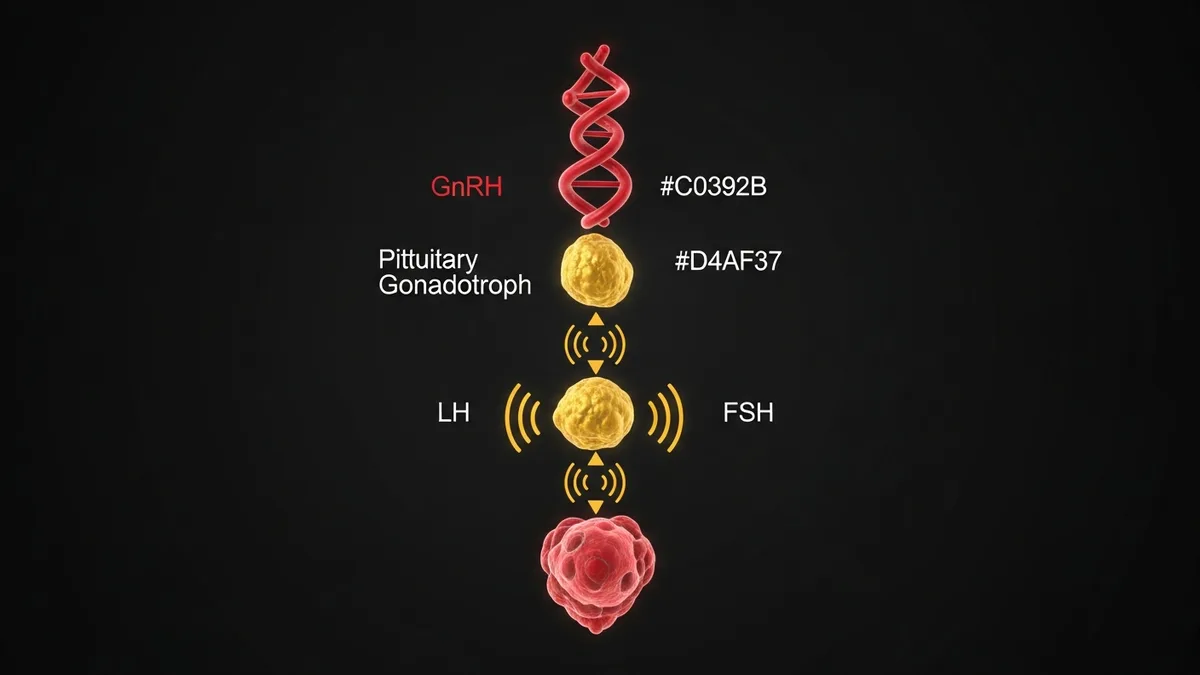
Gonadorelin is the synthetic form of endogenous gonadotropin-releasing hormone (GnRH), a decapeptide (pGlu-His-Trp-Ser-Tyr-Gly-Leu-Arg-Pro-Gly-NH2) secreted in pulses from the hypothalamic arcuate nucleus. In research contexts, gonadorelin is used to study the hypothalamic-pituitary-gonadal (HPG) axis, particularly the pulsatile LH and FSH secretion patterns that regulate gonadal steroidogenesis. Unlike synthetic GnRH agonist analogs (leuprolide, buserelin), which cause receptor desensitization when administered continuously, gonadorelin administered in short pulses activates pituitary gonadotrophs in a manner that mimics the physiological pulse pattern required for sustained LH and FSH secretion.
- Knobil E et al. (1980) demonstrated in primate models that pulsatile GnRH stimulation is required for normal LH and FSH secretion, and continuous GnRH paradoxically suppresses gonadotropin output, establishing the foundational principle for pulsatile GnRH research. (PMID 6776368)
- Marshall JC et al. documented that GnRH pulse frequency determines the ratio of LH to FSH secretion: higher frequency favors LH, lower frequency favors FSH, providing a research framework for studying gonadotropin ratios in reproductive physiology models.
- Gonadorelin research in HPG axis restoration models has demonstrated its utility in studying testosterone axis recovery after androgen suppression, with pulsatile administration restoring LH and FSH dynamics in preclinical castration models.
- The decapeptide structure of gonadorelin has a half-life of 2-10 minutes in circulation, requiring either pulsatile pump administration or precise injection timing in research protocols measuring dynamic gonadotropin responses.
- Comparative research between gonadorelin and kisspeptin-10 (also an HPG activator) has shown that both compounds converge on GnRH neuron activation, with kisspeptin acting upstream of the GnRH pulse generator.
GnRH Receptor Mechanism and Gonadotropin Secretion
Gonadorelin binds to the GnRH receptor (GnRHR), a Gq/11-coupled G-protein receptor expressed on pituitary gonadotroph cells. Receptor activation stimulates PLC, generating IP3 (which releases intracellular calcium) and DAG (which activates PKC). Together, these second messengers trigger fusion of secretory vesicles containing luteinizing hormone (LH) and follicle-stimulating hormone (FSH) with the gonadotroph plasma membrane.
The ratio of LH to FSH secreted in response to GnRH stimulation depends on pulse frequency. High-frequency pulses (every 60-90 minutes in primates) preferentially stimulate LH secretion, while lower-frequency stimulation (every 180-360 minutes) promotes FSH secretion. This frequency-encoding mechanism is a central subject of neuroendocrine research into reproductive physiology and has practical implications for studying different phases of the reproductive cycle in animal models.
Pulsatile Administration: A Research Requirement
The paradoxical suppression of LH and FSH by continuous GnRH stimulation is a well-established phenomenon studied extensively in the neuroendocrine literature. Continuous receptor occupancy leads to GnRHR downregulation and uncoupling from Gq signaling, effectively desensitizing the gonadotroph. This principle is exploited therapeutically by GnRH agonist analogs used for medical castration, but researchers studying HPG axis activation must use pulsatile administration to maintain receptor sensitivity and sustained gonadotropin secretion.
In research settings, pulsatile gonadorelin is typically delivered by subcutaneous infusion pump programmed for pulse intervals mimicking the endogenous hypothalamic frequency (approximately 60-120 minutes in rodents). Manual injection protocols with precise timing intervals are used in acute studies measuring single-pulse LH responses rather than chronic axis stimulation. Researchers designing gonadorelin experiments must account for the short half-life (2-10 minutes) in selecting blood sampling timepoints.

HPG Axis Research Applications
Gonadorelin research applications span multiple domains of reproductive neuroendocrinology. In hypogonadal animal models, pulsatile gonadorelin administration has been used to determine whether diminished LH and testosterone output arises from hypothalamic GnRH deficiency or pituitary-level impairment. If the pituitary responds normally to exogenous gonadorelin, the deficiency is localized to the hypothalamic pulse generator. If pituitary response is blunted, pituitary-level pathology is implicated.
HPG axis research comparing gonadorelin with kisspeptin-10 has become a productive area for studying upstream control of GnRH neurons. Kisspeptin-10, the active decapeptide fragment of kisspeptin, stimulates GnRH neuron firing and represents a regulatory node upstream of hypothalamic GnRH secretion. Researchers use both compounds to dissect the kisspeptin-GnRH-LH signaling cascade in animal models of reproductive suppression or stress-induced hypogonadism. Spartan does not carry gonadorelin itself, but researchers comparing HPG axis activators can review the kisspeptin product page linked above, or browse the broader sexual health research category for related reproductive axis compounds.
In the context of testosterone research, gonadorelin is used in post-androgen suppression protocols to study HPG axis recovery. Animal models of androgen suppression (gonadectomy or androgen receptor blockade followed by washout) have employed pulsatile gonadorelin to characterize the time course and extent of pituitary LH secretory capacity recovery. This research has implications for understanding the neuroendocrine mechanisms underlying testosterone axis restoration.
Comparison with Synthetic GnRH Agonist Analogs
Gonadorelin (native GnRH 1-10) contrasts sharply with synthetic long-acting GnRH agonist analogs in research utility. Analogs such as leuprolide incorporate D-amino acid substitutions at position 6 and a Pro-NH-ethylamide C-terminal modification that increases plasma half-life from minutes to hours. When administered continuously, these long-acting analogs cause gonadotropin suppression via receptor downregulation, opposite to the stimulatory effect of pulsatile gonadorelin.
GnRH antagonist analogs (cetrorelix, ganirelix) block GnRHR competitively without the flare effect seen with agonist analogs. Research comparing these three pharmacological approaches (pulsatile gonadorelin, continuous agonist, and antagonist) in gonadotropin secretion models has established the mechanistic basis for receptor activation vs. desensitization in the pituitary gonadotroph.
Research Safety and Handling
Gonadorelin is well-tolerated in preclinical research models at doses used in standard HPG axis studies. The primary effects are LH and FSH surges followed by testosterone or estradiol elevation in intact animals, which must be monitored as potential confounds in studies with other endpoints. The very short half-life means that acute effects dissipate within 30-60 minutes in most models, allowing research protocols to reset the HPG axis to baseline between experimental pulses.
Gonadorelin in Fertility and Hypogonadism Research Models
One of the most studied research applications of gonadorelin involves models of functional hypogonadism and fertility restoration. Because endogenous GnRH pulsatility is required for normal HPG axis function, researchers use exogenous pulsatile gonadorelin administration to restore LH and FSH secretion in GnRH-deficient animal models. These research designs have contributed substantially to understanding the neuroendocrine regulation of reproductive function and have informed clinical approaches to conditions of GnRH deficiency.
Published data from pulsatile gonadorelin infusion studies in GnRH-deficient rodent and primate models demonstrate that appropriately timed pulses restore the pituitary-gonadal axis within days of initiating treatment. Research reviewed by Spratt et al. (PMC1492054) established that pulse interval is the primary determinant of whether LH or FSH predominates in the hormonal response, with faster pulses favoring LH and slower pulses favoring FSH in sheep models that have been extensively validated for reproductive neuroendocrinology research.
In male research models, pulsatile gonadorelin administration has been used to study testosterone recovery following androgen suppression or in conditions of GnRH neuron disruption. Researchers track LH, FSH, and testosterone levels across time points to characterize the restoration of testicular steroidogenic function. These models are valuable for understanding the sequence and kinetics of HPG axis recovery, information relevant to both fertility research and pharmacological study of androgen biosynthesis pathways.
Female reproductive research has also utilized gonadorelin to study folliculogenesis, ovulation induction, and luteal phase dynamics. In anovulatory animal models, pulsatile GnRH administration via programmed pump systems reproduces the mid-cycle LH surge and subsequent ovulation with high reproducibility, providing researchers with a controlled model system for studying ovarian physiology, egg maturation, and corpus luteum formation.
Research comparing gonadorelin to longer-acting GnRH agonist analogs such as leuprolide reveals important distinctions in HPG axis outcome. While long-acting agonists desensitize GnRH receptors and produce gonadotropin suppression through receptor downregulation, pulsatile gonadorelin maintains or restores receptor responsiveness, reflecting its physiological pulse frequency. This receptor dynamic is the basis for the contrasting reproductive effects observed between gonadorelin and depot GnRH agonist preparations in comparative endocrinology research.
Explore Spartan Peptides’ catalog of research-grade compounds: Browse Research Peptides at Spartan Peptides
Written by the Spartan Research Team
Our team of peptide researchers and biochemists reviews every article for scientific accuracy. Learn more about our team →