
Hexarelin: Growth Hormone Secretagogue Mechanisms

Written bySpartan Research Team
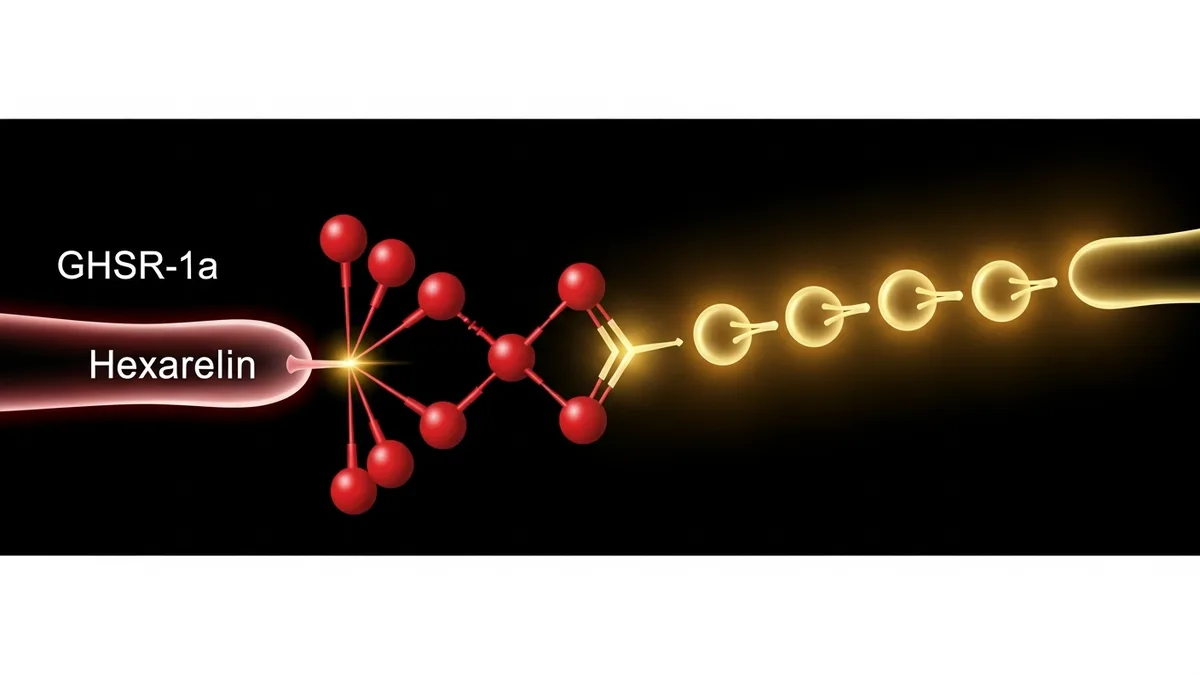
Hexarelin (also known as Examorelin or EP-23905) is a synthetic hexapeptide that acts as a potent agonist at the growth hormone secretagogue receptor type 1a (GHS-R1a). It was developed in Italy in the early 1990s by researchers at Europeptides and characterized extensively by Ghigo, Arvat, and colleagues at the University of Turin. The compound produces some of the strongest GH pulse amplification documented among the GHRP family, which has made it a reference compound in GHS research for over 30 years.
The sequence is His-D-2-MeTrp-Ala-Trp-D-Phe-Lys-NH2. That modification at position 2 (using a methylated tryptophan) is part of what distinguishes Hexarelin from GHRP-6, the natural ghrelin-like compound it was derived from. It’s about six amino acids and a molecular weight of roughly 887 Da, compact enough to be stable under standard laboratory storage conditions.
- Ghigo et al. (1994) documented Hexarelin as one of the most potent GH-releasing peptides examined, showing stronger GH pulse amplification than GHRP-6 and GHRP-2 in parallel study designs (PMID 8021083).
- Muccioli et al. (2001) identified a specific Hexarelin binding site in cardiac tissue (CD36 receptor) independent of GHS-R1a, documenting cardioprotective effects in rat ischemia-reperfusion models that persisted even in GH-deficient animals (PMID 11342501).
- Research has consistently shown that GHS-R1a-independent signaling pathways contribute to Hexarelin’s biological profile, which is unusual among GHRP compounds and expands its research utility beyond simple GH secretagogue applications.
The GHS-R1a Mechanism
GHS-R1a (ghrelin receptor subtype 1a) is expressed in the pituitary, hypothalamus, and multiple peripheral tissues. When activated, it triggers a G-protein signaling cascade that culminates in GH release from pituitary somatotrophs. The receptor also mediates appetite regulation via hypothalamic pathways, which is why ghrelin (the endogenous ligand) is associated with hunger signaling.
Hexarelin is a non-endogenous agonist at this receptor. It binds with high affinity and produces robust GH release, but it also triggers appetite stimulation to some degree, though less pronounced than GHRP-6 in most research models. The compound acts synergistically with GHRH (growth hormone releasing hormone), meaning co-administration produces a larger GH pulse than either compound alone. That synergy has made Hexarelin useful in research designs testing GH axis responsiveness.
One thing worth understanding: GHS-R1a has constitutive activity. That’s actually unusual for a receptor. It’s partially active even without a ligand bound, and this baseline activity may contribute to some of the receptor’s roles in mood, appetite, and metabolic regulation. Hexarelin, as a full agonist, pushes that activity well beyond baseline.
Hexarelin vs GHRP-6 vs GHRP-2: The Comparison
These three compounds are frequently discussed together because they share the GHS-R1a mechanism, but their profiles aren’t identical. Understanding the differences is relevant for researchers choosing between them.
GHRP-6 was the first GHRP studied systematically. It’s a hexapeptide with strong GH-releasing effects and significant appetite stimulation via ghrelin receptor activation. The appetite effect is a confound in research designs where metabolic variables need controlling. GHRP-6 also shows some elevation in cortisol and prolactin in some models.
GHRP-2 was developed as a more potent alternative with less appetite stimulation. It’s generally considered to produce larger GH pulses than GHRP-6 with fewer metabolic side effects, though cortisol and prolactin elevations are still documented in some research protocols.
Hexarelin produces the largest GH pulses of the three in head-to-head preclinical comparisons. The Ghigo group’s 1994 work (PMID 8021083) documented this potency hierarchy. The tradeoff is tachyphylaxis: Hexarelin shows faster desensitization with continued dosing than GHRP-2. GH pulse amplitude attenuates over days to weeks of continuous administration in animal models. Pulsatile protocols preserve response better than continuous infusion.
The appetite stimulation profile is similar to GHRP-2 (less than GHRP-6), and cortisol/prolactin elevations are observed but generally modest in research protocols. For researchers specifically interested in GHS-R1a agonism without the appetite confound, Ipamorelin (see Spartan’s research peptide catalog) is often the preferred compound since it shows essentially no appetite or cortisol effects at research-relevant doses.
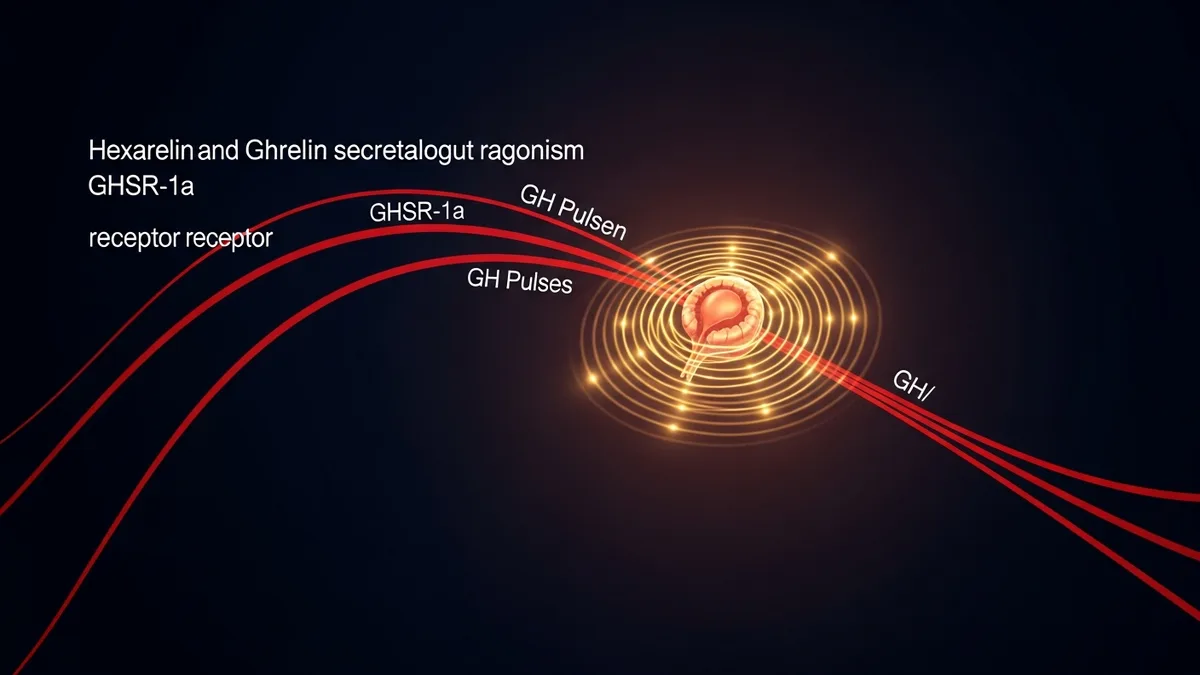
Hexarelin binds GHSR-1a with high affinity and produces potent GH secretagogue activity in pituitary research models. Explore Spartan Peptides catalog.
GH Pulse Dynamics and Tachyphylaxis
GH is secreted in pulses, not continuously. Healthy physiology involves discrete GH bursts, particularly during slow-wave sleep and following exercise. GHRP compounds like Hexarelin amplify these pulses rather than creating sustained GH elevation, which makes them mechanistically different from exogenous GH replacement.
Tachyphylaxis, the reduction in response with repeated stimulation, is the key practical consideration in Hexarelin research designs. Studies examining this phenomenon point to GHS-R1a downregulation and intracellular desensitization mechanisms. The receptor internalizes following activation, and if it’s activated too frequently, it doesn’t have time to recycle to the cell surface before the next stimulus arrives.
Research designs using Hexarelin typically employ pulsatile administration (once or twice daily) rather than continuous infusion for this reason. Even with pulsatile protocols, some attenuation occurs over weeks of administration. Recovery of full GH pulse response after a washout period has been documented in animal models, suggesting reversible desensitization rather than permanent receptor downregulation.
Cardioprotective Research
The cardiac findings are where Hexarelin research gets genuinely surprising. The Muccioli group’s 2001 work (PMID 11342501) identified a Hexarelin binding site in rat and human cardiac tissue that is distinct from GHS-R1a. This receptor was later identified as CD36, a scavenger receptor involved in fatty acid uptake and atherogenic lipid clearance.
In ischemia-reperfusion models (the standard preclinical model for heart attack damage), Hexarelin administration showed reduced myocardial damage in treated animals compared to controls. Critically, this effect persisted in GH-deficient animals (hypophysectomized rats), ruling out the possibility that it was simply a downstream effect of GH elevation. The cardioprotection appeared to be a direct cardiac action through the CD36 pathway.
Subsequent research examined the mechanism more closely. CD36 activation by Hexarelin in cardiac tissue has been linked to activation of anti-apoptotic signaling pathways, including PI3K/Akt and ERK. These are the same pathways targeted by ischemic preconditioning, a phenomenon where brief ischemic episodes protect the heart against subsequent larger ischemic events.
This line of research distinguishes Hexarelin from other GHRP compounds and is why it has maintained research interest even as newer and more selective GHS-R1a agonists have been developed.
Synergy with GHRH Analogs
The combination of a GHS-R1a agonist (like Hexarelin) and a GHRH analog (like CJC-1295) produces synergistic GH release in preclinical models, larger than either compound alone. This makes biological sense: GHRH acts on pituitary GHRH receptors to stimulate GH synthesis and release, while GHS-R1a agonism provides a parallel stimulatory input. Two independent pathways activating the same somatotroph output produce a bigger response than one pathway alone.
For researchers studying GH axis regulation, combination protocols using Hexarelin with GHRH analogs represent a useful tool for maximal GH axis stimulation. The CJC-1295/Ipamorelin blend available through Spartan uses this same dual-pathway principle with Ipamorelin (a more selective GHS-R1a agonist) rather than Hexarelin. Comparing Hexarelin-based combinations with Ipamorelin-based ones in research designs can help delineate the specific contributions of each compound’s receptor profile.
More information on GHRH analog research is available in the Spartan research library, and the broader research peptide catalog covers the full GHS compound class.
Research Purity Considerations
Hexarelin synthesis involves a methylated tryptophan at position 2, a modification that distinguishes it from GHRP-6. This non-standard amino acid makes the synthesis slightly more demanding than simpler GHRP compounds. Researchers should look for HPLC-verified purity of at least 98% and mass spectrometry confirmation of the correct molecular weight (887.0 Da for the free base).
Lyophilized Hexarelin stores well at -20°C. Reconstitution in bacteriostatic water or sterile saline is standard for laboratory use. The compound shows reasonable stability in aqueous solution when kept at 4°C for short-term use, though lyophilized aliquoting is preferred for longer storage to avoid freeze-thaw degradation.
Summary
Hexarelin occupies a specific niche in GHS research: the most potent GHRP by GH pulse amplitude, with documented cardioprotective effects through a GH-independent mechanism. Its tachyphylaxis profile makes study design more demanding than with GHRP-2 or Ipamorelin, but the CD36-mediated cardiac findings give it research utility that purely GHS-R1a-selective compounds don’t have. For researchers studying GH axis regulation, ischemia-reperfusion biology, or comparing GHRP compounds directly, Hexarelin is a well-characterized reference compound with 30 years of preclinical literature.
Spartan Peptides offers GH secretagogue research compounds for in vitro preclinical studies. Browse the research catalog.
Written by the Spartan Research Team
Our team of peptide researchers and biochemists reviews every article for scientific accuracy. Learn more about our team →