
Ipamorelin Research Guide: Selective GH Secretagogue

Written bySpartan Research Team

What makes Ipamorelin selective among GH secretagogues is its restricted receptor binding profile. It gets grouped with other GHRP-class compounds based on shared GHS-R1a pharmacology, but its endocrine fingerprint is different. GHRP-2 and GHRP-6 produce meaningful cortisol and prolactin co-elevation alongside GH at research doses. Ipamorelin doesn’t. That selectivity is the whole reason researchers working on GH axis dynamics reach for it when they want clean GH stimulation without HPA axis noise.
- Raun et al. (1998) established Ipamorelin as the first highly selective GH secretagogue, demonstrating robust GH pulse stimulation without significant cortisol or prolactin elevation in preclinical models (PMID 9544837).
- Hansen et al. (1999) confirmed Ipamorelin’s GH release profiles in adult rat models and characterized its interaction with endogenous somatostatin tone (PMID 10366403).
- In long-term preclinical studies, Ipamorelin produced GH-mediated increases in bone mineral density and body composition parameters without adrenal or prolactin axis activation.
What Is Ipamorelin?
Ipamorelin is a synthetic pentapeptide (Aib-His-D-2Nal-D-Phe-Lys-NH2) developed by Novo Nordisk in the late 1990s. It’s a ghrelin mimetic that acts as a selective GHS-R1a agonist, producing GH release from the anterior pituitary without the off-target receptor interactions that characterize GHRP-6 or, to a lesser extent, GHRP-2. Raun and colleagues at Novo Nordisk characterized it in 1998 and described it explicitly as “the first selective growth hormone secretagogue” in the title of their foundational paper.
The selectivity claim holds up under scrutiny. At doses that produce maximal or near-maximal GH release in rodent models, Ipamorelin doesn’t significantly elevate ACTH, cortisol, or prolactin. GHRP-6 at equivalent GH-stimulating doses produces measurable cortisol and prolactin elevations. GHRP-2 is intermediate. Ipamorelin sits at the selective end of the spectrum, and that’s what drives its specific utility in research designs where endocrine specificity matters.
Mechanism of Action
Ipamorelin binds GHS-R1a (the ghrelin receptor subtype 1a) in the hypothalamus and pituitary. At the pituitary level, GHS-R1a activation triggers phospholipase C signaling, IP3-mediated calcium release, and ultimately GH secretion from somatotroph cells. At the hypothalamic level, Ipamorelin stimulates GHRH release and modulates somatostatin tone. That combination produces the pulsatile GH release characteristic of the GHRP class.
The selectivity mechanism is where Ipamorelin diverges from its GHRP-class relatives. GHRP-6 has significant binding activity at the CRH receptor, which is why it drives cortisol and ACTH release alongside GH. Ipamorelin’s binding profile is substantially more restricted to GHS-R1a. The structural difference (particularly the D-2Naphthylalanine substitution at position 3) appears to reduce affinity for the off-target receptors responsible for HPA activation, while preserving GHS-R1a binding. The result is a cleaner GH stimulus.
Somatostatin modulation plays a role too. Hansen et al. (1999) found that Ipamorelin’s GH-releasing activity is potentiated by somatostatin antagonists and reduced by exogenous somatostatin, confirming that its mechanism involves the same somatostatin-dependent gating as other GH secretagogues. This means Ipamorelin’s GH release output varies with the subject’s endogenous somatostatin tone, which is a relevant variable for in vivo study design.
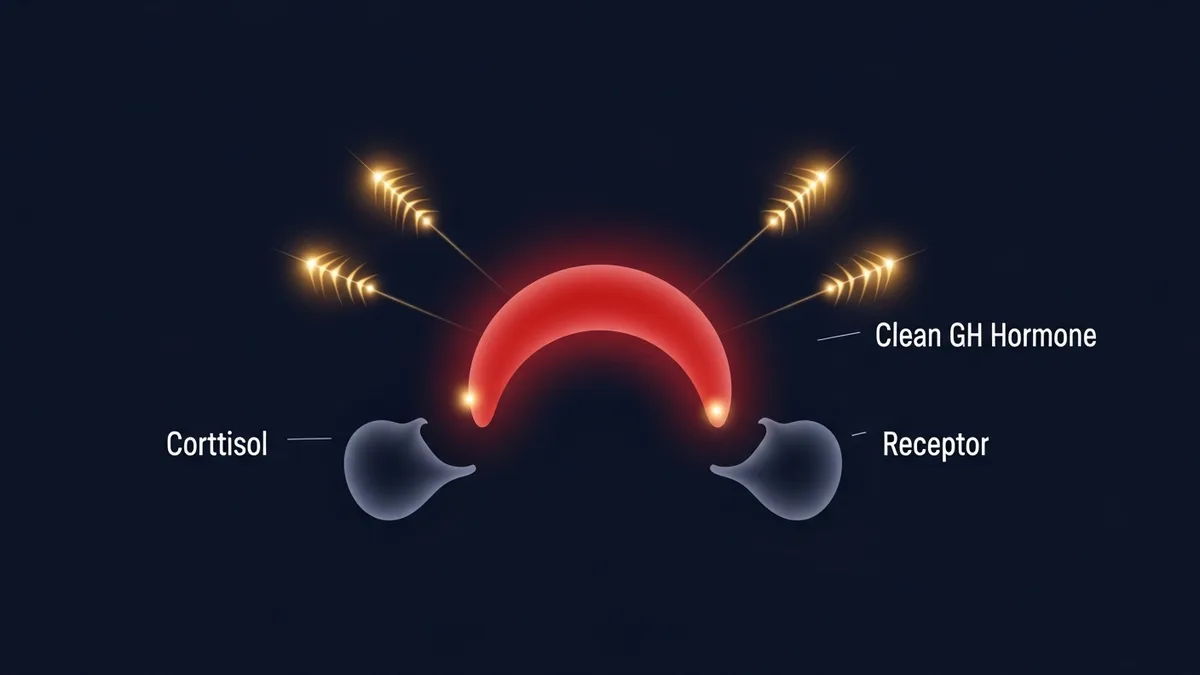
Ipamorelin is distinguished among GH secretagogues by its selective pituitary action without significant cortisol or prolactin co-stimulation. Explore Spartan Peptides catalog.
Key Research Findings
The 1998 Raun et al. paper (PMID 9544837) remains the core reference. Using rat pituitary cell preparations and in vivo rat models, the Novo Nordisk team showed Ipamorelin produced dose-dependent GH release with an ED50 comparable to GHRP-6, but without significant ACTH or cortisol elevation at any dose tested. They tested up to 500 micrograms per kilogram intravenously in rats, doses far exceeding what would produce maximal GH release, and still found no meaningful cortisol response. That was the definitive selectivity demonstration.
Hansen et al. (1999) (PMID 10366403) added important context on the GH release dynamics. They characterized Ipamorelin’s GH pulse profile in adult male rats, establishing the dose-response relationship and confirming the somatostatin dependence of the GH-releasing effect. They also examined chronic dosing effects on growth parameters, finding that sustained Ipamorelin administration over several weeks produced measurable increases in body weight and bone growth in GH-deficient animal models without adrenal axis activation.
Subsequent research has examined Ipamorelin in the context of GH secretagogue combinations. It’s a frequent pairing with CJC-1295 (a GHRH analog) in research panels, because the two compounds act through complementary mechanisms: GHRH stimulation plus GHS-R1a stimulation produces synergistic GH release that exceeds either compound alone. Several labs have quantified this synergy and used Ipamorelin as the GHS-R1a component in mechanistic studies of GH pulse architecture.
Research Applications
Ipamorelin’s primary research value is in studies where clean GH axis stimulation is needed without HPA or prolactin axis interference. This includes GH pulse dynamics research, GH-deficiency models, body composition studies in hypophysectomized animals, and comparative GH secretagogue panels. Its selectivity makes it the preferred GHRP-class compound when cortisol confounding is a concern in the experimental design.
It’s also a standard component in GH secretagogue synergy studies. Because Ipamorelin and GHRH-class analogs (like CJC-1295) act through distinct receptor populations with complementary mechanisms, their combination produces supraadditive GH release. Researchers use this synergy to probe the limits of GH pulse amplitude, study the cellular biology of somatotroph response, and develop models of GH axis regulation.
Bone biology is a third application area. Long-term Ipamorelin administration in preclinical models produces increases in bone mineral density, presumably mediated by elevated GH and downstream IGF-1. The clean HPA profile makes these bone studies cleaner to interpret: you don’t have to model a cortisol-mediated bone loss confound on top of the GH-mediated bone gain signal, which is a genuine advantage over less selective GHRPs.
Sourcing Research-Grade Ipamorelin
Spartan Peptides supplies Ipamorelin in lyophilized form for in vitro and preclinical research use, HPLC-verified for purity and identity. The CJC-1295/Ipamorelin blend is available for research designs using the synergistic combination. For standalone Ipamorelin or the mechanistic background on GHS-R1a pharmacology, the CJC/Ipa compound page covers the relevant context. Researchers comparing Ipamorelin to GHRP-class alternatives may find the complete 2026 guide at spartanpeptides.com/blog/cjc-1295-ipamorelin-complete-2026-research-guide/ useful as a starting point.
Frequently Asked Questions
The selectivity comparison across GH secretagogues is worth putting in precise terms. Raun and colleagues (1998) tested Ipamorelin alongside GHRP-6 and hexarelin in rat models, measuring GH, ACTH, and cortisol responses at equivalent GH-stimulating doses. GHRP-6 produced approximately 3-fold higher ACTH release than Ipamorelin at matched GH output. Hexarelin showed even greater off-target endocrine activation. Ipamorelin’s cortisol and prolactin responses were statistically indistinguishable from vehicle controls at doses producing substantial GH release. That’s a clean separation, not a marginal one.
In longer-term preclinical models, that selectivity advantage compounds. Chronic cortisol elevation from less selective GHRPs introduces a confound that makes it difficult to attribute observed effects specifically to GH and downstream IGF-1 signaling. Ipamorelin removes that confound. Studies on bone mineral density, lean body composition changes, and longitudinal growth in rodent models benefit from the cleaner hormonal signal it provides. The Hansen et al. (1999) data on extended Ipamorelin administration in adult rats showed persistent GH pulse augmentation without signs of somatotroph desensitization over a 12-week observation window, which adds another layer to the selectivity profile.
Written by the Spartan Research Team
Our team of peptide researchers and biochemists reviews every article for scientific accuracy. Learn more about our team →