
Melanotan II Research Guide: MC1R and MC4R Melanocortin Mechanisms

Written bySpartan Research Team
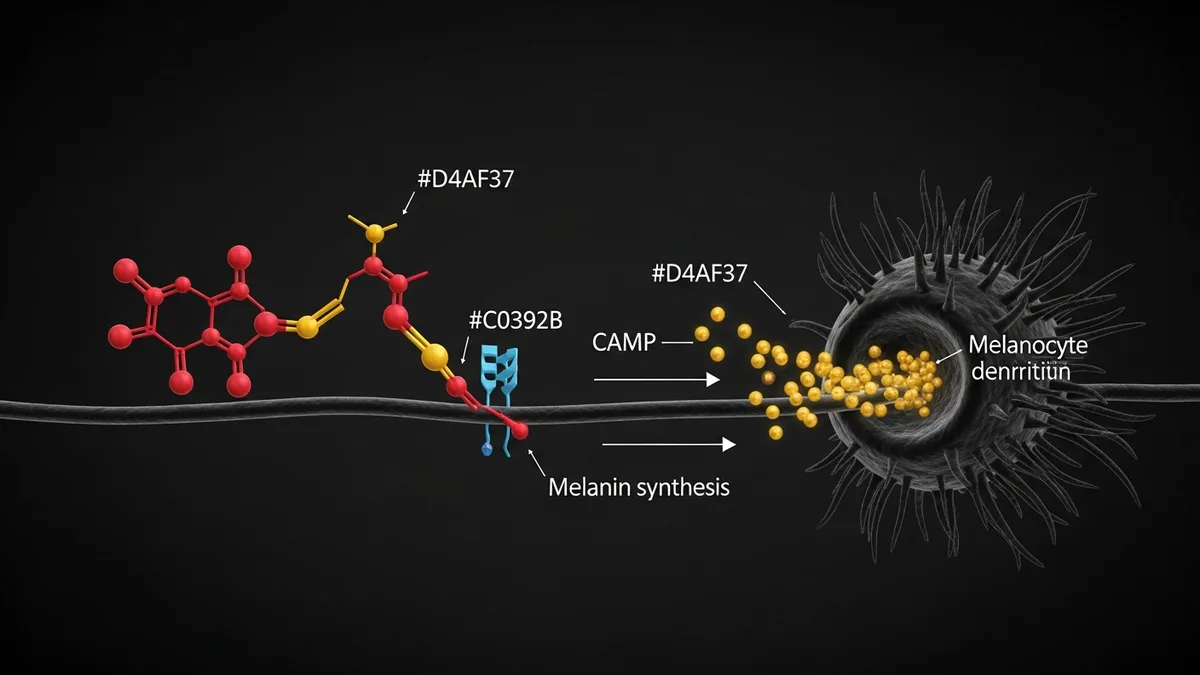
Melanotan II (MT-2) is a synthetic cyclic lactam analog of alpha-melanocyte-stimulating hormone (alpha-MSH), designed with a cyclization between residues 4 (D-Phe) and 10 (Lys) that increases metabolic stability and receptor binding potency compared to linear alpha-MSH. MT-2 non-selectively activates melanocortin receptors MC1R through MC5R, making it a broad pharmacological tool for studying the melanocortin system. Research applications include MC1R-mediated melanogenesis in skin biology models, MC4R-mediated central nervous system signaling for energy homeostasis and sexual function research, and structure-activity relationship studies for developing selective melanocortin subtype agonists. MT-2 is also the parent compound from which PT-141 (bremelanotide) was derived by chemical modification.
- Hadley ME and Dorr RT (2006) reviewed MT-2 pharmacology across melanocortin receptor subtypes, establishing MC1R affinity for skin pigmentation and MC4R for central energy and sexual behavior research. (PMID 16412547)
- Wikberg JE (1999) characterized the five melanocortin receptor subtypes and their tissue distribution, providing the pharmacological framework for understanding MT-2 effects across MC1R (melanocytes), MC3R/MC4R (hypothalamus), and MC5R (exocrine glands). (PMID 9920361)
- MC4R knockout mouse research shows MC4R-null mice develop obesity and hyperphagia, establishing MC4R as a central energy regulator studied using melanocortin agonists including MT-2.
- MT-2 exhibits approximately 12-fold higher potency and longer half-life than linear alpha-MSH due to its cyclic lactam constraint and D-Phe substitution that resist enzymatic degradation.
- Melanin production research in B16 mouse melanoma and primary human melanocyte models shows MC1R-mediated melanogenesis within 24-48 hours of MT-2 administration.
Melanocortin Receptor System Overview
The melanocortin receptor family comprises five Gs-coupled GPCRs (MC1R-MC5R) with distinct tissue distributions. MC1R is expressed on melanocytes and mediates the switch from pheomelanin to eumelanin synthesis. MC2R is the ACTH receptor on adrenal cortex cells. MC3R is expressed in the brain and peripheral tissues with roles in energy balance and inflammation. MC4R is expressed in the central nervous system, particularly hypothalamus, regulating appetite, energy expenditure, and sexual function. MC5R is expressed in exocrine glands and regulates sebaceous secretion.
MT-2 activates MC1R, MC3R, MC4R, and MC5R with varying affinities, but does not activate MC2R. This receptor profile means MT-2 research is interpreted in the context of simultaneous multi-receptor activation unless selective antagonists are co-administered to isolate individual receptor contributions. Researchers designing MC4R-specific experiments co-administer selective MC1R antagonists (agouti peptide fragments) to prevent confounding melanogenic effects.
MC1R Signaling and Melanogenesis Research
MC1R activation by MT-2 triggers a Gs-cAMP-PKA signaling cascade in melanocytes that increases expression of melanogenic enzymes including tyrosinase, TRP-1, and TRP-2. These enzymes catalyze tyrosine to melanin precursor conversion and eumelanin polymerization. cAMP elevation activates microphthalmia-associated transcription factor (MITF), the master regulator of melanocyte differentiation and melanogenic gene expression.
Researchers use MT-2 in melanocyte cell line models (B16 mouse melanoma, MNT-1 human melanoma, primary human melanocytes) to study MC1R signaling and quantify melanin production. Melanin content is measured by NaOH dissolution assay or spectrophotometry at 405-475 nm. MT-2 dose-response studies establish the EC50 for melanogenesis, and structure-activity research using MT-2 analogs identifies receptor-binding residues critical for MC1R selectivity.

MC4R Signaling: Central Nervous System Research
MC4R activation in the hypothalamus is a central area of MT-2 research distinct from peripheral melanogenesis. Hypothalamic MC4R activation reduces food intake (anorexigenic effect) and increases energy expenditure through sympathetic nervous system signaling. Endogenous MC4R ligands are alpha-MSH (agonist) and agouti-related peptide (AgRP, inverse agonist), balancing pro-satiety and pro-hunger signals.
MC4R knockout models are obese and hyperphagic, establishing MC4R as a research target for obesity and metabolic research. MT-2 administration in diet-induced obesity rodent models reduces food intake and body weight when given centrally (i.c.v.) or peripherally at doses sufficient to penetrate the blood-brain barrier. Researchers studying the melanocortin obesity axis use MT-2 as a pharmacological probe to determine MC4R signaling capacity in obese versus lean animals.
MT-2 and PT-141 Comparison in Research
MT-2 is the parent compound from which PT-141 (bremelanotide) was derived. PT-141 incorporates a modification that prevents the cardiovascular side effects (transient blood pressure elevation) observed with MT-2, making PT-141 more suitable for reproductive health research. MT-2 retains broader melanocortin receptor activity useful for comparative pharmacology studies examining which receptor subtypes mediate specific effects. Spartan does not carry MT-2 itself, but researchers studying the same melanocortin receptor family can review the PT-141 product page above, or browse the sexual health research category for related compounds.
In sexual behavior research, both MT-2 and PT-141 activate hypothalamic MC4R pathways associated with pro-erectile and pro-receptive behavior in animal models. MT-2 research uses yawning (MC4R-mediated), penile erections (MC4R), and lordosis behavior (MC3R/MC4R) as behavioral endpoints. The broader receptor profile of MT-2 compared to PT-141 requires pharmacological controls to attribute specific behaviors to specific receptor subtypes.
Cyclic Peptide Structure and Research Implications
The cyclic lactam structure of MT-2 (cyclization between D-Phe4 and Lys7 in the core pharmacophore sequence His-D-Phe-Arg-Trp) limits peptide conformational flexibility, reducing entropy loss upon receptor binding and increasing affinity compared to linear analogs. The D-Phe substitution prevents dipeptidyl peptidase cleavage and extends plasma half-life from 1-2 minutes (linear alpha-MSH) to approximately 5-15 minutes.
Structure-activity relationship research using MT-2 has guided development of selective melanocortin receptor agonists and antagonists for individual subtypes. This research program is a major application of MT-2 as a reference compound in medicinal chemistry, with researchers designing analogs bearing receptor subtype-selective substitutions and comparing activity against MT-2 in binding and functional cAMP assays. Selective MC4R agonists derived from MT-2 analogs are studied for obesity and sexual dysfunction research applications.
Research Protocol Design for MT-2 Studies
MT-2 is administered by subcutaneous, intravenous, or intracerebroventricular (i.c.v.) injection in preclinical research. For peripheral studies measuring melanogenic endpoints, subcutaneous or tail vein injection is standard. For central MC4R studies, i.c.v. cannula placement allows direct CNS delivery, bypassing the blood-brain barrier (BBB) permeability limitations that may affect subcutaneous doses in rodent models.
Behavioral endpoints in MT-2 research include quantification of yawning episodes, stereotyped grooming patterns, food intake measurement by metabolic cage, and sexual behavior scoring. Melanogenesis endpoints include flank skin melanin content measured spectrophotometrically and melanocyte morphology by histology. Researchers studying the full spectrum of MT-2 effects typically measure multiple endpoints to characterize receptor subtype contributions in their specific animal model. For additional context on melanocortin research compounds, see the complete research peptides guide.
Melanotan II Pharmacokinetics and Receptor Selectivity Research
Melanotan II (MT-2) is a cyclic lactam analog of alpha-MSH, modified to enhance stability and receptor binding affinity compared to the linear endogenous peptide. The cyclization via a lactam bridge between the lysine and aspartate residues in the 4-10 core sequence confers resistance to proteolytic degradation and constrains the peptide backbone in a receptor-compatible conformation. Researchers use MT-2 as a high-affinity tool compound for studying melanocortin receptor pharmacology across MC1R, MC3R, MC4R, and MC5R subtypes.
Pharmacokinetic studies in rodent models have characterized MT-2 plasma half-life at approximately 1-2 hours following subcutaneous administration, significantly longer than the 15-minute half-life of linear alpha-MSH. Tissue distribution studies using radiolabeled MT-2 have documented accumulation in skin, hypothalamus, spinal cord, and peripheral nerve tissue, consistent with the receptor expression patterns of MC1R (melanocytes), MC4R (hypothalamic neurons), and MC3R (limbic and spinal tissue).
The lack of selectivity of MT-2 across multiple melanocortin receptor subtypes is a key consideration in research design. Studies using MC4R knockout mice have documented the loss of MT-2-induced penile erection responses, confirming that MC4R mediates this effect, while MC1R-null melanocytes show absent tanning responses to MT-2, confirming MC1R dependence for eumelanin synthesis. These genetic tool studies have helped dissect the receptor-specific contributions to MT-2’s diverse biological effects in research models.
Research comparing MT-2 to the more selective PT-141 compound reveals important structural-functional distinctions. PT-141 (bremelanotide) is a des-acyl analog of MT-2 that retains high MC3R and MC4R affinity while showing reduced MC1R activity, making it more selective for CNS melanocortin effects. This comparison has been valuable for delineating which pharmacological effects of MT-2 are attributable to central versus peripheral receptor activation. Investigators designing studies to isolate CNS melanocortin effects typically prefer PT-141-type compounds, while studies requiring combined pigmentation and CNS endpoint measurement use MT-2 for its broader receptor coverage.
Research into MT-2 and appetite regulation has examined its effects through MC4R-mediated suppression of food intake in rodent models. Studies using intracerebroventricular (ICV) and peripheral MT-2 administration designs have compared the anorexigenic potency of MT-2 to endogenous alpha-MSH and to selective MC4R agonists, contributing to the literature on melanocortin system participation in energy homeostasis research.
Explore research-grade melanocortin peptides and other compounds: Browse Spartan Peptides Research Catalog
Written by the Spartan Research Team
Our team of peptide researchers and biochemists reviews every article for scientific accuracy. Learn more about our team →