
Peptide Reconstitution and Dosing: A Complete Researcher’s Guide

Written bySpartan Research Team
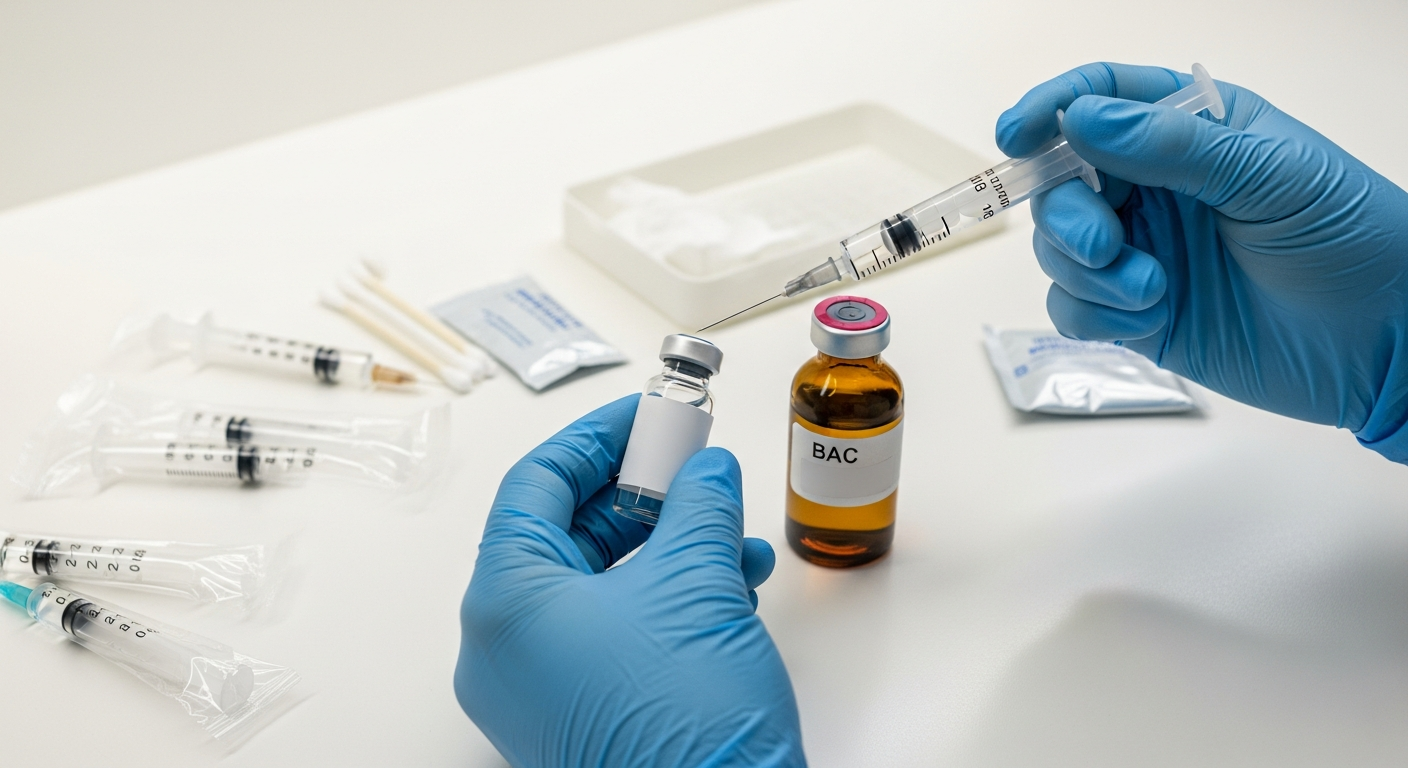
Accurate reconstitution is the foundation of reproducible peptide research. Whether you’re working with BPC-157, CJC-1295, GHK-Cu, or any lyophilized compound, the steps below form a standardized protocol that minimizes degradation risk and ensures consistent, measurable dosing across every experiment.
Key Research Findings
- Bacteriostatic water (0.9% benzyl alcohol) extends reconstituted peptide stability to 4–6 weeks when refrigerated
- Acetic acid (0.1–1%) improves solubility for water-resistant peptides; avoid vortex mixing — gentle swirl only
- Aliquot reconstituted peptides before freezing to eliminate repeated freeze-thaw cycles, which degrade structural integrity
- Dosing volume is calculated as: Volume (mL) = Desired dose (mg) ÷ Concentration (mg/mL)
What Is Peptide Reconstitution?
Lyophilized (freeze-dried) peptides are supplied as a white or off-white powder sealed under vacuum or inert gas. Reconstitution is the process of introducing a sterile solvent—most commonly Bacteriostatic Water (BAC water)—to dissolve the powder into an injectable solution. The resulting solution maintains peptide stability for weeks when stored correctly.
Why BAC Water for Peptides?
BAC water contains 0.9% benzyl alcohol as a preservative. This is critical for multi-use vials: benzyl alcohol prevents microbial growth, extending the usable shelf life of your reconstituted solution from hours (with plain sterile water) to 4–6 weeks (refrigerated). For research purposes, BAC water is the industry standard. See our detailed breakdown in the Peptide Reconstitution Calculator & BAC Water Guide for solvent selection criteria and mixing ratios by compound.
Step-by-Step Reconstitution Protocol
Materials Required
- Lyophilized peptide vial (e.g., 5 mg BPC-157)
- BAC water (bacteriostatic water for injection)
- Insulin syringes (U-100, 1 mL)
- Alcohol swabs (70% isopropyl)
- Clean, flat work surface
- Nitrile gloves
Procedure
- Sanitize everything. Wipe the rubber septum of both the peptide vial and BAC water vial with an alcohol swab. Allow to air-dry for 15 seconds before piercing.
- Calculate your BAC water volume. Determine the desired final concentration (see math section below), then draw that volume of BAC water into your insulin syringe.
- Inject slowly. Insert the needle at a slight angle through the rubber stopper of the peptide vial. Direct the stream of BAC water against the glass wall—never directly onto the lyophilized cake, which can shear peptide bonds.
- Do not shake. After adding the solvent, gently swirl or roll the vial between your palms until the powder is fully dissolved. Vigorous shaking denatures sensitive peptide structures.
- Inspect the solution. A properly reconstituted peptide solution should be clear and colorless (some copper peptides such as GHK-Cu may show a faint blue tint). Any particulate matter or cloudiness may indicate degradation or contamination—discard if in doubt.
- Label and date the vial. Record the reconstitution date, concentration, and compound name. Store immediately per guidelines below.
Reconstitution Math: mg to mcg Conversions
Getting the math right is non-negotiable. Here is the standard framework researchers use:
Core Formula
Concentration (mcg/mL) = Peptide mass (mcg) ÷ Volume of BAC water added (mL)
Since 1 mg = 1,000 mcg, a 5 mg vial contains 5,000 mcg total.
Example A — Standard 5 mg Vial
Goal: 500 mcg/mL concentration
Calculation: 5,000 mcg ÷ 500 mcg/mL = 10 mL BAC water
To draw 250 mcg: pull 0.5 mL on the syringe (the 50-unit mark on a U-100 insulin syringe).
Example B — 2 mg Vial at Higher Concentration
Goal: 1,000 mcg/mL (1 mg/mL)
Calculation: 2,000 mcg ÷ 1,000 mcg/mL = 2 mL BAC water
To draw 200 mcg: pull 0.2 mL (the 20-unit mark on a U-100 syringe).
Example C — 10 mg Vial for Dilute Dosing
Goal: 250 mcg/mL (useful when working with high-potency compounds)
Calculation: 10,000 mcg ÷ 250 mcg/mL = 40 mL BAC water (across multiple vials or a larger vessel)
To draw 100 mcg: pull 0.4 mL (40 units on a U-100 syringe).
Use our interactive reconstitution calculator to instantly compute volumes for any vial size and target concentration.
How to Read an Insulin Syringe
U-100 insulin syringes are calibrated in units based on insulin (100 units = 1 mL). For peptide research, treat units as a proxy for microliters:
- 10 units = 0.10 mL = 100 µL
- 20 units = 0.20 mL = 200 µL
- 50 units = 0.50 mL = 500 µL
- 100 units = 1.00 mL = 1,000 µL (full syringe)
For precision, use 0.3 mL (30-unit) or 0.5 mL (50-unit) syringes when working with small volumes. The shorter barrel reduces dead-space waste and improves graduation readability. Always draw slightly past your target volume, remove bubbles by tapping, then depress to the exact graduation line.
Storage Temperatures and Shelf Life
Lyophilized (Dry Powder) — Unreconstituted
- Short-term (up to 6 months): Refrigerate at 2–8°C, protected from light
- Long-term (up to 24 months): Freeze at −20°C in sealed vials; minimize freeze-thaw cycles
- Shipping: Most peptides tolerate ambient temperatures for 5–7 days in transit without significant degradation
Reconstituted Solution (BAC Water)
- Refrigerated (2–8°C): Stable for 4–6 weeks in most peptides
- Room temperature: Use within 24–48 hours; avoid prolonged ambient exposure
- Do not freeze reconstituted solutions unless the peptide’s datasheet specifically indicates freeze-stability post-reconstitution
Particularly heat-sensitive peptides (e.g., GLP-1(Sema), GLP-2(Tirz)) should be stored at the cold end of the 2–8°C range and shielded from UV light. Research on BPC-157 suggests it is among the more thermostable peptides, yet refrigerated storage is still recommended post-reconstitution to maintain batch-to-batch consistency.
Handling Tips to Preserve Peptide Integrity
- Minimize light exposure. UV radiation cleaves peptide bonds. Store vials in amber glass or opaque containers; work under indirect lighting.
- Avoid repeated needle punctures. Each puncture introduces a small contamination risk. Consider transferring the bulk reconstituted solution to a single-use aliquot series for multi-week protocols.
- Use the smallest effective syringe. Smaller dead volumes reduce waste and measurement error.
- Keep vials vertical in the refrigerator. Horizontal storage increases the surface area exposed to the septum interface, increasing oxidation risk over time.
- Do not mix peptides in the same vial unless specific co-solubility data is available for your combination. Cross-contamination can trigger aggregation.
- Track every draw. Maintain a lab log with draw date, volume, and calculated remaining quantity. Peptide concentration should be verified by your supplier’s CoA (Certificate of Analysis), which reports purity ≥98% by HPLC.
Quick-Reference Dosing Table
| Vial Size | BAC Water Added | Final Concentration | Volume per 250 mcg |
|---|---|---|---|
| 2 mg | 2 mL | 1,000 mcg/mL | 25 units (0.25 mL) |
| 5 mg | 5 mL | 1,000 mcg/mL | 25 units (0.25 mL) |
| 5 mg | 10 mL | 500 mcg/mL | 50 units (0.50 mL) |
| 10 mg | 10 mL | 1,000 mcg/mL | 25 units (0.25 mL) |
| 10 mg | 20 mL | 500 mcg/mL | 50 units (0.50 mL) |
Summary Checklist Before Each Research Session
- ☑ Verify peptide identity and lot number against CoA
- ☑ Confirm vial has not exceeded recommended reconstituted shelf life
- ☑ Sanitize all septa with fresh alcohol swab
- ☑ Recalculate concentration if volume was drawn since last session
- ☑ Inspect solution clarity before each draw
- ☑ Record draw in lab notebook
All content is intended for laboratory and academic research purposes only. Not for human consumption.
References
- PMID 27980598 — Stability of synthetic peptides in aqueous solution: effects of pH, temperature, and preservatives
- PMID 31126321 — Impact of freeze-thaw cycling on peptide integrity and biological activity in research preparations
- PMID 23458303 — Solubility optimization strategies for synthetic peptides in laboratory research applications
Written by the Spartan Research Team
Our team of peptide researchers and biochemists reviews every article for scientific accuracy. Learn more about our team →
Sourcing in bulk for your lab or institution?
Spartan Peptides offers wholesale access for research institutions, CROs, and licensed distributors. Minimum 50g per SKU or 2,000 units — every order ships with a third-party Certificate of Analysis.
Apply for Wholesale Access →