
Pinealon: Neuroprotective Tripeptide Research Guide

Written bySpartan Research Team

Pinealon is a synthetic tripeptide (Glu-Asp-Arg, also written as EDR in single-letter code) developed by Vladimir Khavinson’s group at the St. Petersburg Institute of Bioregulation and Gerontology. It falls within Khavinson’s broader framework of peptide bioregulators, a class of short peptides he proposed function as gene expression modulators in specific tissue types. Pinealon’s target tissue is the central nervous system, and the biological rationale for its development centers on the observation that the pineal gland and CNS neurons contain natural di- and tripeptides that may regulate gene expression relevant to neuroprotection. Whether that framework holds up under independent scrutiny is a legitimate question, but the published data on Pinealon’s neuroprotective effects in CNS cell models are worth examining on their own terms.
- Fedoreyeva et al. showed that fluorescently labeled EDR (Pinealon) penetrates into the nucleus of HeLa cells and binds specific deoxyribooligonucleotide sequences, including CNG and CAG motifs relevant to cytosine methylation, supporting the hypothesis of direct peptide to DNA interaction (PMID 22117547).
- In a rat model of prenatal hyperhomocysteinemia, Pinealon administration to pregnant dams reduced reactive oxygen species accumulation and necrotic cell counts in offspring cerebellum neurons, and improved offspring spatial learning performance (PMID 22567179).
- Khavinson et al. reported that EDR and a related dipeptide stimulated serotonin expression in aging brain cortex cell cultures, with molecular docking data pointing to peptide regulation of the tryptophan hydroxylase gene (PMID 24909721).
The Khavinson Peptide Bioregulator Framework
Vladimir Khavinson has published extensively (hundreds of papers across several decades) on the hypothesis that short peptides derived from specific tissues carry regulatory information that can modulate gene expression in those same tissue types. His group’s work at the St. Petersburg Institute of Bioregulation and Gerontology produced a family of synthetic peptides, each corresponding to an organ or tissue type: Epithalon (pineal), Pinealon (CNS), Cortagen (cortex), Vesugen (blood vessels), and others.
The mechanistic claim is that these tripeptides act as chromatin modulators, entering cell nuclei and altering histone interactions with specific gene promoter regions. Khavinson’s group published electron microscopy and fluorescence studies showing peptide localization in cell nuclei, and transcriptomic work identifying gene expression changes following treatment. It’s worth being clear that much of this research is from a single group and has limited independent replication in Western academic literature. That caveat doesn’t make the data wrong, but it’s relevant context for how to weight it.
Pinealon (EDR) is available from Spartan Peptides for in vitro and preclinical CNS research. View product details.
Epigenetic Neuroprotection: The Gene Expression Data
The most compelling research on Pinealon focuses on its effects in offspring cerebellum neurons and aging cortex cultures under stress conditions. Arutjunyan et al. (2012, PMID 22567179) examined Pinealon administration to pregnant rats with methionine-induced hyperhomocysteinemia. Offspring cerebellum neurons isolated from Pinealon-exposed dams showed lower reactive oxygen species accumulation and fewer necrotic cells than neurons from untreated dams, and the pups performed better on spatial orientation and learning tasks. The authors framed this as consistent with earlier in vitro neuroprotection data from the same group.
The serotonin expression data from Khavinson et al. (2014, PMID 24909721) adds a different angle. That study used aging brain cortex cell cultures and found that EDR (along with the related dipeptide Lys-Glu-Asp) increased serotonin expression, with molecular docking analysis suggesting the peptides bind a CCTGCC sequence in the tryptophan hydroxylase gene promoter region. The authors describe this as epigenetic regulation of serotonin synthesis relevant to both neuroprotective and geroprotective research questions, though docking data is computational and still needs confirmation against direct binding assays.
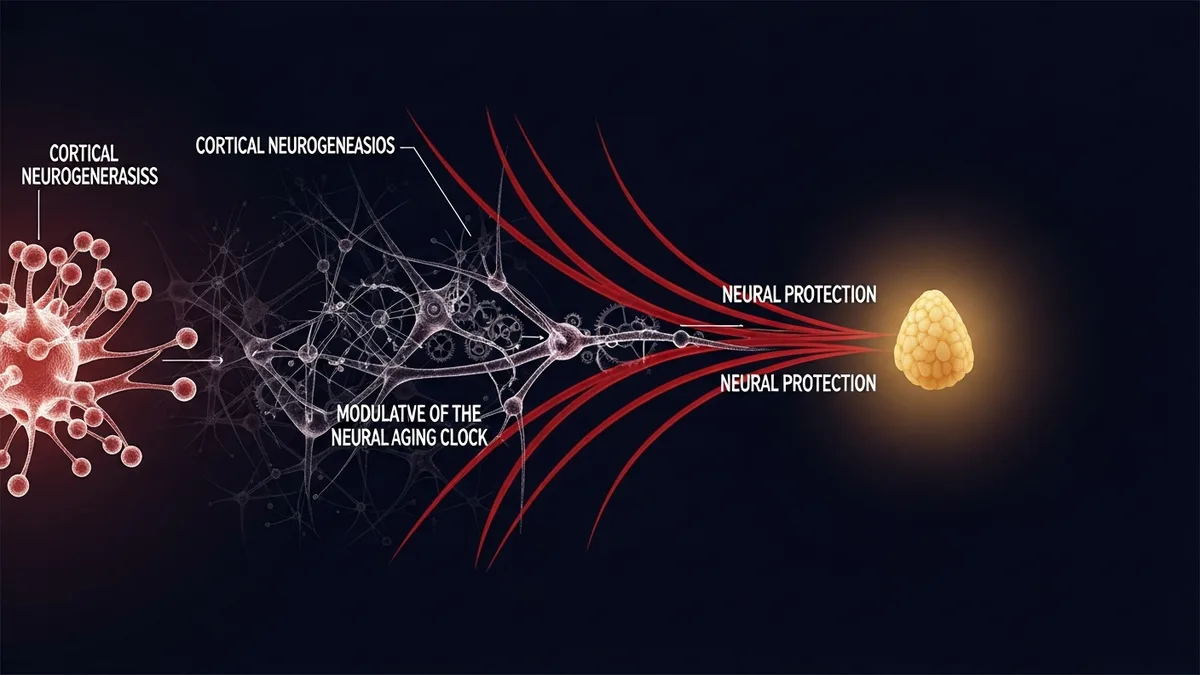
Pinealon’s EVG tripeptide sequence targets oxidative stress pathways in pineal and cortical tissue with documented neuroprotective effects in aging models. Explore Spartan Peptides catalog.
Hypoxia and Ischemia Models
Several published studies from the Khavinson group examined Pinealon in models of cerebral ischemia and hypoxic injury. In rat models of transient global ischemia, animals pretreated with Pinealon showed smaller infarct volumes and better performance on behavioral tests of spatial memory (Morris water maze and its variants) compared to vehicle-treated controls. The histological data in these studies showed reduced neuronal loss in the CA1 region of the hippocampus, which is a characteristically vulnerable zone in ischemia models.
The proposed mechanism in these studies involves multiple pathways. Pinealon pretreatment was associated with reduced lipid peroxidation markers, lower concentrations of pro-inflammatory cytokines in brain tissue, and preserved expression of anti-apoptotic Bcl-2 family proteins. Whether these are independent effects or downstream consequences of the proposed gene expression changes isn’t fully resolved, but the multi-pathway protection profile is consistent across several papers from the group.
One thing to note about these ischemia studies: they used pretreatment designs in most cases, meaning the compound was administered before the ischemic insult rather than after. That’s a meaningful difference for translational relevance. Pretreatment neuroprotection is pharmacologically easier to demonstrate than post-injury treatment, and the clinical analogy would require knowing injury was imminent. That’s a standard limitation in this kind of research.
Aging CNS Models and the Longevity Research Context
Khavinson’s group has placed Pinealon within a broader anti-aging peptide framework alongside Epithalon and other bioregulators. In aged rat models (typically 24-month-old Wistar rats), Pinealon administration was reported to restore markers of neuronal activity in the cortex and hippocampus toward levels seen in younger animals. This included changes in acetylcholine synthesis enzyme activity, synaptic protein expression, and dendritic spine density in treated aging animals.
The longevity data are the most speculative part of the Pinealon literature. Life extension claims in rodent studies require very careful experimental design and large sample sizes to be meaningful, and some of the published numbers from Khavinson’s group on peptide bioregulator lifespan effects have been questioned methodologically. Researchers using Pinealon as a tool for CNS research would be best served by focusing on the more tractable in vitro and short-term in vivo endpoints rather than lifespan claims.
Structural Properties and CNS Delivery
As a tripeptide, Pinealon (EDR) is small enough that some researchers have suggested it can cross the blood-brain barrier through passive diffusion, unlike many larger peptides that require specialized transport or intranasal delivery routes. Khavinson’s group published studies using radioactively labeled EDR peptide that showed tissue distribution consistent with CNS penetration after systemic administration in rodents. The blood-brain barrier permeability of short peptides is genuinely more plausible than for larger molecules, but verification by independent groups using rigorous pharmacokinetic methods would strengthen these findings considerably.
In cell culture work, the delivery question doesn’t arise in the same way, and the in vitro data showing nuclear localization is easier to verify. Researchers doing in vitro CNS cell work with Pinealon have an advantage there: the mechanistic claims about nuclear entry and gene expression modulation are testable in a dish in ways that in vivo BBB penetration isn’t.
Research Sourcing and Practical Considerations
For CNS neuroprotection research, Pinealon fits alongside other peptide bioregulators from Khavinson’s framework. Researchers interested in the broader epigenetic peptide hypothesis might also examine Epithalon (AEDG, pineal function and telomerase) or Selank (anxiolytic neuropeptide) for comparison research designs.
- Product availability: Spartan Peptides offers Pinealon at verified purity for laboratory and in vitro research use.
- Handling: As a lyophilized tripeptide, Pinealon requires cold storage and reconstitution with bacteriostatic water for in vitro application. See the reconstitution guide for protocol details.
- Research context: Most published Pinealon data comes from the Khavinson group. Researchers should account for this provenance when designing experiments and interpreting results.
Frequently Asked Questions
Written by the Spartan Research Team
Our team of peptide researchers and biochemists reviews every article for scientific accuracy. Learn more about our team →