
Research Peptides vs Research Chemicals: Understanding the Difference

Written bySpartan Research Team
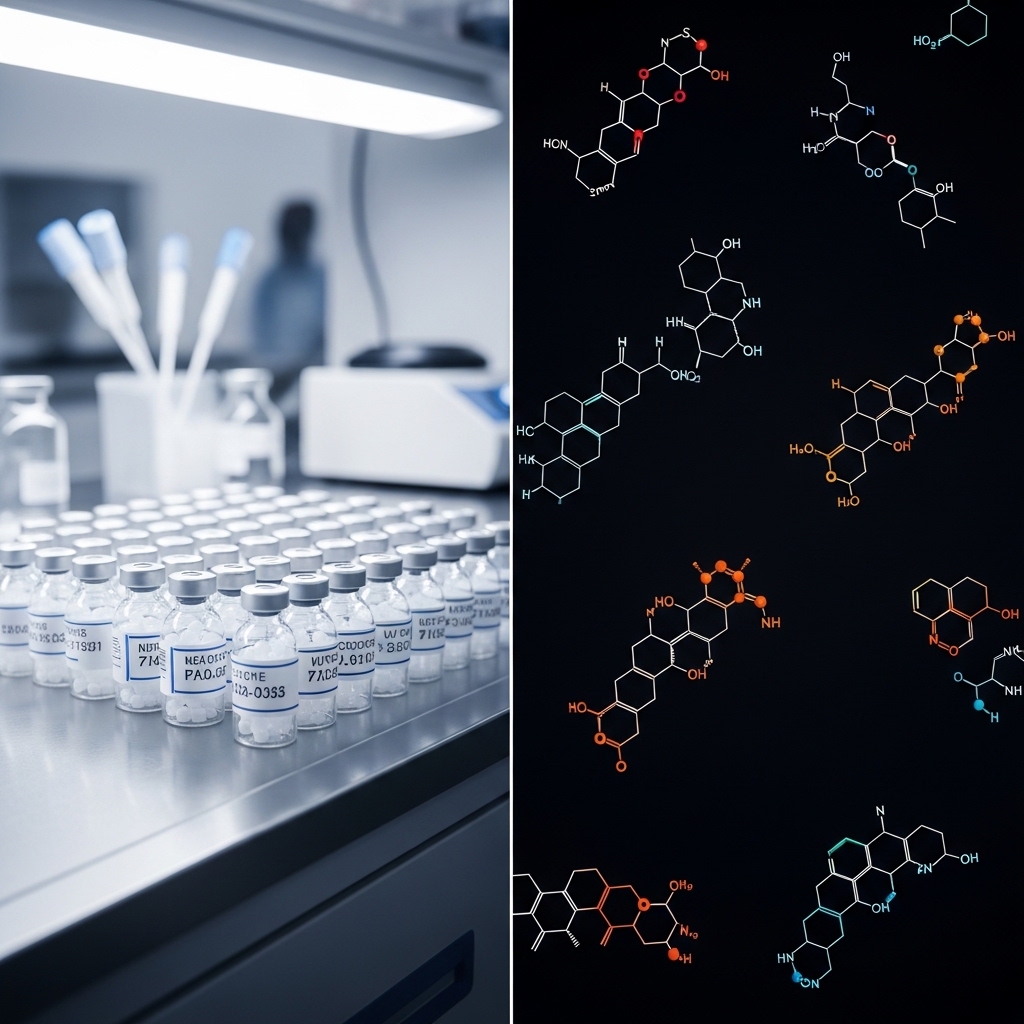
The terms research peptides and research chemicals are frequently used interchangeably in online scientific communities — yet they describe fundamentally different categories of compounds. Understanding this distinction is not merely semantic. It has direct implications for experimental design, quality verification, regulatory status, and the reliability of published data. This article provides a clear, science-grounded comparison of the two categories.
Defining Research Chemicals
In broad scientific usage, the term research chemical refers to any synthetic psychoactive or bioactive small molecule that has not yet been approved for clinical or consumer use and is being studied primarily for its pharmacological properties. These compounds are typically characterized by:
- Low molecular weight — generally below 500 Daltons (adhering loosely to Lipinski’s Rule of Five for oral bioavailability)
- Synthetic small-molecule architecture — carbon-based ring systems, heterocyclic scaffolds, and functional group additions that are not derived from natural amino acid sequences
- Novel or analog structures — often designed as structural analogues of controlled substances or approved drugs, intended to probe receptor pharmacology
- Oral or transdermal absorption potential — due to their small size and lipophilicity
Research chemicals encompass an extremely diverse range of compound classes: phenethylamines, tryptamines, cathinones, cannabinoids, benzodiazepine analogues, and designer stimulants, among others. Their synthesis typically follows organic chemistry pathways rather than biotechnological or peptide-chemistry methods.
Defining Research Peptides
A peptide is a polymer of amino acids joined by peptide (amide) bonds. Research peptides are laboratory-synthesized amino acid chains — typically ranging from dipeptides (2 residues) to larger sequences of 40–50 residues — designed to replicate, modulate, or study the function of endogenous signaling peptides found in biological systems.
Key structural characteristics of research peptides include:
- Amino acid backbone — the chain is built from the same 20 standard amino acids (or occasionally non-standard/D-amino acid variants) that constitute all natural proteins
- Higher molecular weight — most research peptides range from ~500 Da (dipeptides) to ~5,000 Da or more for longer sequences
- Hydrophilicity and enzymatic susceptibility — unlike most small-molecule research chemicals, peptides are generally water-soluble and subject to proteolytic degradation
- Biological specificity — peptides often bind to specific receptors, enzymes, or transport proteins with high affinity, reflecting their natural origins
Prominent examples in the research literature include tissue-repair sequences such as BPC-157 (a 15-amino acid gastric pentadecapeptide), copper-binding tripeptides such as GHK-Cu, growth hormone secretagogues, melanocortin peptides, and GLP-1 receptor agonist analogues (referred to in some research contexts as GLP-1(Sema) class compounds).
Structural Differences: A Side-by-Side Comparison
| Property | Research Peptides | Research Chemicals |
|---|---|---|
| Structural basis | Amino acid chains | Synthetic small molecules |
| Molecular weight | ~500–5,000+ Da | Typically <500 Da |
| Synthesis method | Solid-phase peptide synthesis (SPPS) | Organic chemical synthesis |
| Biological origin | Natural analogues / endogenous sequences | Novel synthetic scaffolds |
| Metabolic fate | Proteolytic degradation to amino acids | Hepatic/renal metabolism, variable |
| Route of administration (research) | Typically parenteral (subcutaneous/IV) | Variable (oral, intranasal, etc.) |
Regulatory Considerations
The regulatory status of research peptides and research chemicals diverges significantly across jurisdictions, and researchers must stay current with applicable law.
Many classical research chemicals — particularly those that are structural analogues of controlled substances — fall under analog acts or blanket bans in jurisdictions such as the United States, United Kingdom, and the European Union. The U.S. Federal Analogue Act (21 U.S.C. § 813), for example, treats substances “substantially similar” to Schedule I or II compounds as Schedule I when intended for human consumption. This creates a complex, often ambiguous legal environment for research purposes.
Research peptides, as a class, generally occupy a different regulatory space. Most peptides are not scheduled under the Controlled Substances Act. However, this does not mean they exist in a complete regulatory vacuum:
- The FDA may regulate certain peptides as unapproved drugs if marketed with therapeutic claims
- The DEA has begun scheduling specific peptides on a case-by-case basis (e.g., certain melanocortin analogues)
- Several countries classify specific growth hormone-releasing peptides as prescription-only or banned substances in sports contexts
- Some GLP-1 receptor agonist peptide analogues may be subject to compounding pharmacy restrictions
Researchers are advised to consult the current regulatory landscape before beginning any peptide research program.
Quality Standards: Why Peptides Require Their Own Verification Protocols
One of the most critical distinctions between research peptides and small-molecule research chemicals lies in the quality verification process. Due to the structural complexity of peptides, standard analytical methods used for small molecules are insufficient on their own.
HPLC Purity Analysis
High-Performance Liquid Chromatography (HPLC) separates a peptide sample into its constituent components and quantifies each peak as a percentage of total area under the curve. A high-quality research peptide should demonstrate ≥98% purity by reverse-phase HPLC. Impurity peaks may represent:
- Deletion sequences (amino acids skipped during synthesis)
- Truncated sequences (synthesis termination before completion)
- Oxidized variants (particularly methionine, cysteine, and tryptophan residues)
- Racemized residues (D-amino acid incorporation)
- Residual protecting groups from SPPS chemistry
None of these impurities would be identified by simple melting point or NMR analysis alone — methods that may suffice for small-molecule research chemicals.
Mass Spectrometry Confirmation
Mass spectrometry (MS) — typically electrospray ionization (ESI-MS) or MALDI-TOF — provides the definitive molecular weight confirmation that the correct peptide sequence was synthesized. For a researcher, a Certificate of Analysis (CoA) bearing both an HPLC chromatogram and an MS spectrum provides two independent lines of evidence:
- HPLC confirms purity — minimal impurity peaks, high main peak area
- MS confirms identity — observed m/z matches the theoretical molecular weight of the target sequence
This dual-verification standard is not typically required for small-molecule research chemicals, where structural confirmation by NMR and GC-MS may be adequate. For peptides, the layered complexity of amino acid sequence, stereochemistry, and post-synthesis modification demands a higher analytical bar.
Researchers interested in evaluating peptide quality documentation should review the standards outlined in Understanding Peptide Purity: HPLC, MS, and Quality Markers Explained.
Sourcing Quality Differences
The sourcing landscape for research peptides and research chemicals differs substantially. Small-molecule research chemicals are often sourced from traditional organic chemistry supply chains and can be characterized by standard analytical methods available in most laboratory settings.
Research peptides, however, require specialized manufacturing infrastructure:
- Solid-Phase Peptide Synthesizers (SPPS) — automated instrumentation for sequential amino acid coupling
- HPLC purification systems — preparative-scale columns to isolate the target peptide from deletion and truncation by-products
- Lyophilizers — freeze-drying equipment to produce the stable, white lyophilized powder that constitutes most research peptide products
- Analytical laboratory capabilities — in-house or contracted HPLC and MS systems for lot-by-lot CoA generation
The capital and technical requirements for high-quality peptide production are substantially greater than for small-molecule synthesis, which is why the supply chain for research peptides is comparatively concentrated among fewer, more specialized vendors. For researchers, this underscores the importance of sourcing from vendors that provide full analytical documentation — including lot-specific CoAs — rather than treating peptides as commodity chemicals.
Why the Distinction Matters for Research Integrity
Conflating research peptides with research chemicals is not merely a nomenclature issue — it can undermine research integrity. The two categories carry different:
- Stability profiles — peptides require cold-chain storage and protection from freeze-thaw cycling; small molecules are often stable at room temperature
- Reconstitution protocols — lyophilized peptides must be reconstituted in bacteriostatic water or specific solvents; small molecules dissolve in DMSO or ethanol
- Dosing considerations — peptide biological activity depends on intact sequence integrity; degraded or impure peptides will produce unreliable experimental outputs
- Mechanism of action — peptides typically act via receptor binding or enzyme modulation using their natural amino acid geometry; small molecules may act via entirely different mechanisms
For any researcher designing in vitro or in vivo experiments, misidentifying a peptide as a generic research chemical — or failing to apply appropriate quality standards — risks producing non-reproducible data and potentially drawing erroneous conclusions.
Written by the Spartan Research Team
Our team of peptide researchers and biochemists reviews every article for scientific accuracy. Learn more about our team →