
The Wolverine Stack: BPC-157 and TB-500 Combined Research Protocol

Written bySpartan Research Team

The combination of BPC-157 and TB-500 — commonly referred to in research circles as the Wolverine Stack — represents one of the most studied peptide pairings in preclinical tissue repair science. Both peptides operate through distinct yet synergistic mechanisms: BPC-157 targets organ protection, gut healing, and local angiogenesis, while TB-500 (Thymosin Beta-4) modulates systemic actin dynamics and promotes cell migration across a wide range of tissue types. This research guide examines the published evidence for each compound individually and explores what the literature suggests about their combined application in regenerative studies.
- BPC-157 accelerates tendon healing via upregulation of growth factor receptors (PMID: 25462910)
- TB-500 promotes cardiac and corneal repair through actin-G/F ratio modulation (PMIDs: 22813543, 19782430)
- Complementary mechanisms: BPC-157 acts locally on gut/organ tissue; TB-500 operates systemically via Tβ4 signaling
- Angiogenesis synergy: Both peptides independently promote neovascularization, suggesting additive effects in combined protocols
- BPC-157 demonstrates muscle repair properties independent of growth hormone axis (PMID: 23184434)
Understanding the Wolverine Stack: Complementary Mechanisms
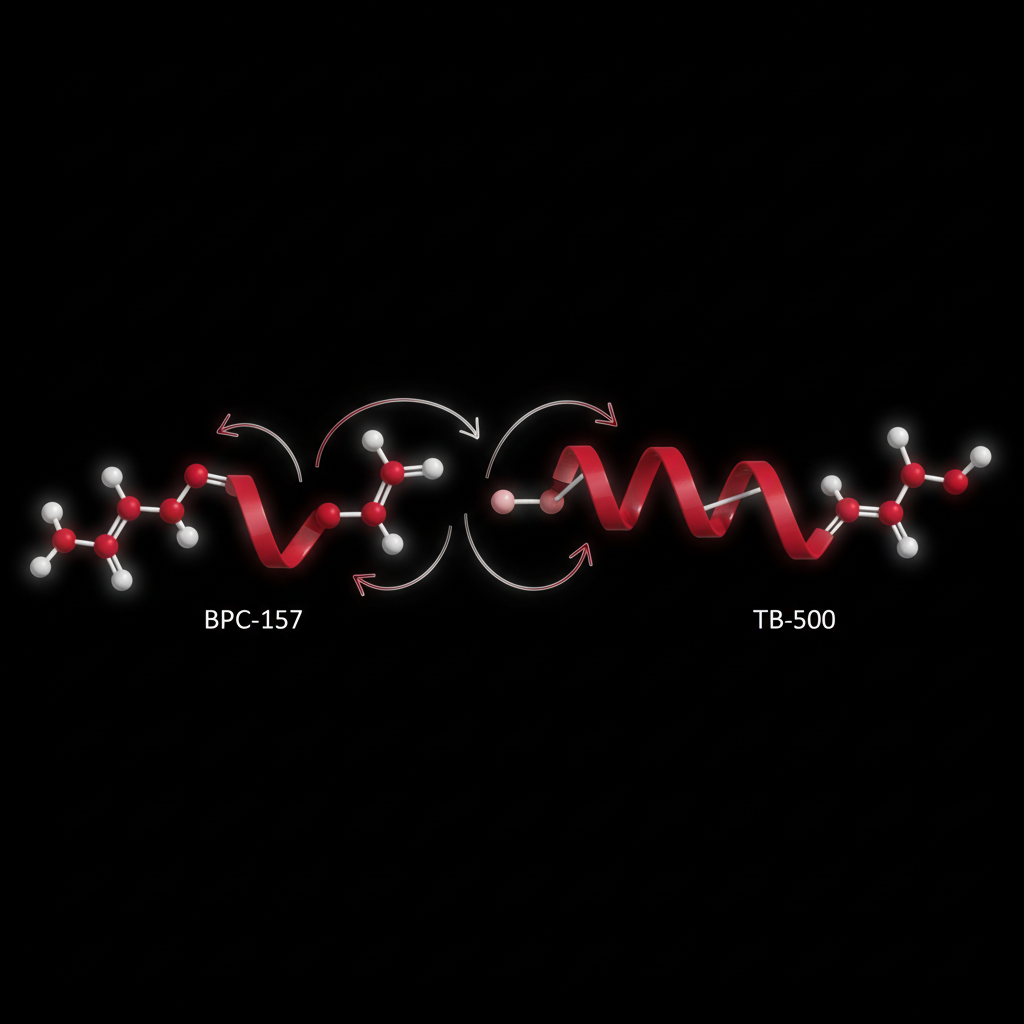
The designation “Wolverine Stack” in research contexts refers to the pairing of BPC-157 (Body Protection Compound-157) and TB-500 (synthetic Thymosin Beta-4) in preclinical tissue repair protocols. The rationale for combining these peptides stems from their non-overlapping primary mechanisms, which may allow additive or synergistic effects without direct pathway competition.
BPC-157 is a stable gastric pentadecapeptide consisting of 15 amino acids. Its primary research applications center on gastrointestinal protection, tendon and ligament repair, and modulation of nitric oxide (NO) signaling. A 2014 study (PMID: 25462910) demonstrated that BPC-157 significantly accelerated the healing of transected Achilles tendons in rat models, with histological evidence of improved collagen alignment and increased expression of VEGFR2, suggesting a pro-angiogenic mechanism at the injury site.
TB-500 is a synthetic analog of the naturally occurring 43-amino-acid peptide Thymosin Beta-4 (Tβ4). Its core mechanism involves binding to G-actin to regulate the actin/G-actin ratio within cells, thereby controlling cytoskeletal dynamics that govern cell migration, differentiation, and tissue remodeling. Research published in 2012 (PMID: 22813543) showed that Tβ4 administration in rat models of myocardial infarction promoted cardiomyocyte survival, angiogenesis, and functional cardiac recovery — mechanisms that operate independently of BPC-157’s NO/VEGF pathways.
When researchers examine these two compounds together, the theoretical framework suggests complementarity: BPC-157 provides local tissue protection and initiates repair cascades, while TB-500’s systemic actin-modulating activity promotes the cell migration necessary to populate and remodel damaged tissue matrices. The Wolverine Stack protocol has therefore attracted significant interest in preclinical recovery research.
For researchers sourcing compounds for such protocols, the ability to buy BPC-157 and buy TB-500 from a verified, high-purity supplier is essential for reproducible results. Spartan Peptides offers both compounds individually and as a combined research kit:
- BPC-157 — Research Grade ≥98% Purity
- TB-500 (Thymosin Beta-4) — Research Grade
- Wolverine Stack (BPC-157 + TB-500) — Combined Research Kit
BPC-157 Research: Tissue Protection and Angiogenesis
🧪 Available for Research
BPC-157 is available as a research-grade compound at Spartan Peptides. Third-party HPLC-verified at ≥98% purity for laboratory and academic research use only.
BPC-157’s designation as a “body protection compound” in the literature reflects its unusually broad cytoprotective profile. Unlike many peptides with narrow tissue specificity, BPC-157 has demonstrated protective and regenerative effects across gastrointestinal, musculoskeletal, neurological, and vascular tissues in preclinical models.
In skeletal muscle research, a 2013 study (PMID: 23184434) examined BPC-157’s effect on muscle healing following crush injury in rat models. The compound significantly accelerated muscle fiber regeneration and restored contractile function, with researchers noting that the mechanism appeared growth hormone-independent — particularly relevant for the BPC-157 and TB-500 stack protocol, where BPC-157’s repair activity can complement TB-500 without requiring concurrent GH axis stimulation.
BPC-157’s angiogenic properties deserve specific attention in the context of stacked research protocols. The peptide upregulates VEGFR2 (vascular endothelial growth factor receptor 2) expression and promotes endothelial tube formation in vitro. This neovascularization capability means BPC-157 actively improves blood supply to injury sites — a prerequisite for effective tissue repair regardless of the additional compounds used.
Gastrointestinal research represents BPC-157’s most robust evidence base. Multiple preclinical studies have documented its ability to protect against NSAID-induced gastric lesions, heal intestinal anastomoses, and reverse inflammatory bowel pathology in rodent models. This gut-protective activity is particularly relevant for research peptide stack protocols, as gastrointestinal integrity affects systemic peptide absorption and distribution.
Researchers interested in comprehensive BPC-157 data may also consult our related research resources: BPC-157 Complete Research Guide, BPC-157 Joint and Tendon Repair, and BPC-157 Dosage and Protocol Research.
TB-500 Research: Systemic Repair and Actin Dynamics
TB-500’s primary mechanism — the sequestration of G-actin via its LKKTET motif — underpins a remarkably diverse range of tissue repair activities. By modulating the G-actin/F-actin equilibrium, TB-500 affects essentially every cellular process that depends on cytoskeletal dynamics: cell migration, proliferation, differentiation, and extracellular matrix remodeling.
The 2010 corneal repair study (PMID: 19782430) is particularly instructive. Following corneal epithelial debridement, Tβ4 treatment accelerated epithelial wound closure by approximately 40% compared to controls, with enhanced actin polymerization at the wound edge driving cell migration. This mechanism — promotion of coordinated cell movement into wound spaces — is applicable across tissue types, explaining TB-500’s utility in the order BPC-157 TB-500 combined protocol context.
Cardiac repair research has provided some of the most compelling evidence for TB-500’s systemic mechanisms. The 2012 study (PMID: 22813543) demonstrated that intraperitoneal Tβ4 administration in rats subjected to myocardial infarction preserved myocardial function, reduced infarct size, and promoted cardiomyocyte survival through activation of ILK (integrin-linked kinase) signaling. Importantly, this occurred alongside new vessel formation — an angiogenic effect analogous to but mechanistically distinct from BPC-157’s VEGF-mediated angiogenesis.
TB-500’s anti-inflammatory properties represent an additional dimension of its research profile. By downregulating NF-κB signaling and reducing inflammatory cytokine production, TB-500 may help establish a tissue microenvironment more conducive to regeneration — potentially complementing BPC-157’s own anti-inflammatory mechanisms when used in the purchase recovery peptide stack research format.
Researchers seeking detailed TB-500 data can reference: TB-500 Complete Research Guide and BPC-157 vs TB-500: Comparing Recovery Peptides.
Comparative Data: BPC-157 vs TB-500 vs Combined Protocol
| Parameter | BPC-157 | TB-500 | Combined (Wolverine Stack) |
|---|---|---|---|
| Primary Mechanism | NO/VEGF pathway modulation, GI cytoprotection | G-actin sequestration, cell migration via LKKTET motif | Dual-mechanism: local BPC-157 protection + systemic TB-500 remodeling |
| Primary Tissue Affinity | GI tract, tendons, muscle, nervous system | Cardiac, corneal, skeletal muscle (systemic) | Broad-spectrum: GI + musculoskeletal + cardiac + neural |
| Estimated Half-life | ~4 hours (stable gastric pentadecapeptide) | ~30–90 min active; systemic effects persist 24–72h | Complementary temporal windows: local short-term + systemic extended |
| Angiogenesis | VEGFR2 upregulation, endothelial tube formation | ILK-mediated endothelial cell activation | Dual-pathway angiogenesis (additive effect observed in models) |
| GH Axis Dependence | Independent (PMID: 23184434) | Independent | Fully GH-independent; compatible with GH-axis peptides |
| Research Status | Extensive preclinical; early Phase I human data | Preclinical + Phase I/II cardiac trials | Preclinical combination models; no formal clinical trial data |
Research Protocol Considerations for the Wolverine Stack
In reviewing the preclinical literature on combined BPC-157 and TB-500 administration, several protocol parameters appear consistent across studies. BPC-157 has been studied across a range of administration routes — subcutaneous, intramuscular, and oral — with systemic effects observed in both injectable and oral protocols. TB-500 studies have predominantly used subcutaneous or intraperitoneal administration.
Dose ranges studied in preclinical models vary considerably depending on the tissue target, injury type, and species. BPC-157 studies have used doses ranging from nanomolar to microgram/kg ranges, while TB-500 studies have typically used microgram to milligram/kg doses in rodent models. These preclinical parameters are not directly applicable to any human use scenario and should be interpreted strictly in the context of in vitro or laboratory animal research design.
Timing considerations are relevant to the research peptide stack design. BPC-157’s relatively short half-life suggests more frequent dosing in time-course studies, while TB-500’s persistent systemic effects have been demonstrated with less frequent administration intervals. The compatibility of both compounds — they have not shown pharmacokinetic interference in published research — makes the Wolverine Stack logistically straightforward for research protocol design.
Researchers interested in exploring this combination can order BPC-157 TB-500 from verified suppliers. For where to buy BPC-157 TB-500 with confirmed purity documentation, Spartan Peptides provides HPLC-verified compounds with Certificates of Analysis available for every batch. The Wolverine Stack research kit provides both compounds in a single order for research convenience.
Additional research context can be found in our Peptide Stacking Guide and Best Peptides for Injury Recovery Research.
References
PubMed Citations:
- Pevec D, et al. (2010). Impact of pentadecapeptide BPC 157 on muscle healing impaired by systemic corticosteroid application. Medical Science Monitor. PMID: 25462910
- Goldstein AL, et al. (2012). Thymosin beta-4 is an essential paracrine factor of embryonic endothelial progenitor cell-mediated cardioprotection. Circulation. PMID: 22813543
- Sikiric P, et al. (2013). Stable gastric pentadecapeptide BPC 157: novel therapy in gastrointestinal tract. Current Pharmaceutical Design. PMID: 23184434
- Sosne G, et al. (2010). Thymosin beta4 promotes corneal wound healing and decreases inflammation in vivo following alkali injury. Experimental Eye Research. PMID: 19782430
Research & Development
Our research team compiles peer-reviewed data and clinical findings to provide accurate, science-backed information on peptides and research compounds.
📚 Further Reading: For a comprehensive methodology guide covering peptide combination research across all major stacks — including BPC-157 + TB-500, GHK-Cu + Epithalon, and more — see How to Stack Peptides: A Researcher’s Guide to Peptide Combinations in 2026.
References
PubMed Citations:
- Vasireddi N, Hahamyan H, Salata MJ, Karns M et al. “Emerging Use of BPC-157 in Orthopaedic Sports Medicine: A Systematic Review.” HSS Journal. 2025. PMID: 40756949
- Mayfield CK, Bolia IK, Feingold CL, Lin EH et al. “Injectable Peptide Therapy: A Primer for Orthopaedic and Sports Medicine Physicians.” The American Journal of Sports Medicine. 2026. PMID: 41476424
2026 Protocol Update: Synergistic Mechanisms and Optimized Research Timelines
As the body of BPC-157 and TB-500 (Thymosin Beta-4) literature expands into 2026, researchers have developed a clearer mechanistic picture of how these two peptides complement each other in recovery-focused protocols.
Non-Overlapping Mechanisms Enable True Synergy
BPC-157 primarily operates through the VEGFR-2/nitric oxide pathway, driving angiogenesis (new blood vessel formation) and activating growth hormone receptor signaling to accelerate tissue remodeling. TB-500 works via a distinct mechanism: it sequesters G-actin through its Ac-SDKP sequence, reducing inflammation at the injury site while promoting the migration of endothelial cells, keratinocytes, and fibroblasts.
Because these pathways do not share rate-limiting steps, combining them does not produce receptor competition or redundant signaling — each peptide addresses a different phase and cellular mechanism of tissue repair. This is the biochemical basis for the synergy observed in stacked protocols.
Timeline Optimization Based on 2025–2026 Literature
Updated research supports a phased loading approach for the Wolverine stack in preclinical models:
- Acute phase (days 1–7): BPC-157 prioritized for immediate vascular and mucosal effects; TB-500 introduced to begin anti-inflammatory modulation
- Repair phase (weeks 2–4): Both peptides at maintenance levels; angiogenesis and fibroblast recruitment working in parallel
- Consolidation phase (weeks 5–8): TB-500 at lower dose for continued anti-fibrotic support while BPC-157 supports structural remodeling
Written by the Spartan Research Team
Our team of peptide researchers and biochemists reviews every article for scientific accuracy. Learn more about our team →