GHK-Cu (copper tripeptide-1, glycyl-L-histidyl-L-lysine) is a naturally occurring tripeptide-copper complex studied for tissue repair, collagen synthesis, wound healing acceleration, and gene expression modulation. Documented in preclinical research for fibroblast activity, extracellular matrix remodeling, and neuroprotective effects. For laboratory and in-vitro research use only.
Key Research Findings
- Collagen upregulation: GHK-Cu stimulates collagen I, III, and VI synthesis in fibroblast cultures, a well-replicated mechanism across dermal matrix and skin repair research.
- Wound healing: Preclinical models show faster wound closure via increased fibroblast proliferation, angiogenesis, and matrix metalloproteinase regulation consistent with normal tissue remodeling.
- Gene expression breadth: Pickart and Margolina (2018) documented GHK-Cu modulation of 4,000+ genes covering inflammation, oxidative stress, and tissue repair pathways. (PMID: 30101257)
- Neuroprotection: GHK-Cu upregulates nerve growth factor (NGF) and shows antioxidant activity in neural oxidative stress models, expanding its research relevance beyond dermatology.
Product Specifications
| Purity |
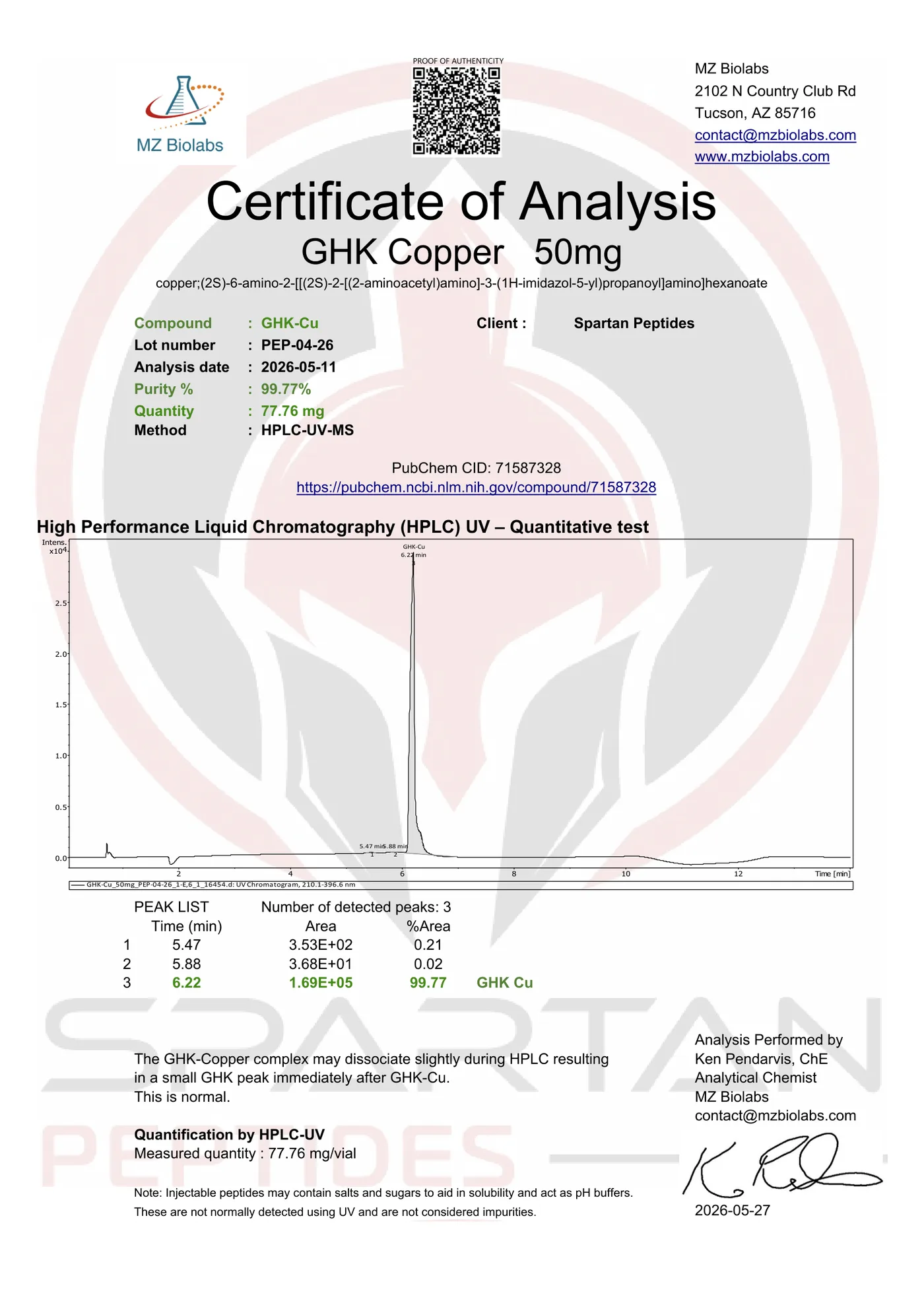
>=98% (HPLC-verified) |
| Format |
Lyophilized powder |
| Amount per vial |
50 mg |
| CAS Number |
89030-95-5 (GHK-Cu complex) |
| Sequence |
Glycyl-L-Histidyl-L-Lysine (Gly-His-Lys) |
| Storage |
-20 degrees C, protect from light and moisture |
| Stability |
24 months lyophilized; 7 days reconstituted at 4 degrees C |
| Certificate of Analysis |
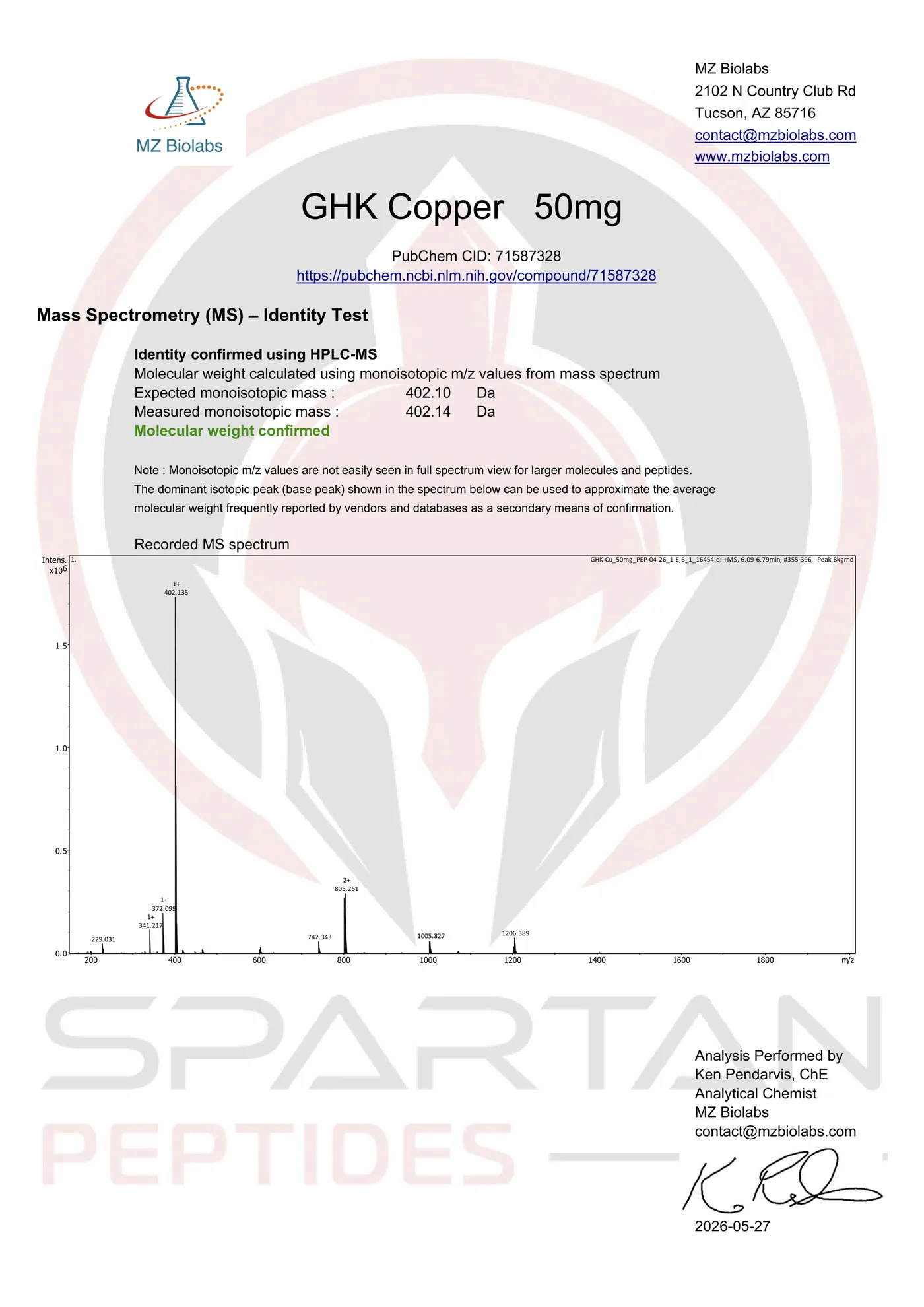
View batch COA (MZ Biolabs) |
What Makes GHK-Cu Distinct in Peptide Research
It's not just the peptide sequence. The copper chelation is what drives the biology. GHK-Cu carries a Cu(II) ion that participates directly in enzymatic pathways, including lysyl oxidase activity tied to collagen crosslinking, and copper-zinc superoxide dismutase function in antioxidant defense. Strip the copper, and you lose most of the compound's documented activity. That's why researchers specify GHK-Cu specifically, not a generic tripeptide.
The Pickart and Margolina (2018) finding of 4,000+ gene modulations is what separates GHK-Cu from most other research peptides. Most compounds have a defined target pathway. This one appears to recalibrate aging-associated gene expression patterns more broadly, which is why it shows up across wound biology, dermatology, and neuroprotection research. Whether that breadth reflects a central regulatory role or multiple independent mechanisms is still an open question.
In stacking research, GHK-Cu pairs frequently with BPC-157 and Epithalon. BPC-157 primarily signals cytoprotection and angiogenesis through growth hormone receptor and nitric oxide pathways. GHK-Cu signals tissue maintenance and matrix remodeling via fibroblast recruitment and MMP modulation. The mechanisms are complementary rather than redundant, which is the logic behind their co-investigation in tissue repair models.
Third-Party Purity Verification
Each batch of Spartan Peptides GHK-Cu is tested by MZ Biolabs, an independent third-party analytical laboratory. Testing confirms HPLC purity at or above 98%, compound identity, and absence of major contaminants.
View the batch COA
Research Areas
Wound Healing and Tissue Repair
Multiple preclinical studies have examined GHK-Cu's role in wound healing. In rabbit wound models, the complex demonstrated accelerated healing compared to zinc oxide and other control compounds. Burns research indicated potential healing rate increases of up to 33% in relevant preclinical models. Research in diabetic ulcer models further suggested GHK-Cu may outperform untreated controls.
Collagen Synthesis and Extracellular Matrix
In vitro studies have explored GHK-Cu's influence on fibroblast activity. Research has examined its potential to stimulate collagen and decorin synthesis, support extracellular matrix remodeling, and modulate metalloproteinase activity. These enzymes are central to matrix breakdown and tissue restructuring in wound biology.
Skin Barrier and Dermal Research
GHK-Cu has been studied for potential effects on epidermal thickness, skin barrier function restoration, and dermal density. Topical and in vitro models have investigated changes in skin glycosaminoglycan levels, elastin production, and keratinocyte activity.
Anti-Inflammatory and Antioxidant Mechanisms
Research has examined GHK-Cu's antioxidant and anti-inflammatory properties. Studies have explored its capacity to modulate cytokine expression, reduce oxidative stress markers in cell culture systems, and interact with NF-kB signaling pathways involved in inflammation.
Angiogenesis and Immune Cell Recruitment
GHK-Cu's proposed mechanism involves the recruitment of macrophages and other immune cells to injury sites, along with promotion of angiogenesis. These activities are thought to underlie improvements observed in preclinical wound healing models.
Hair Follicle Research
Several studies have investigated GHK-Cu's potential effects on hair follicle biology, including follicular enlargement and stimulation of hair growth in preclinical models. Research has examined interactions with scalp fibroblast activity and follicular keratinocytes.
Gene Expression Modulation
GHK-Cu has been shown in research settings to modulate expression of over 4,000 human genes, with particular focus on pathways related to tissue remodeling, antioxidant defense, and inflammation resolution. These findings position it as a subject of broad interest in systems biology and peptide research.
Frequently Asked Questions
What is GHK-Cu used for in research?
GHK-Cu is investigated in preclinical research for tissue repair, collagen synthesis, wound healing acceleration, antioxidant defense, and gene expression modulation. Its documented role in fibroblast activity and extracellular matrix remodeling makes it a frequently referenced compound in dermatology, wound biology, and longevity research models.
What purity should research-grade GHK-Cu be?
Research-grade GHK-Cu should be verified at 98% or higher by HPLC. Lot-specific certificate of analysis documentation from an independent laboratory is the verification standard for controlled research use. Batch-level claims without lot-specific data are not sufficient for fibroblast assays or gene expression studies where compound integrity is a study variable.
How is GHK-Cu reconstituted for laboratory use?
Add sterile water or bacteriostatic water slowly down the vial wall and swirl gently to dissolve. Don't vortex. Mechanical shearing degrades the peptide-copper complex. Reconstituted solutions should be aliquoted and stored at -20 degrees C in single-use portions to minimize freeze-thaw cycles. Use within 7 days when stored at 4 degrees C after reconstitution.
What does GHK-Cu stack with in research protocols?
GHK-Cu is co-investigated with BPC-157 in tissue repair models due to complementary mechanisms: BPC-157 signals cytoprotection and angiogenesis, while GHK-Cu signals matrix remodeling and fibroblast recruitment. It also appears in longevity research stacks alongside Epithalon. TB-500 is another common co-compound in recovery-focused research protocols.
Is GHK-Cu the same as copper peptide?
Yes, the terms are used interchangeably. GHK-Cu refers specifically to glycyl-L-histidyl-L-lysine chelated with a Cu(II) ion. The copper chelation is required for bioactivity. Not all copper-containing peptides are GHK-Cu, so researchers should confirm the specific compound and copper-binding status when sourcing for studies that depend on the GHK carrier system.
Scientific References
- Pickart L, Vasquez-Soltero JM, Margolina A. GHK Peptide as a Natural Modulator of Multiple Cellular Pathways in Skin Regeneration. Biomed Res Int. 2015;2015:648108. PubMed
- Pickart L. The human tri-peptide GHK and tissue remodeling. J Biomater Sci Polym Ed. 2008;19(8):969-88. PubMed
- Choi HR, Kang YA, Ryoo SJ, et al. Stem cell recovering effect of copper-free GHK in skin. J Pept Sci. 2012;18(11):685-90. PubMed
- Arul V, Gopinath D, Gomathi K, Jayakumar R. Biotinylated GHK peptide incorporated collagenous matrix: A novel biomaterial for dermal wound healing in rats. J Biomed Mater Res B Appl Biomater. 2005;73(2):383-91. PubMed
- Pickart L, Margolina A. Regenerative and Protective Actions of the GHK-Cu Peptide in the Light of the New Gene Data. Int J Mol Sci. 2018;19(7):1987. PubMed
Research Use Only. This product is intended exclusively for laboratory and in vitro research purposes. It is not intended for human or veterinary use, consumption, injection, or any therapeutic application. This product has not been evaluated or approved by the Food and Drug Administration. Spartan Peptides makes no claims regarding safety, efficacy, or suitability of this compound outside of controlled laboratory research. All handling must comply with applicable institutional and governmental regulations. Researchers are solely responsible for ensuring compliance with all applicable guidelines.