
CJC-1295 and Ipamorelin Blend: Two Peptides, Two Receptors, One Vial

Written bySpartan Research Team
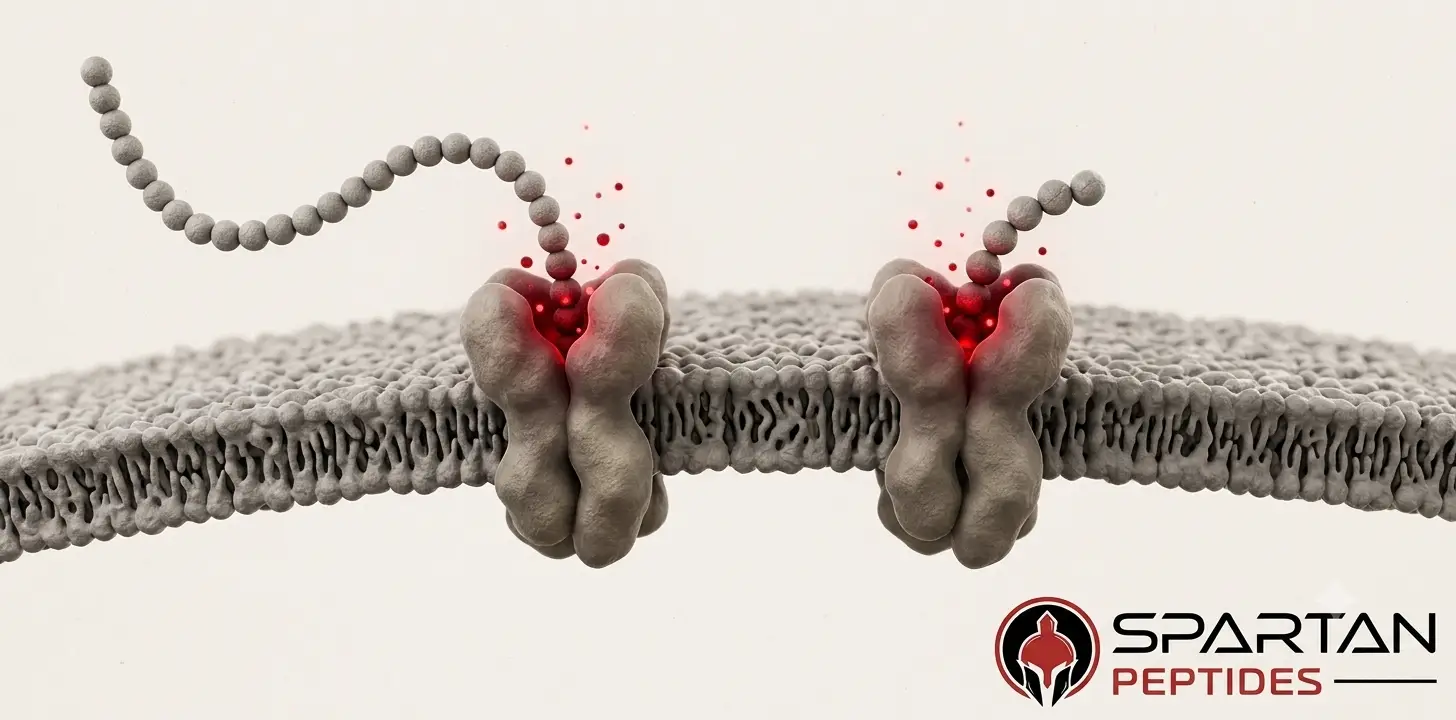
The CJC-1295 ipamorelin blend is a research vial holding two separate peptides: CJC-1295 without DAC, a 29-amino-acid analog of growth hormone-releasing hormone, and ipamorelin, a five-amino-acid growth hormone secretagogue. They act on two different receptors. Each was studied on its own in rats, mice and swine, and the blend is sold for laboratory research use only.
- Two separate molecules. The vial holds CJC-1295 (no DAC) and ipamorelin side by side, each with its own mass and its own COA line.
- Two different receptors. CJC-1295 is a GHRH analog; ipamorelin acts on the growth hormone secretagogue receptor (Raun et al., 1998).
- No DAC in this product. Spartan’s blend uses CJC-1295 without the albumin-binding hook, which changes how long it lasts in rats (Jetté et al., 2005).
- The pairing is a design choice. Researchers combine a GHRH-receptor signal with a secretagogue-receptor signal to study two inputs at once.
- Neither is FDA approved. Both are research compounds.
What is the CJC-1295 ipamorelin blend?
The CJC-1295 ipamorelin blend is one vial containing two peptides that researchers often study together. CJC-1295 is a modified copy of the first 29 amino acids of growth hormone-releasing hormone, and ipamorelin is a short synthetic peptide that works through a different receptor entirely.
Spartan’s version pairs 5 mg of CJC-1295 without DAC with 5 mg of ipamorelin in a 10 mg vial. That “without DAC” detail matters more than it sounds, and it gets its own section below.
The blend exists because the two peptides don’t do the same thing. One mimics the hormone that tells the pituitary to release growth hormone; the other knocks on a second door to the same cell. For researchers studying how the pituitary responds to two inputs at once, a vial that holds both is simpler than two vials.
The blend at a glance
| Feature | CJC-1295 (no DAC) | Ipamorelin |
| What it is | Modified GHRH(1-29) analog | Synthetic pentapeptide secretagogue |
| Length | 29 amino acids | 5 amino acids |
| Approximate mass | About 3,368 Da | About 712 Da |
| Receptor | GHRH receptor | Growth hormone secretagogue receptor |
| Key animal model | Rats, GHRH-knockout mice | Swine, rats |
| Amount in Spartan’s vial | 5 mg | 5 mg |
CJC-1295: the GHRH half
Natural GHRH is a 44-amino-acid hormone made in the hypothalamus. Most of its signaling lives in the first 29 amino acids, and most of its fragility lives at the very front, where the enzyme DPP-IV cuts it.
CJC-1295 keeps those 29 amino acids and swaps four of them to make the chain harder to break down (Jetté et al., 2005). The same paper describes a second modification: a chemical hook that binds the blood protein albumin so the peptide circulates for days in rats. That hook is the DAC, short for drug affinity complex.
In GHRH-knockout mice, which can’t make their own GHRH, CJC-1295 restored growth (Alba et al., 2006). A clinical study in healthy adults is also often cited for CJC-1295 (Teichman et al., 2006); this guide notes it exists and doesn’t report its outcomes, because that isn’t what research-grade material is for.
The CJC-1295 research guide covers the molecule in depth, including the four substitutions.
Why “no DAC” matters
The DAC version and the no-DAC version are different molecules with different behavior. With the albumin hook, CJC-1295 stayed active in rats for days; without it, the peptide is a short-lived GHRH analog that still carries the four protective substitutions (Jetté et al., 2005).
Spartan’s blend uses the no-DAC form. If a certificate of analysis for this product reported a mass far above 3,368 Da, that would suggest the DAC form, and it would be the wrong molecule for this vial.
Ipamorelin: the secretagogue half
Ipamorelin has nothing to do with GHRH structurally. Five amino acids long, it binds the growth hormone secretagogue receptor, the receptor the stomach hormone ghrelin uses (Raun et al., 1998).
Its 1998 introduction paper ran experiments in swine and in rat pituitary cells. The swine work showed growth hormone release with no accompanying increase in ACTH or cortisol, a contrast with older secretagogues that led the authors to describe ipamorelin as selective (Raun et al., 1998).
That selectivity is the whole reason ipamorelin ends up in blends. A secretagogue that only touched one axis was easier to pair with a GHRH analog than one that moved several.
Why the two are paired
The pituitary cell that releases growth hormone carries both receptors. GHRH analogs signal through one, secretagogues through the other, and in cell and animal work the two inputs don’t simply add; they interact.

So a vial with both lets a study ask a cleaner question than either peptide alone can: what happens when both doors are opened at once? That’s a question about receptor biology, and it’s why the pairing shows up across the whole research-peptide market.
It also means the two halves have to be measured separately. A result attributed to “the blend” without a CJC-only and an ipamorelin-only arm can’t say which half did the work.
What each half’s literature actually tested
| Question | CJC-1295 | Ipamorelin |
| Introduced in | Jetté et al., 2005 (rats) | Raun et al., 1998 (swine, rat cells) |
| What was shown | Four substitutions resist DPP-IV; DAC form lasts days in rats | Growth hormone release without ACTH or cortisol rise in swine |
| Knockout model | Restored growth in GHRH-knockout mice (Alba et al., 2006) | Not reported in the sources here |
| Studied as a pair? | No; the key papers tested each alone | No |
Ipamorelin vs CJC-1295
People search this comparison as if the two were rivals. They’re complementary. Ipamorelin is tiny, about 712 Da, and acts on the secretagogue receptor; CJC-1295 is nearly five times its mass and acts on the GHRH receptor.
The practical difference for a lab is identity testing. On a mass spectrum the two can’t be confused, and a blend’s certificate should show both peaks.
For the GHRH-side comparison, the tesamorelin peptide guide sets CJC-1295 against the full-length 44-amino-acid analog, and tesamorelin vs sermorelin covers the two approved GHRH drugs.
Four checks for a blend study
- Which CJC-1295? DAC and no-DAC behave differently in rats. The methods section should say which was used.
- Were there single-compound arms? Without them, nothing can be attributed to the pairing.
- What species? Swine, rats and knockout mice answer different questions.
- And what receptor was measured? A readout from the GHRH receptor says nothing about the secretagogue receptor, and vice versa.
Are CJC-1295 and ipamorelin FDA approved?
No. The FDA has not approved CJC-1295, ipamorelin or any blend of the two. Both are research chemicals, and the vial is sold for laboratory work.
Verifying a two-peptide vial
A blend’s certificate of analysis has to do double duty. Look for:
- Two identities by mass spectrometry. One peak near 3,368 Da for CJC-1295 (no DAC), one near 712 Da for ipamorelin.
- A purity figure for each peptide rather than one blended percentage.
- A lot number that matches the vial.
Spartan’s CJC-1295 and ipamorelin blend ships as 5 mg plus 5 mg, and the published certificates of analysis cover each lot. Researchers comparing secretagogue designs can also see the GH secretagogue stack research page.
Storing the blend
Both peptides ship together as one lyophilized powder. Keep sealed vials cold, dark and dry, under the conditions on the certificate, and record the lot against every experiment.
The blend, summarized
The CJC-1295 and ipamorelin blend is two peptides acting on two receptors of the same pituitary cell. CJC-1295 without DAC is a protected 29-residue GHRH analog studied in rats and knockout mice; ipamorelin is a five-residue secretagogue first characterized in swine.
Each half has its own literature and its own line on the COA. Read any blend result with that in mind.
CJC-1295 and ipamorelin questions
What is CJC-1295 ipamorelin?
It’s a research vial containing two separate peptides: CJC-1295 without DAC, a 29-amino-acid GHRH analog, and ipamorelin, a five-amino-acid growth hormone secretagogue. They act on different receptors and are sold for laboratory research only.
What’s the difference between CJC-1295 with DAC and without DAC?
DAC is an albumin-binding hook that kept CJC-1295 active in rats for days. The no-DAC form keeps the four protective amino acid substitutions but not the hook, so it’s a short-acting analog. Spartan’s blend uses the no-DAC form.
Ipamorelin vs CJC-1295: which does what?
CJC-1295 mimics growth hormone-releasing hormone at the GHRH receptor. Ipamorelin acts on the growth hormone secretagogue receptor; the swine study behind it showed growth hormone release with ACTH and cortisol left unchanged. They’re paired because they use different doors.
What is ipamorelin?
Ipamorelin is a synthetic five-amino-acid peptide introduced in 1998 as the first selective growth hormone secretagogue. It acts on the same receptor as the stomach hormone ghrelin and was characterized in swine and rat pituitary cells.
Has the blend been studied as a combination?
The key papers for each peptide tested it alone. A useful combination study needs a CJC-1295-only arm, an ipamorelin-only arm, both together, and a control, so the effect of pairing can be separated from each half.
How do you verify a CJC-1295 and ipamorelin blend?
By certificate of analysis. Mass spectrometry should show two peaks, near 3,368 Da for CJC-1295 without DAC and near 712 Da for ipamorelin, with HPLC purity reported for each and a lot number matching the vial.
Is the CJC-1295 ipamorelin blend FDA approved?
No. The FDA has approved neither peptide, and no approved product contains the blend. Research-grade vials are laboratory reagents, sold under a lot-specific certificate of analysis and not for any other use.
Research use disclaimer. All content published by Spartan Peptides is for educational and research purposes only. It is not medical advice and is not a recommendation for human use. Products sold on this site are research compounds intended for laboratory and in vitro applications only.
Written by the Spartan Research Team
Our team of peptide researchers and biochemists reviews every article for scientific accuracy. Learn more about our team →