
Tesamorelin Peptide: How It Compares to Sermorelin, CJC-1295 and Ipamorelin

Written bySpartan Research Team
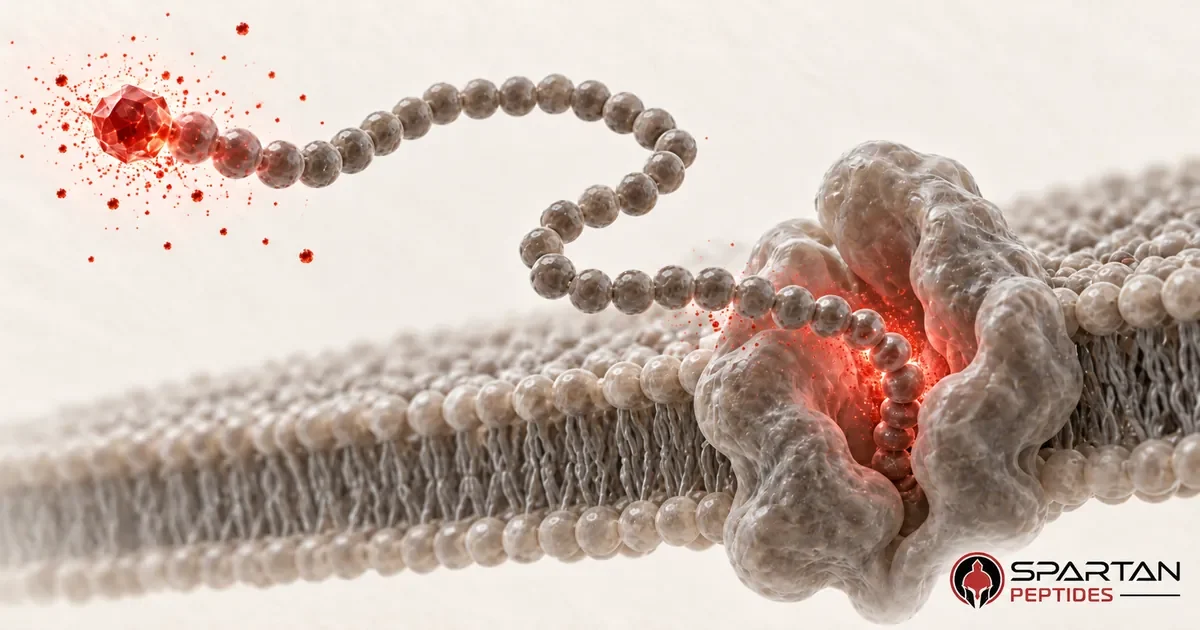
- The whole hormone, plus a cap. Tesamorelin keeps all 44 amino acids of human GHRH and adds a hexenoyl group to the first one (FDA-approved label).
- An approved drug since 2010. The FDA approved tesamorelin as a prescription product under the name Egrifta.
- Not the first GHRH analog approved. Sermorelin got there earlier, in 1990 and 1997, before its maker discontinued it.
- Sermorelin and CJC-1295 are shorter. Both are built on the first 29 amino acids of GHRH, the part that does most of the signaling.
- Ipamorelin uses another receptor. It acts on the growth hormone secretagogue receptor instead (Raun et al., 1998).
What is tesamorelin?
Tesamorelin is a synthetic form of growth hormone-releasing hormone, or GHRH, the signal the hypothalamus sends to the pituitary to release growth hormone. Most GHRH analogs trim the hormone down, but tesamorelin keeps the full 44-amino-acid human sequence. During development it carried the code TH9507.
The difference is a small chemical cap. A hexenoyl group, a six-carbon chain with a double bond at its third position, sits on the tyrosine at the start of the molecule (FDA-approved label).
It’s prepared as an acetate salt, and its molecular weight as the free base is 5,135.9 Da (FDA-approved label). That’s about one and a half times the mass of the 29-amino-acid analogs it’s usually compared with.
Tesamorelin key facts
| Feature | Tesamorelin |
|---|---|
| What it is | Synthetic analog of human growth hormone-releasing hormone (GHRH) |
| Length | 44 amino acids, the full human GHRH sequence |
| Modification | Hexenoyl group (C6, double bond at position 3) on the N-terminal tyrosine |
| Molecular weight | 5,135.9 Da (free base) |
| Form | Acetate salt |
| Development code | TH9507 |
| Regulatory status | FDA-approved prescription drug since 2010 (Egrifta); research-grade material is not that drug |
The growth hormone relay in 30 seconds
Think of the growth hormone axis in mammals as a three-runner relay. The hypothalamus sends GHRH to the pituitary, the pituitary releases growth hormone, and growth hormone prompts the liver to make IGF-1.
Tesamorelin steps in at the first handoff, the GHRH receptor. Every compound here targets that relay, though not all at the same step.
Why cap the front end?
Natural GHRH doesn’t last long. The enzyme DPP-IV cuts it at its starting end, and GHRH analogs in research were designed to hold up better against that enzyme (Jetté et al., 2005).
Tesamorelin’s hexenoyl cap sits right at that weak point. Other analogs solve the same problem by swapping amino acids, and that difference drives every comparison below.
Tesamorelin vs sermorelin
Sermorelin is a synthetic copy of GHRH(1-29), the first 29 amino acids, with nothing added. Tesamorelin keeps all 44 and adds the cap.

Tesamorelin vs sermorelin
| Feature | Tesamorelin | Sermorelin |
|---|---|---|
| Length | 44 amino acids | 29 amino acids |
| Built on | Full human GHRH | GHRH(1-29) |
| Modification | Hexenoyl cap on the first amino acid | None |
| Receptor | GHRH receptor | GHRH receptor |
| FDA history | Approved 2010 as Egrifta | Approved 1990 and 1997 as Geref; later discontinued |
Both act on the same receptor, so the real contrast is design. One keeps the whole hormone and protects its front end; the other keeps only the working fragment and leaves it exposed.
Sermorelin also reached the market first. The FDA approved Geref in 1990 and again in 1997, and after it left the market the agency determined it wasn’t withdrawn for reasons of safety or effectiveness (Federal Register, 2013).
Tesamorelin vs CJC-1295
CJC-1295 is also built on GHRH(1-29), with four amino acids swapped to resist enzymes. Its DAC version adds a hook that binds the blood protein albumin, designed to extend its activity, and it was characterized in rats (Jetté et al., 2005).
So the two attack one problem from opposite ends. Tesamorelin keeps the full sequence and caps it, while CJC-1295 trims to 29 amino acids and rewrites the sequence.
For the shorter analog’s full story, see CJC-1295, and for a side-by-side, tesamorelin vs CJC-1295.
Tesamorelin vs ipamorelin
Ipamorelin isn’t a GHRH analog at all. It’s a five-amino-acid peptide that acts on a different receptor, the growth hormone secretagogue receptor (Raun et al., 1998).
In swine, ipamorelin released growth hormone without the rise in ACTH and cortisol seen with older secretagogues, which earned it the label of first selective growth hormone secretagogue (Raun et al., 1998). Because it works through a separate door, it’s often studied alongside a GHRH analog.
Spartan’s CJC-1295 and ipamorelin blend, which uses CJC-1295 without DAC, pairs the two receptor routes for that reason.
Telling GHRH-family peptides apart by mass
On paper these compounds blur together. In a vial they don’t, because their masses differ widely and mass spectrometry measures mass directly.
Approximate mass by compound
| Compound | Length | Approximate mass |
|---|---|---|
| Tesamorelin | 44 amino acids, capped | 5,135.9 Da (free base) |
| CJC-1295 without DAC | 29 amino acids | About 3,368 Da |
| Ipamorelin | 5 amino acids | About 712 Da |
That gap makes a simple identity check. A certificate reporting a mass that doesn’t match the label means the vial holds something else.
Before you cite a tesamorelin paper
- Confirm the molecule. Tesamorelin, sermorelin and CJC-1295 all act on the GHRH receptor, and reviews sometimes discuss them together.
- Check the mass basis. The label gives molecular weight as the free base, so a figure quoted for the acetate salt will run higher.
- Separate lab work from clinical work. Because it’s an approved drug, most tesamorelin papers are clinical, and those answer different questions from laboratory studies.
- Keep receptors straight. A GHRH analog and a secretagogue like ipamorelin act through different receptors, so their results don’t substitute for each other.
Is tesamorelin FDA approved?
Yes, as a prescription drug. The FDA approved tesamorelin in 2010 under the brand name Egrifta, for one narrowly defined indication (FDA-approved label).
That approval covers the finished prescription product. Research-grade tesamorelin sold for laboratory use is a separate research compound. It isn’t the approved drug and isn’t for human use.
Where the laboratory evidence is thin
Tesamorelin is unusual among research peptides because most of its published work is clinical. It was developed as a drug, so the bulk of the literature comes from trials in people, which this article doesn’t report.
That leaves a thinner laboratory record than for BPC-157 or CJC-1295, where animal studies dominate. Structure and comparison are where tesamorelin is easiest to understand, so that’s where this guide spends its time.
Storage for a 44-residue peptide
Research tesamorelin arrives freeze-dried. Unopened vials go in cold, dark, dry storage, at whatever temperature the lot’s certificate gives.
Note the lot number in your records alongside each experiment. A peptide this large is worth tracking carefully.
Verifying a tesamorelin lot
- Mass first. At about 5,136 Da, tesamorelin separates easily from 29-amino-acid analogs by mass spectrometry.
- Then HPLC purity, reported as the share of the main peak.
- Then the paperwork. Certificate and vial should carry an identical lot code.
Spartan stocks Tesamorelin 5mg for laboratory work, plus a two-peptide vial of CJC-1295 with tesamorelin. Check the published certificates of analysis before ordering.
Tesamorelin in one minute
Tesamorelin is the full 44-amino-acid GHRH sequence with a hexenoyl cap on its front end. Sermorelin and CJC-1295 take the shorter 29-amino-acid route, and ipamorelin works on a different receptor entirely.
It became an approved prescription drug in 2010, two decades after sermorelin first did. That history is exactly why research-grade material has to be understood as something separate from the approved product.
Tesamorelin questions
What is tesamorelin?
Tesamorelin is a synthetic analog of growth hormone-releasing hormone: the full 44-amino-acid human GHRH sequence with a hexenoyl group attached to the first amino acid. Research-grade tesamorelin is sold for laboratory use only.
Is tesamorelin a peptide?
Yes. It’s a 44-amino-acid peptide with a small chemical cap on its first residue, and its molecular weight is 5,135.9 Da as the free base, according to the FDA-approved label.
What’s the difference between tesamorelin and sermorelin?
Sermorelin is GHRH(1-29), the first 29 amino acids of the hormone with no modification. Tesamorelin keeps all 44 amino acids and adds a hexenoyl cap. Both act on the GHRH receptor, and both have been FDA-approved drugs.
What’s the difference between tesamorelin and ipamorelin?
Tesamorelin is a GHRH analog that acts on the GHRH receptor. Ipamorelin is a five-amino-acid growth hormone secretagogue that acts on a different receptor, the growth hormone secretagogue receptor.
What’s the difference between tesamorelin and CJC-1295?
Both act on the GHRH receptor. Tesamorelin keeps the full 44-amino-acid sequence with a cap; CJC-1295 is a 29-amino-acid analog with four amino acid substitutions, and its DAC version binds albumin.
What is TH9507?
TH9507 is the development code tesamorelin carried before approval. It refers to the same capped 44-amino-acid GHRH analog, and the code still appears in older research papers and trial records.
Is sermorelin still FDA approved?
No longer marketed. Sermorelin was approved as Geref in 1990 and 1997, and its maker later discontinued it. In 2013 the FDA determined it wasn’t withdrawn from sale for reasons of safety or effectiveness.
Is tesamorelin FDA approved?
Yes, as the prescription drug Egrifta, approved in 2010 for one narrowly defined indication. Research-grade tesamorelin is a research compound, not that drug, and isn’t for human use.
Research use disclaimer. All content published by Spartan Peptides is for educational and research purposes only. It is not medical advice and is not a recommendation for human use. Products sold on this site are research compounds intended for laboratory and in vitro applications only.
Written by the Spartan Research Team
Our team of peptide researchers and biochemists reviews every article for scientific accuracy. Learn more about our team →