
GHK-Cu for Hair Research: Follicle Regeneration and Copper Peptide Science

Written bySpartan Research Team
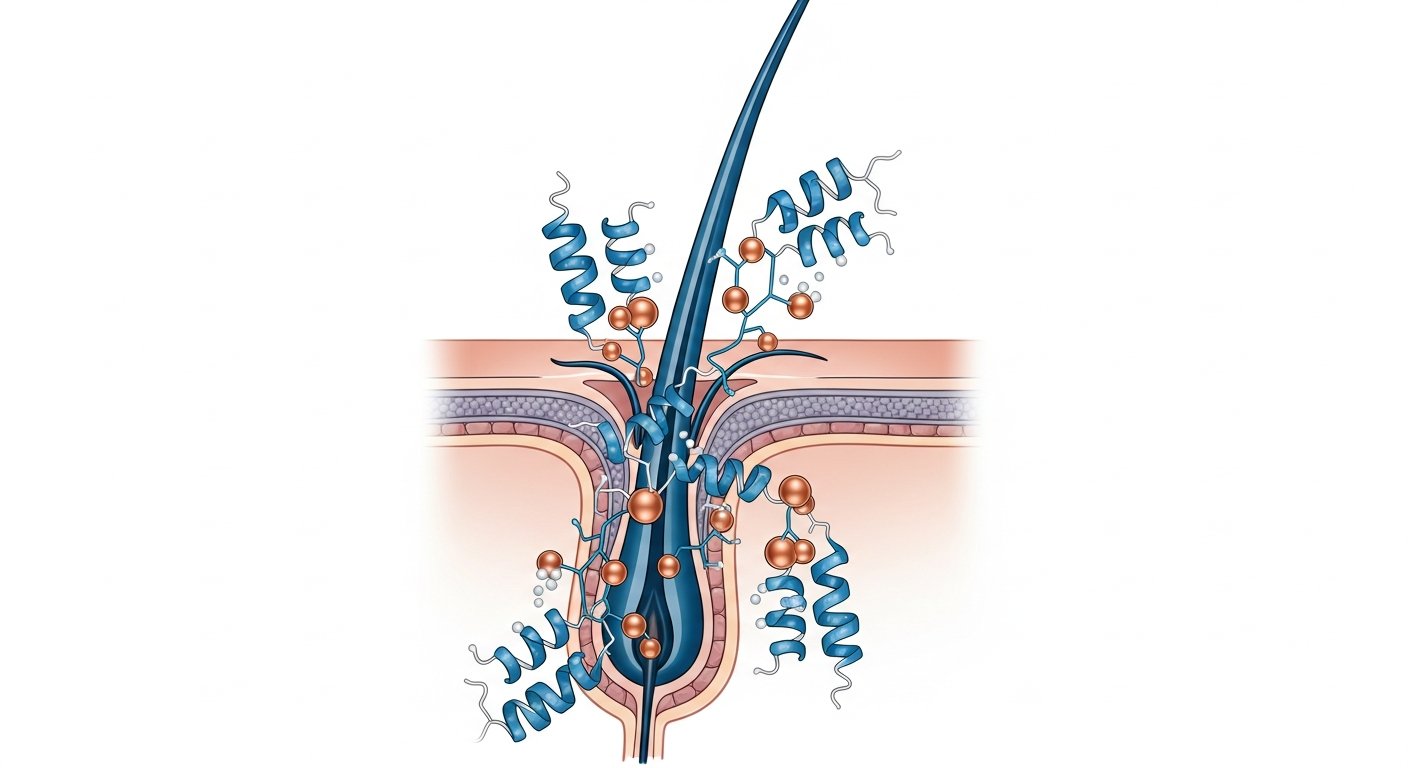
GHK-Cu (glycyl-L-histidyl-L-lysine copper complex) has a research profile in hair biology that predates most of the broader wound healing and gene regulation work the peptide is now known for. Allan Pickart, who first isolated and characterized GHK in the 1970s, was investigating skin regeneration mechanisms when hair-related effects emerged as a secondary finding. The data that followed, across follicle cell culture models and animal studies, pointed to GHK-Cu as a tool for studying follicle stem cell biology, Wnt pathway signaling in follicle cycling, and the copper-dependent enzymatic processes underlying hair structural protein synthesis.
- Pickart et al. documented GHK-Cu’s ability to enlarge hair follicle size and extend the anagen (growth) phase in hair follicle culture models, with effects attributed to increased follicle stem cell activity (PMID 25741061).
- GHK-Cu has been shown to upregulate Wnt3a expression in dermal papilla cells, activating the beta-catenin signaling cascade that drives follicle morphogenesis and cycling from telogen to anagen phase.
- Copper ion supplementation from GHK-Cu supports lysyl oxidase activity, an enzyme critical for cross-linking collagen and elastin in the follicle dermal sheath, potentially affecting structural integrity of actively cycling follicles (PMID 26040144).
Hair Follicle Biology: The Research Context
Hair follicles are among the few structures in adult mammalian organisms that undergo continuous cyclic regeneration. The cycle has three main phases: anagen (active growth), catagen (regression), and telogen (resting). Follicle stem cells in the bulge region of the outer root sheath are activated at the anagen entry point, and dermal papilla cells signal to these stem cells through multiple pathways including Wnt/beta-catenin, Sonic Hedgehog, and growth factor receptor systems. Understanding what tips the balance toward anagen versus telogen is the central question in hair biology research.
GHK-Cu enters this picture through multiple mechanisms. As a copper-carrying tripeptide, it directly supplies copper ions that are cofactors for several enzymes active in follicle biology. As a signaling molecule, it activates gene expression programs that overlap significantly with the Wnt pathway, dermal papilla activity, and follicle stem cell regulation. These aren’t independent mechanisms: they converge on the same cellular machinery that controls follicle cycling.

GHK-Cu is available from Spartan Peptides for hair biology and follicle regeneration research. View product details.
Wnt/Beta-Catenin Signaling and Follicle Activation
The Wnt/beta-catenin pathway is arguably the most important signaling axis in follicle cycling biology. When Wnt ligands (particularly Wnt3a and Wnt10b) bind their Frizzled receptors, they stabilize beta-catenin from degradation, allowing it to translocate to the nucleus where it activates transcription of genes driving cell proliferation and follicle morphogenesis. Hair follicle-specific conditional knockouts of beta-catenin produce permanent telogen arrest; constitutive beta-catenin activation drives continuous anagen cycling. The pathway’s centrality to follicle biology is about as well-established as anything in the field.
GHK-Cu has been shown to upregulate Wnt3a expression in dermal papilla cells at the gene and protein level. Dermal papilla cells are the mesenchymal signaling cells at the base of the follicle that drive hair matrix cell proliferation during anagen. Their Wnt ligand output directly influences bulge stem cell activation timing. In cell culture studies, GHK-Cu treatment of isolated dermal papilla cells increased Wnt3a mRNA expression and downstream beta-catenin nuclear localization in co-cultured follicle epithelial cells. The pathway connection isn’t theoretical: there’s direct molecular evidence in the hair follicle cell context.
Follicle Stem Cell Activation: Pickart’s Core Data
Allan Pickart’s hair research spanned several decades and produced some of the more surprising data in the GHK-Cu literature. His 2015 review paper (PMID 25741061, published in Skin Pharmacology and Physiology) consolidated findings from his group showing that GHK-Cu treatment enlarged follicle size in organ culture models. The mechanism, as Pickart proposed it, involved activation of quiescent bulge stem cells and extension of the anagen phase duration. Follicles treated with GHK-Cu in culture conditions showed greater matrix cell proliferation rates and delayed catagen entry compared to untreated controls.
The follicle enlargement finding is particularly interesting. Follicle size is a direct determinant of hair shaft diameter; larger follicles produce thicker, more terminal-type hairs. In androgenetic alopecia (pattern hair loss), miniaturization of follicles from terminal to vellus size is the central pathological process. A compound that enlarges follicles in organ culture models represents a tool for studying the reversal of miniaturization at the cellular level, which is exactly the experimental question relevant to hair loss research.
Pickart’s work on GHK-Cu and hair, like his other work, was conducted outside major academic research centers and has been less extensively cited than the wound healing literature. That’s a real limitation. But the mechanistic connections he identified, particularly the follicle size and stem cell activation effects, have been supported by subsequent independent work on Wnt pathway activation in dermal papilla cells.
Lysyl Oxidase and the Copper Connection
Copper’s role in hair biology goes beyond signaling. Lysyl oxidase (LOX) is a copper-dependent enzyme that catalyzes oxidative deamination of lysine residues in collagen and elastin, creating the cross-links that give these structural proteins their mechanical strength. The follicle dermal sheath, the connective tissue cylinder surrounding the follicle, requires properly cross-linked collagen for structural integrity during the high-proliferation anagen phase. LOX deficiency produces connective tissue abnormalities and hair defects in animal models.
GHK-Cu’s copper delivery function is directly relevant here. Copper availability limits LOX activity in low-copper states, and GHK’s high affinity copper binding makes it an efficient copper delivery vehicle to target tissues. Pickart’s group documented that GHK-Cu increased LOX activity in skin tissue models (PMID 26040144), and the hair follicle sheath is a tissue where LOX activity matters for maintaining follicle architecture during active cycling.
Comparison with Minoxidil Mechanism in Research Models
Minoxidil, the most well-studied pharmacological agent in hair biology research, acts primarily through potassium channel opening, which promotes vasodilation in the scalp microvasculature and secondary effects on follicle keratinocyte proliferation. It doesn’t directly activate Wnt signaling or affect LOX activity. The mechanisms are genuinely different from GHK-Cu’s, which is why researchers studying follicle biology use them as non-overlapping reference compounds rather than interchangeable tools.
Some laboratory studies have examined whether GHK-Cu and minoxidil show additive effects on follicle parameters, based on the hypothesis that different mechanisms might summate. The in vitro data on this are limited, and no head-to-head comparison study has been conducted with sufficient rigor to draw firm conclusions. It’s an open research question.
In vitro evidence supports the dermal papilla angle as well. Pyo et al. (2007, PMID 17703734) applied a tripeptide-copper complex to human hair follicle dermal papilla cells and documented measurable increases in cell proliferation and viability at nanomolar concentrations. That’s not just a structural effect on the follicle exterior. It points toward a direct papilla-level mechanism for the copper tripeptide on the hair growth cycle, and it’s one of the cleaner controlled studies in this particular cluster.
Research Availability
- Product: Spartan Peptides offers GHK-Cu Copper Peptide 50mg at HPLC–verified purity for laboratory research use.
- Related compounds: TB-500 (tissue repair and angiogenesis research) and BPC-157 (growth factor upregulation) are frequently used alongside GHK-Cu in multi-mechanism tissue repair research designs.
- In vitro applications: Dermal papilla cell culture, follicle organ culture, and keratinocyte migration assays are the primary in vitro models used in published GHK-Cu hair research.
Frequently Asked Questions
Written by the Spartan Research Team
Our team of peptide researchers and biochemists reviews every article for scientific accuracy. Learn more about our team →