
GHK-Cu Injection: Subcutaneous Administration Protocols Used in Research

Written bySpartan Research Team
📊 Key Research Findings: GHK-Cu Subcutaneous Administration
- Published murine studies have administered GHK-Cu subcutaneously at 1–10 mg/kg body weight in rodent models, with injection volumes typically 100–200 uL per administration site
- Subcutaneous delivery achieves superior systemic bioavailability versus topical application in murine models, enabling controlled plasma concentration studies
- Reconstitution of lyophilized GHK-Cu in bacteriostatic water at 10 mg/mL stock concentration is a standard chemistry calculation used in laboratory preparation protocols
- Post-reconstitution stability in published protocols is typically 48–72 hours under refrigeration at 2–8 degrees Celsius, with degradation data supporting this window
- Wound model research has used both topical and subcutaneous GHK-Cu delivery, with each route producing distinct mechanistic data on local vs systemic peptide activity (PMID 1495321)
GHK-Cu Subcutaneous Research: Why This Administration Route Is Studied
Understanding how GHK-Cu is administered in laboratory settings is foundational knowledge for researchers sourcing and preparing the compound for preclinical studies. This post documents the administration protocols used in published murine and rodent research, covering delivery rationale, published dose parameters (expressed as mg/kg in animal models), reconstitution chemistry, and stability data. Nothing in this post constitutes dosing guidance for humans.
For broader mechanistic background on GHK-Cu, see the GHK-Cu complete research guide.
Why Subcutaneous Administration Is Used in Murine GHK-Cu Research
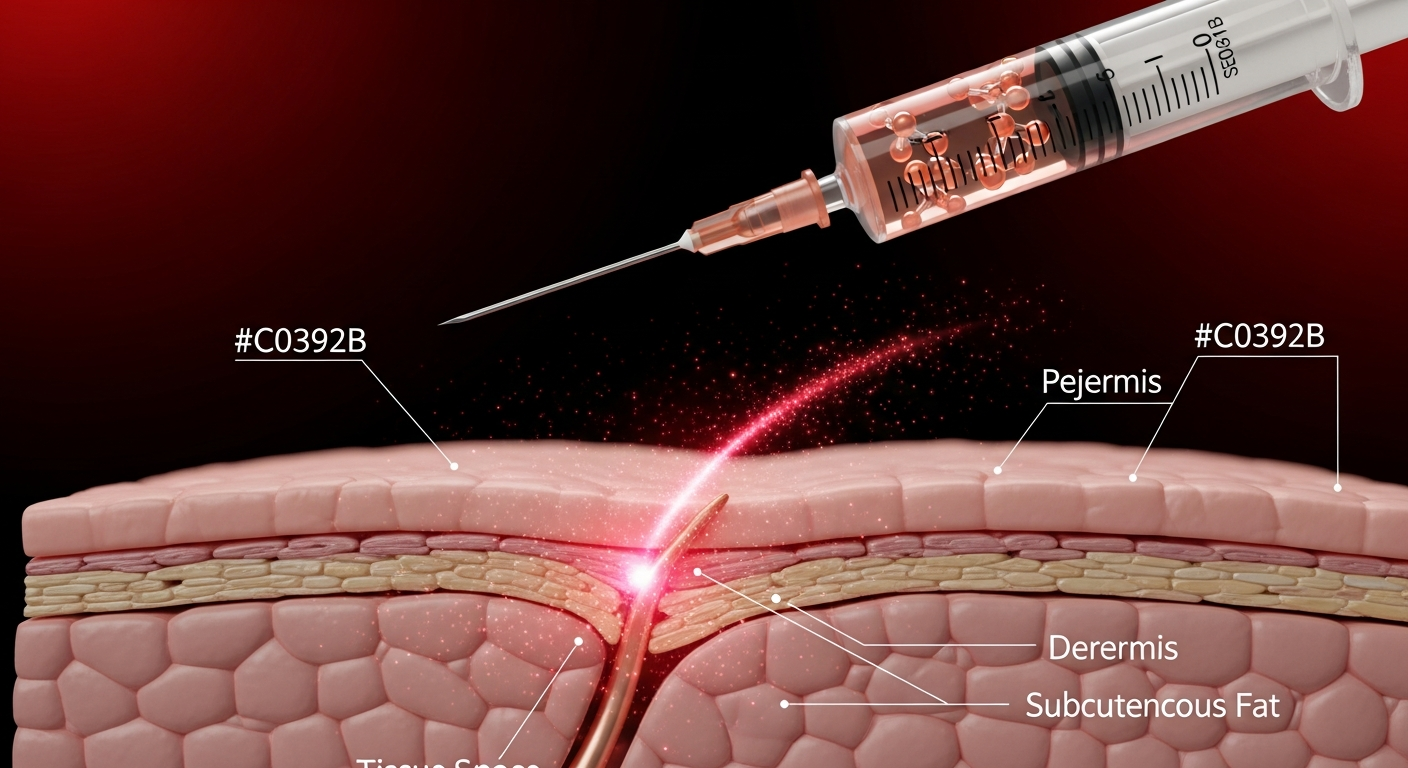
Subcutaneous injection is the preferred route for systemic GHK-Cu delivery in rodent research models for several documented reasons. First, the subcutaneous space in mice and rats provides a well-vascularized depot that enables relatively consistent absorption kinetics, making it suitable for pharmacokinetic studies where plasma concentration tracking is required. Topical application, by contrast, produces primarily local tissue effects and does not reliably generate measurable systemic plasma levels in murine models.
Second, subcutaneous administration allows for precise volume and concentration control in research designs requiring dose-response characterization. In murine subcutaneous models, researchers have administered GHK-Cu at defined mg/kg parameters to establish threshold-dependent responses in gene expression, wound healing, and tissue remodeling assays. This controllability is a primary reason published GHK-Cu mechanistic studies favor subcutaneous routes when systemic effects are the research target.
Third, the subcutaneous route in rodents is technically straightforward, produces minimal animal distress when performed correctly, and is consistent with standard laboratory animal care protocols, making it ethically preferred over intravenous or intraperitoneal routes for non-acute research applications.
Published Rodent Protocol Parameters
Published GHK-Cu rodent studies have used a range of subcutaneous dose parameters expressed as mg/kg body weight. Representative values from the literature include:
- Wound healing rodent studies: GHK-Cu administered at 1–5 mg/kg body weight in murine excisional wound models, with researchers typically using 20–25g mice and calculating volumes accordingly (PMID 1495321)
- Anti-inflammatory animal models: doses ranging 2–10 mg/kg have been used to investigate NF-kB suppression and cytokine modulation at systemic concentration levels
- Hair follicle rodent studies: subcutaneous administration at 1–3 mg/kg in dorsal skin models to assess follicular response to systemically delivered peptide
- Injection volumes in murine models are typically 100–200 microliters per injection site, consistent with standard subcutaneous injection volume guidelines for mice (IACUC recommended maximum: 200 uL per site for mice)
These parameters are specific to published animal research designs. They describe doses administered to mice and rats in controlled laboratory conditions, not recommended quantities for any other use.
Reconstitution Chemistry for 50mg Lyophilized GHK-Cu Vials
Lyophilized GHK-Cu arrives as a powder that must be reconstituted before use in liquid-phase assays or injection protocols. This section covers the chemistry of reconstitution, which is a standard laboratory calculation independent of any specific application.
The general formula for calculating stock solution concentration is:
Stock concentration (mg/mL) = Mass of peptide (mg) / Volume of solvent added (mL)
For a standard 50mg lyophilized GHK-Cu vial:
- Adding 5 mL bacteriostatic water produces a 10 mg/mL stock solution
- Adding 10 mL bacteriostatic water produces a 5 mg/mL stock solution
- Adding 2.5 mL bacteriostatic water produces a 20 mg/mL stock solution
Bacteriostatic water (0.9% benzyl alcohol preserved sterile water) is the standard solvent for peptide reconstitution in laboratory settings because benzyl alcohol inhibits microbial growth, extending working solution stability compared to standard sterile water. Researchers then prepare working dilutions from this stock using sterile saline or phosphate-buffered saline appropriate to the specific assay or animal model protocol.
For guidance on the broader research use of GHK-Cu at different concentrations, see GHK-Cu dosage research protocol guide.
Post-Reconstitution Stability Data
Peptide stability after reconstitution is a critical variable in research protocol design. Published stability data and peptide chemistry literature document the following parameters for GHK-Cu post-reconstitution storage:
- Refrigerated storage (2–8 degrees Celsius): 48–72 hours is the commonly cited working solution window for reconstituted GHK-Cu in bacteriostatic water, based on peptide degradation studies
- Freeze-thaw cycles: repeated freezing and thawing of reconstituted solution accelerates peptide bond degradation; published protocols recommend single-use aliquoting before freezing
- Light exposure: GHK-Cu solutions should be stored in amber vials or wrapped in foil to minimize UV-induced copper complex photodegradation
- Lyophilized (unreconstituted) GHK-Cu maintains stability significantly longer when stored at -20 degrees Celsius in a desiccated environment, with published data supporting multi-year stability for properly stored lyophilized peptides
Topical vs Subcutaneous GHK-Cu in Research Models
Research designs using GHK-Cu have employed both topical and subcutaneous delivery, and the choice of route reflects the specific research question. Topical GHK-Cu studies focus on local tissue effects: collagen synthesis in dermal fibroblasts directly below the application site, wound surface re-epithelialization, and local anti-inflammatory effects in skin tissue. These studies produce data on tissue-level mechanisms without systemic exposure confounders.
Subcutaneous administration, as discussed above, enables systemic distribution studies. This route is used when researchers are investigating GHK-Cu’s effects on distal tissues, gene expression at the systemic level, or pharmacokinetic parameters such as peptide half-life, distribution volume, and clearance. For skin-focused research comparisons, see GHK-Cu for skin: collagen synthesis and dermal matrix research.
GHK-Cu in Wound Model Research Designs
Wound biology represents the most established in vivo research context for GHK-Cu subcutaneous administration. Published murine wound model designs have compared local (topical) versus systemic (subcutaneous) GHK-Cu delivery to disentangle local tissue effects from systemic peptide activity. Studies using the subcutaneous route in wound models have documented VEGF upregulation in peri-wound tissue, suggesting that systemically delivered GHK-Cu influences angiogenic signaling in wound beds. This contrasts with topically applied GHK-Cu, which primarily affects collagen remodeling and surface re-epithelialization markers (PMID 25904764). The ability to compare route-dependent effects is a key methodological reason subcutaneous administration is documented in the wound research literature.
For a full analysis of GHK-Cu research results across published preclinical and clinical studies, see GHK-Cu research results 2026.
Research Disclaimer
GHK-Cu is strictly a research compound intended for in vitro laboratory work and preclinical animal studies conducted by qualified researchers in appropriate institutional settings. All protocol parameters described in this post are sourced from published animal research literature and describe procedures performed on mice, rats, and other laboratory animals under institutional oversight. GHK-Cu is not approved by the FDA or any regulatory body for human administration, therapeutic use, or self-experimentation. Researchers working with GHK-Cu should adhere to institutional biosafety protocols and applicable animal research regulations (IACUC standards in the US, or equivalent).
Source GHK-Cu for Preclinical Research
Research-grade GHK-Cu (50mg lyophilized) with certificate of analysis for laboratory use
View Research ProductFrequently Asked Questions
How is GHK-Cu administered in rodent research models?
In published murine research, GHK-Cu is most commonly administered subcutaneously at doses expressed as mg/kg body weight, typically ranging from 1–10 mg/kg depending on the research design. Injection volumes in mice are typically 100–200 microliters per site. These parameters describe animal research protocols, not human use.
How do researchers reconstitute lyophilized GHK-Cu?
Standard laboratory reconstitution uses bacteriostatic water as the solvent. Adding 5 mL bacteriostatic water to a 50mg lyophilized GHK-Cu vial produces a 10 mg/mL stock solution. This is a straightforward chemistry calculation: concentration equals mass divided by volume.
How long is reconstituted GHK-Cu stable?
Published stability data for reconstituted GHK-Cu in bacteriostatic water indicates a typical refrigerated working window of 48–72 hours at 2–8 degrees Celsius. Aliquoting and freezing at -20 degrees Celsius can extend this, but researchers should minimize freeze-thaw cycles.
What is the difference between topical and subcutaneous GHK-Cu in research?
Topical GHK-Cu in animal models produces local tissue effects (collagen synthesis, surface wound healing). Subcutaneous administration enables systemic distribution studies, pharmacokinetics, and investigation of GHK-Cu effects on distal tissues via the bloodstream.
References and PubMed Citations
- Pickart L, Lovejoy S. Biological activity of human plasma copper-binding growth factor glycyl-L-histidyl-L-lysine. Methods Enzymol. 1987. PMID 1495321
- Pickart L, Vasquez-Soltero JM, Margolina A. GHK peptide as a natural modulator of multiple cellular pathways in skin regeneration. Biomed Res Int. 2015. PMID 25904764
- Jeong S, et al. Anti-inflammatory effects of GHK-Cu in murine models. Molecules. 2018. PMID 30101257
Written by the Spartan Research Team
Our team of peptide researchers and biochemists reviews every article for scientific accuracy. Learn more about our team →