
GHK-Cu vs Copper Peptide: What’s the Difference in Research?

Written bySpartan Research Team
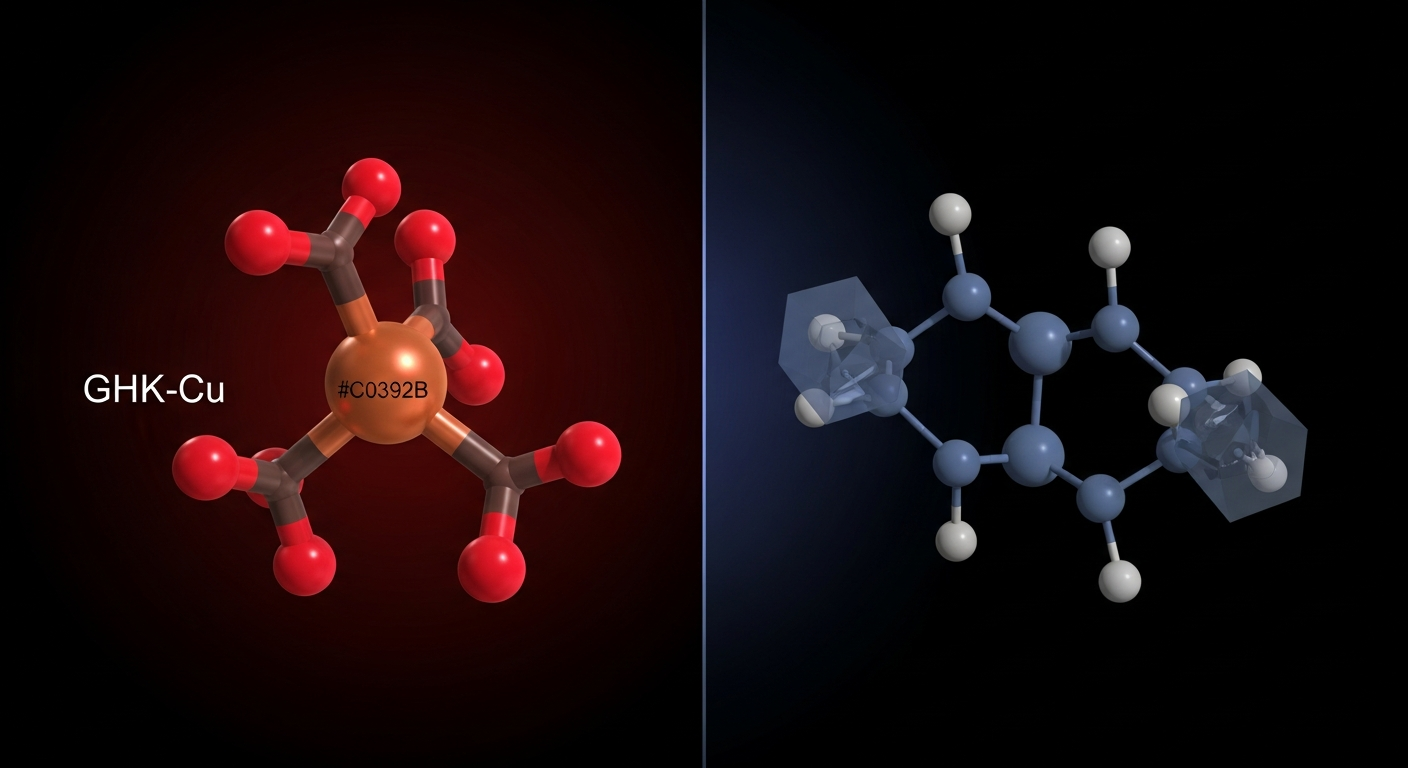
“Copper peptide” and “GHK-Cu” are used interchangeably across online research communities, supplement forums, and even some peer-reviewed literature. For casual readers, the distinction barely matters. For researchers sourcing compounds for reproducible in vitro work, understanding the difference between GHK-Cu specifically and “copper peptides” as a category is essential. It affects what you order, from whom, and how you interpret the research literature you’re replicating. This guide clarifies both terms, explains why the distinction matters for research sourcing decisions, and addresses what researchers typically mean when they search for “GHK peptide.”
What Is GHK-Cu Specifically?
GHK-Cu is glycine-histidine-lysine copper(II) complex: a specific tripeptide sequence bound to a copper ion. The molecular formula is precise. The amino acid sequence — glycine, then histidine, then lysine — creates a specific three-dimensional structure with a defined copper coordination geometry. This is not simply “copper attached to any peptide.” The GHK sequence was first identified in human plasma albumin in 1973 by Dr. Loren Pickart, who spent subsequent decades mapping its biological activity in tissue remodeling, wound healing, and gene expression regulation.
GHK-Cu occurs naturally in human plasma, saliva, and urine, with plasma concentrations decreasing significantly with age: approximately 200 ng/mL in youth, declining to below 80 ng/mL by age 60. This age-associated decline is part of why the anti-aging research community has focused so heavily on GHK-Cu. The “Cu” designation in GHK-Cu is not a marketing suffix — it specifies the copper-bound form, which is the biologically active research compound with the coordination geometry documented in the published literature. GHK without the copper ion (free tripeptide) has reduced biological activity in research models. The copper coordination is mechanistically significant.
What Are “Copper Peptides” Generally?
“Copper peptide” is a broader category term that refers to any peptide sequence that forms a stable complex with copper ions. Multiple copper peptides have been studied in the scientific literature, including AHK-Cu (alanine-histidine-lysine copper complex) and various other histidine-containing peptide fragments capable of copper coordination. However, none of these alternative copper peptides approaches the research depth of GHK-Cu. The Pickart laboratory and subsequent independent groups have published extensively on GHK-Cu across five decades, building a literature base that other copper peptides simply lack.
In practical terms: when a peer-reviewed paper in wound healing, dermatology, or anti-aging research refers to “copper peptide” without further specification, it almost invariably means GHK-Cu. The compound has so thoroughly dominated the copper peptide research space that the category name has become synonymous with the specific compound. This creates potential confusion for researchers who encounter “copper peptide” in product listings — the term does not guarantee GHK-Cu is what they are actually receiving.
Why the Distinction Matters for Researchers
Research reproducibility depends on compound specificity. If a researcher designs an experiment to replicate Pickart’s gene expression findings using “copper peptide” sourced from a supplier who has not confirmed the GHK sequence, the experiment has a fundamental validity problem before it begins. The biological activity documented in the GHK-Cu literature is specific to the GHK-Cu molecular structure — it cannot be assumed to transfer to other copper peptides or to GHK without copper coordination.
Molecular weight is one practical identifier: GHK-Cu has a confirmed molecular weight of approximately 340 Da (as the copper complex, depending on salt form). This distinguishes it from alternative copper peptide fragments, which have different molecular weights. Researchers verifying compound identity should confirm both the peptide sequence (Gly-His-Lys) and the copper coordination state. Products labeled only as “copper peptide” without GHK sequence confirmation carry sourcing risk for research applications.
Purity standards are the second critical variable. The GHK-Cu literature was built on research-grade compound with purity standards consistent with pharmaceutical research. Replicating those findings at lower purity introduces confounding variables. Anti-aging researchers consistently prioritize greater than or equal to 98% HPLC-verified purity from suppliers who explicitly confirm the GHK-Cu sequence — not just “copper peptide” as a category label. See the GHK-Cu sourcing guide for 2026 for a detailed breakdown of what to look for in a research-grade supplier.
GHK-Cu Research Mechanisms: Why It Dominates the Category
The reason GHK-Cu has become THE copper peptide of interest in longevity and repair research is not brand recognition — it is mechanistic breadth. No other copper peptide has documented activity across the following research pathways simultaneously:
Extracellular matrix regulation: GHK-Cu has documented roles in collagen I, III, and IV synthesis, decorin and SPARC production, and matrix metalloproteinase regulation in fibroblast models. This combination of pro-synthesis and remodeling activity is unique in the copper peptide literature. The GHK-Cu topical research guide covers the collagen and dermal matrix data in detail.
Gene expression modulation: Pickart’s genomic analyses showed GHK-Cu modulates over 31% of aging-related genes in fibroblast models — the most cited finding in the copper peptide anti-aging literature. No other copper peptide has been subjected to comparable genomic analysis.
Neurological activity: GHK-Cu shows nerve growth factor (NGF) upregulation in neural cell models and neuroprotective activity in oxidative stress models. Other copper peptides do not have published neurological research at comparable depth.
Anti-inflammatory activity: GHK-Cu suppresses NF-kB inflammatory signaling in cell models and has documented cytokine modulation (IL-6, TNF-alpha reduction) in inflammatory challenge studies. This systemic anti-inflammatory activity is mechanistically distinct from the topical anti-inflammatory effects of copper ions alone.
When Researchers Search “GHK Peptide”
When researchers search “GHK peptide,” they are almost always looking for information on GHK-Cu — the copper-bound form. The “GHK” tripeptide sequence alone (without copper coordination) has reduced biological activity in most research models. The published literature that researchers are typically trying to access — Pickart’s gene expression datasets, wound healing studies, anti-aging genomic analyses — all used the GHK-Cu complex specifically. The distinction matters for ordering: researchers should look for products labeled GHK-Cu (or GHK copper complex, Gly-His-Lys copper(II)) with explicit sequence verification, not simply “GHK” or “copper peptide.” For the full mechanistic picture, see the GHK-Cu complete research guide.
Key Research Findings: GHK-Cu vs Copper Peptides
- Specificity matters: GHK-Cu (glycine-histidine-lysine copper(II) complex) has documented biological activity specific to its amino acid sequence and copper coordination geometry — not transferable to other copper peptides.
- Molecular weight verification: GHK-Cu has an approximate molecular weight of 340 Da. This distinguishes it from other copper peptide fragments in sourcing verification.
- Research depth: GHK-Cu has over 50 years of published research across skin, wound healing, neurology, and anti-aging gene expression. No other copper peptide approaches this research depth.
- Declining natural levels: Plasma GHK-Cu concentrations decline from approximately 200 ng/mL in youth to below 80 ng/mL by age 60 — part of why it has attracted sustained anti-aging research interest.
Source GHK-Cu for Research
The copper peptide research community prioritizes sequence-verified GHK-Cu rather than generic “copper peptide” products for research applications. GHK-Cu 50mg at Spartan Peptides is glycine-histidine-lysine copper(II) complex: sequence-confirmed, greater than or equal to 98% HPLC-verified purity, USA-manufactured in a cGMP-compliant facility. Researchers working in collagen synthesis, gene expression, wound healing, or anti-aging models can confirm compound identity through the explicit GHK-Cu labeling rather than the ambiguous “copper peptide” category.
Frequently Asked Questions: GHK Peptide vs Copper Peptide
What is GHK peptide?
GHK peptide refers to the tripeptide sequence glycine-histidine-lysine (Gly-His-Lys). In research contexts, “GHK peptide” almost always refers to GHK-Cu: the copper(II) complex of GHK, which is the biologically active form documented in the published literature. The copper-bound form has documented activity in collagen synthesis, gene expression modulation, wound healing, and neuroprotection. GHK without copper coordination has reduced activity in most research models.
Is GHK-Cu the same as copper peptide?
GHK-Cu is a specific copper peptide — the most researched one. “Copper peptide” is a broader category term that could technically refer to any peptide-copper complex. GHK-Cu has so thoroughly dominated copper peptide research that the terms are often used interchangeably, but they are not identical. For research purposes, sequence-verified GHK-Cu (glycine-histidine-lysine copper(II) complex) should be specified rather than generic “copper peptide.”
What does the “Cu” mean in GHK-Cu?
Cu is the chemical symbol for copper (from the Latin “cuprum”). In GHK-Cu, it specifies that the GHK tripeptide is complexed with a copper(II) ion. This copper coordination is what gives GHK-Cu its biological activity in research models. The copper ion is not simply present — it forms a specific coordination complex with the histidine residue of the GHK sequence that is critical to the compound’s mechanism of action. GHK without the copper ion has reduced biological activity.
What is the difference between GHK and GHK-Cu in research?
GHK is the tripeptide sequence (Gly-His-Lys) alone. GHK-Cu is the copper(II) complex of that tripeptide. The biological activity documented in the published literature — gene expression modulation, collagen synthesis promotion, wound healing, neuroprotection — was demonstrated with GHK-Cu specifically. The copper coordination is mechanistically significant, enabling the compound’s redox activity, antioxidant enzyme interactions, and copper delivery to target tissues. For research applications, GHK-Cu (copper-bound form) is the relevant compound.
What purity should copper peptide (GHK-Cu) be for research use?
Anti-aging and longevity researchers consistently prioritize GHK-Cu at greater than or equal to 98% purity as confirmed by HPLC (high-performance liquid chromatography). The foundational GHK-Cu literature was conducted with research-grade compound at comparable purity standards. Lower purity introduces confounding variables into research models and raises questions about whether observed effects are attributable to GHK-Cu specifically or to impurities. Researchers should request explicit HPLC purity data rather than relying on general “research grade” claims.
Research Citations
1. Pickart L, Vasquez-Soltero JM, Margolina A. “GHK-Cu May Prevent Oxidative Stress in Skin by Regulating Copper and Modifying Expression of Numerous Antioxidant Genes.” Cosmetics. 2015;2(3):236-247. PMID: 25904764.
2. Pickart L, Margolina A. “Regenerative and Protective Actions of the GHK-Cu Peptide in the Light of the New Gene Data.” Int J Mol Sci. 2018;19(7):1987. PMID: 30101257.
Spartan Research Library
Go Deeper on the Science
Browse study indexes, compound comparisons, and protocol stacks in the Spartan Peptides Research Library.
Written by the Spartan Research Team
Our team of peptide researchers and biochemists reviews every article for scientific accuracy. Learn more about our team →