
Ipamorelin: Complete Research Guide (2026)

Written bySpartan Research Team
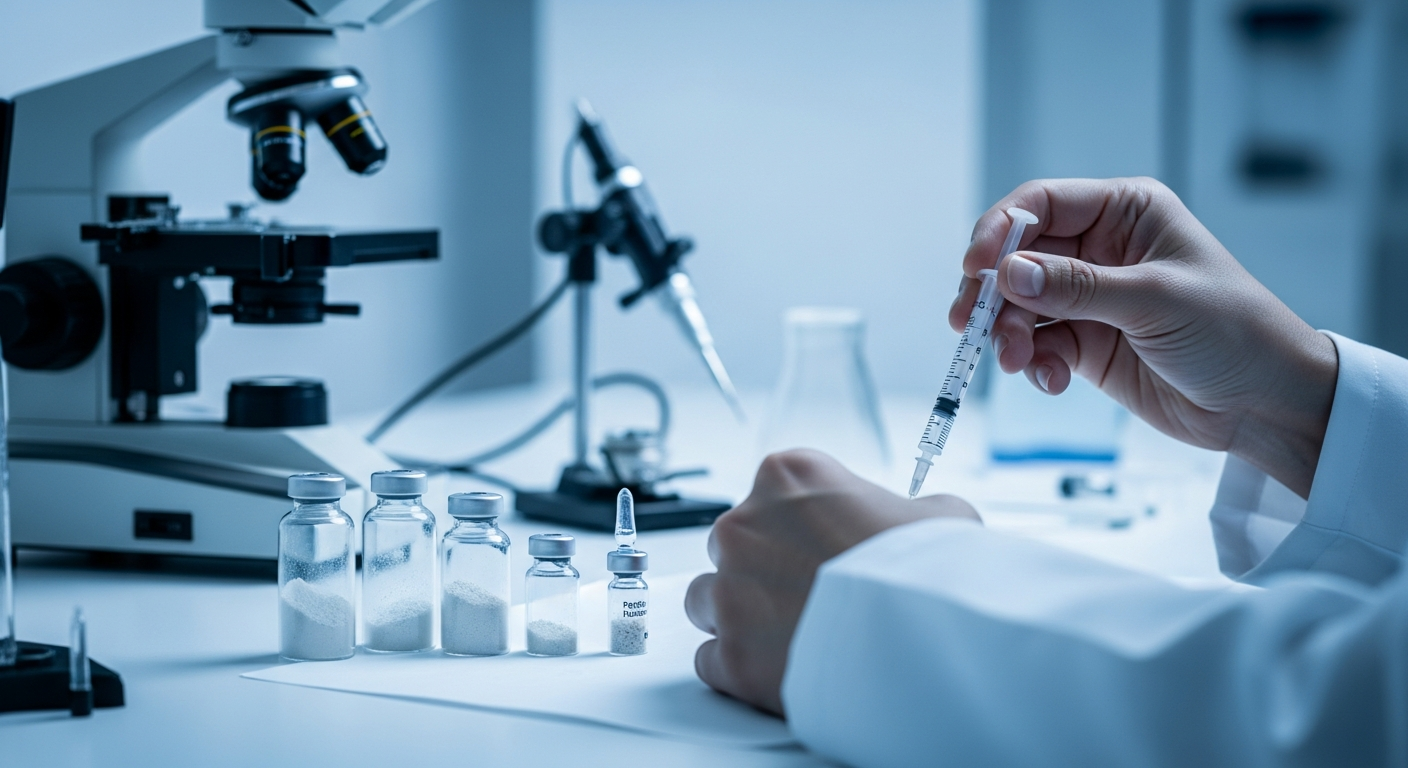
Ipamorelin is a synthetic pentapeptide — five amino acids — designed to selectively stimulate growth hormone (GH) release from the anterior pituitary. First characterized in the late 1990s, it belongs to the growth hormone secretagogue (GHS) class alongside compounds like GHRP-2 and GHRP-6. What distinguishes ipamorelin in preclinical research is a narrow receptor-binding profile that produces robust GH pulsatility with notably less stimulation of cortisol and prolactin compared to earlier-generation GH secretagogues. This selectivity has made ipamorelin one of the more studied reference compounds in GH research across metabolism, body composition, and bone biology.
- Ipamorelin selectively stimulates GH release via GHSR-1a with minimal ACTH/cortisol co-stimulation — its primary advantage over GHRP-2 and GHRP-6 in isolated GH axis research (Raun et al., 1998)
- 8-week administration in female rats increased cortical bone mineral density and periosteal bone formation rate without adverse resorption markers (Svensson et al., 2000)
- In diet-induced obese rat models, ipamorelin reduced fat mass while preserving lean body mass at a magnitude comparable to direct recombinant GH (Johansen et al., 1999)
- CJC-1295 and ipamorelin act through non-competing GHRH and GHSR-1a pathways — co-administration produces synergistic GH output exceeding either compound alone
Note: All compounds discussed here are for laboratory and preclinical research use only. This content is not medical advice and does not describe human therapeutic applications.
Mechanism of Action: GHSR-1a Agonism
Ipamorelin exerts its primary effect by binding to the growth hormone secretagogue receptor type 1a (GHSR-1a) — the same G-protein coupled receptor targeted by endogenous ghrelin. Activation of GHSR-1a in somatotroph cells of the anterior pituitary triggers intracellular calcium mobilization and protein kinase C signaling cascades, leading to pulsatile GH secretion into circulation.
Unlike ghrelin itself, ipamorelin does not carry the octanoyl side chain responsible for ghrelin’s peripheral metabolic effects, producing a cleaner pharmacological profile in preclinical models. Importantly, ipamorelin’s binding selectivity means it does not significantly activate pathways leading to ACTH stimulation (and the downstream cortisol release) that limits research utility of less selective compounds like GHRP-6 at higher concentrations.
The downstream hormonal sequence follows: GHSR-1a activation → pulsatile GH release → hepatic IGF-1 synthesis → peripheral IGF-1 receptor signaling. This axis underlies the research interest in ipamorelin across tissue anabolism, bone modeling, fat metabolism, and cellular repair research contexts.
Research and Clinical Studies
Original Characterization: GH Pulsatility and Receptor Selectivity
Raun et al. (1998; PMID: 9598572, European Journal of Endocrinology) published the foundational characterization of ipamorelin as a novel GH-releasing peptide. Using rat models, the researchers demonstrated that ipamorelin produced dose-dependent GH release with a potency and efficacy comparable to GHRP-6, while producing significantly lower elevations in plasma ACTH and cortisol. At doses producing equivalent GH responses, ipamorelin’s effect on corticotropic axis hormones was described as negligible in the tested models. The authors proposed this selectivity profile as a potential research advantage over earlier GH secretagogues for studies requiring isolated GH/IGF-1 axis stimulation without confounding glucocorticoid variables.
Bone Density and Skeletal Modeling
Svensson et al. (2000; PMID: 10820804, Growth Hormone & IGF Research) investigated ipamorelin’s effects on bone parameters in young female rats over an 8-week administration period. The study reported increased cortical bone mineral density and periosteal bone formation rate in treated animals compared to controls. Longitudinal bone growth rate and tibial length were also elevated in the ipamorelin-treated cohort. Critically, the study found no adverse changes in cortical bone geometry or markers of bone resorption, suggesting that the observed density gains reflected net anabolic activity on the skeletal compartment. The authors attributed these findings to the sustained GH/IGF-1 axis stimulation produced by twice-daily ipamorelin administration in the model.
Body Composition in Diet-Induced Obesity Models
Johansen et al. (1999; PMID: 10323351, Journal of Endocrinology) examined the body composition effects of ipamorelin in diet-induced obese female rats. Following 8 weeks of administration, the treatment group demonstrated significantly reduced fat mass compared to vehicle-treated controls, alongside preservation of lean body mass. Plasma IGF-1 concentrations were elevated in the ipamorelin group, consistent with GH axis activation. The researchers noted that the magnitude of fat mass reduction was comparable to that observed with direct recombinant GH administration in similar models, suggesting that ipamorelin’s pulsatile GH stimulation was sufficient to replicate downstream lipolytic and anabolic signaling in this context.
GH Pulse Amplitude and Frequency in Aged Models
Aging is associated with a progressive decline in endogenous GH pulse amplitude — a phenomenon sometimes referred to as somatopause. Preclinical research has evaluated GH secretagogues including ipamorelin as tools for restoring pulsatile GH secretion patterns in aged animal models. Studies in aged rats have demonstrated that ipamorelin administration increases GH pulse amplitude without disrupting the physiological pulsatile pattern, as GH release remains episodic rather than becoming tonically elevated. This maintained pulsatility is considered important in GH research because tonic GH elevation — as opposed to pulsatile — has been associated with differential downstream receptor regulation and metabolic outcomes in preclinical models.
Ipamorelin vs. GHRP-2 vs. GHRP-6: Research Profile Comparison
The three most commonly referenced GHSR agonists in preclinical research — ipamorelin, GHRP-2, and GHRP-6 — share the same receptor target but exhibit meaningfully different selectivity profiles:
- Ipamorelin: High GH selectivity. Minimal ACTH/cortisol stimulation. No significant prolactin elevation at research doses. Considered the cleanest GH secretagogue from a selectivity standpoint. Preferred in studies where isolated GH axis activation is the objective.
- GHRP-2: Strong GH release. Moderate ACTH and cortisol stimulation. Some prolactin elevation. More potent per unit than ipamorelin in some pituitary cell assays. Used in studies examining broader pituitary signaling.
- GHRP-6: Robust GH release. Notable ACTH, cortisol, and prolactin co-stimulation. Also activates ghrelin receptors in the gut, producing appetite-stimulating effects in rodent models. Used in feeding behavior and GI motility research contexts.
For researchers whose primary interest is the GH/IGF-1 axis in isolation — without cortisol or prolactin confounders — ipamorelin’s selectivity makes it the reference compound of choice in that class.
CJC-1295 + Ipamorelin: The Rationale Behind the Combination
Ipamorelin and CJC-1295 (a GHRH analogue) are frequently studied in combination because they act through two complementary and non-competing mechanisms:
- CJC-1295 binds to GHRH receptors on pituitary somatotrophs, which amplifies the baseline GH response capacity — essentially raising the “ceiling” of GH secretion per pulse.
- Ipamorelin acts as the pulsatile trigger via GHSR-1a, producing the GH release event.
Preclinical studies examining co-administration of GHRH analogues with GH secretagogues consistently demonstrate synergistic GH output — the combined response exceeding what either compound produces individually. The mechanistic logic is that GHRH amplification and ghrelin receptor activation converge on the same somatotroph cell through independent signaling pathways, producing additive intracellular calcium signaling and cAMP accumulation. This combination approach is among the most studied frameworks in GH research, and the CJC-1295 + Ipamorelin blend from Spartan Peptides provides both compounds at ≥98% HPLC-verified purity for laboratory research use.
Ipamorelin in the GH Peptide Research Landscape
Ipamorelin sits within a broader family of research tools targeting the GH/IGF-1 axis. Understanding where it fits helps contextualize its research applications:
- Ipamorelin — GHSR-1a agonist; selective GH pulsatility, bone density, body composition research
- CJC-1295 + Ipamorelin Blend — GHRH + GHSR-1a dual-mechanism; synergistic GH axis research
- CJC-1295 + Tesamorelin Blend — Alternative GHRH pairing; visceral adiposity and HIV-associated lipodystrophy research context
- Tesamorelin — GHRH analogue; visceral fat metabolism, GH axis in metabolic disease models
Research Considerations
Several factors are relevant when working with ipamorelin in preclinical settings:
- Pulsatile vs. continuous delivery: The majority of ipamorelin research uses intermittent administration to preserve the physiological pulsatile GH pattern. Continuous infusion models have been used in specific contexts but produce different receptor regulation outcomes.
- Dose range in animal studies: Published preclinical research has used doses ranging from approximately 25 mcg/kg to 300 mcg/kg depending on species and study objectives. Parameters vary significantly across experimental designs.
- Reconstitution and stability: As a lyophilized peptide, ipamorelin requires reconstitution with sterile bacteriostatic water for research use. See How to Reconstitute Peptides Safely for R&D for laboratory handling protocols.
- Purity verification: Research-grade ipamorelin should carry HPLC purity documentation. All Spartan Peptides compounds are tested at ≥98% purity. See How to Read a Peptide Certificate of Analysis for COA interpretation guidance.
Related Research Resources
- CJC-1295 + Ipamorelin: Complete 2026 Research Guide
- Growth Hormone Peptide Research: CJC-1295, Tesamorelin, GHRP-6
- Do Growth Hormone Peptides Really Work?
- Tesamorelin vs CJC-1295: Research Comparison
- How to Reconstitute Peptides Safely for R&D
Research Use Only: All compounds referenced in this article are intended for laboratory and preclinical research purposes only. This content does not constitute medical advice. These compounds are not approved for human therapeutic use and should not be used in humans. All research must be conducted in compliance with applicable institutional and regulatory guidelines.
Written by the Spartan Research Team
Our team of peptide researchers and biochemists reviews every article for scientific accuracy. Learn more about our team →