
Peptide Storage and Stability: What Researchers Need to Know

Written bySpartan Research Team
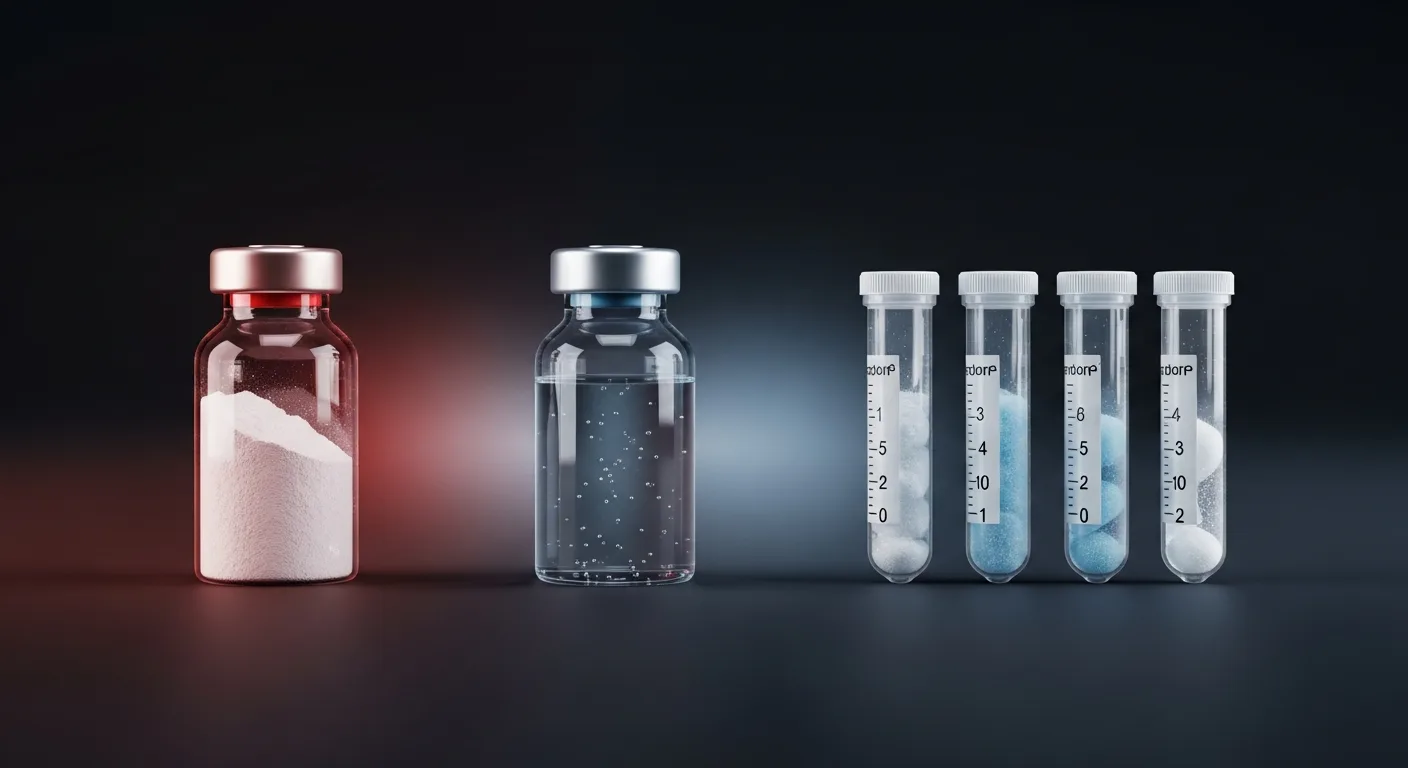
Peptide degradation doesn’t announce itself. A solution can look perfectly clear while losing 30 to 40% of its active content to oxidation or aggregation. The research literature on peptide formulation stability is clear: storage conditions matter enormously, and the mistakes researchers make most often are entirely avoidable. Manning et al. (2010) documented that improper freeze-thaw practices alone can cause significant aggregation in otherwise stable peptide formulations.
This guide covers everything researchers need to know about peptide storage and stability, from the lyophilized state through reconstitution, refrigeration, and multi-week use. We’ll get into the chemistry of what causes degradation, the practical best practices the literature supports, and the common mistakes that silently undermine experimental results.
- Lyophilized peptides stored at -20°C maintain stability for 2 or more years; reconstituted solutions should be used within 4 weeks at 2-8°C (with bacteriostatic water)
- Amino acid composition is the primary determinant of degradation susceptibility: cysteine, methionine, tryptophan, and asparagine are highest-risk residues
- Freeze-thaw cycles should be limited to 3 or fewer; aliquoting before initial freeze is the standard research practice
- Light exposure causes photodegradation in peptides with aromatic amino acids; amber vials and foil wrapping are appropriate precautions
- Chang and Pikal (2009) established that lyophilization cycle parameters directly affect long-term peptide stability
- pH of reconstitution vehicle affects solubility and stability; most peptides are stable at pH 4 to 8

Lyophilized vs Reconstituted: Understanding the Stability Difference
The most important concept in peptide storage is the difference between lyophilized (freeze-dried) and reconstituted states. These aren’t just different physical forms; they have fundamentally different chemical environments and degradation kinetics.
In the lyophilized state, water activity is extremely low (typically below 0.2). Without water as a medium, most degradation reactions slow to a near-halt. Hydrolysis can’t occur without water. Oxidation slows dramatically because dissolved oxygen isn’t present. Aggregation is minimized because peptide mobility is restricted in the solid matrix. This is why a lyophilized peptide stored properly can remain stable for years while the same peptide in solution degrades in weeks.
Chang and Pikal (2009, PMID: 19568956) established that the lyophilization process itself matters enormously for downstream stability. The primary drying and secondary drying cycle parameters determine residual moisture content, and residual moisture above 1 to 2% significantly accelerates degradation even in ostensibly “freeze-dried” products. Quality suppliers control these parameters carefully. Our quality assurance process includes residual moisture testing as part of lot release specifications.
Once reconstituted, the peptide is in an aqueous environment and all the degradation pathways reopen. The clock starts ticking. How fast depends on the peptide’s amino acid composition, the pH of the reconstitution vehicle, storage temperature, light exposure, and oxygen levels.
Temperature Requirements: A Practical Breakdown
Temperature is the most controllable variable in peptide storage, and the research guidance is consistent.
- Room temperature (15 to 25°C): appropriate for lyophilized peptides only during brief transit or bench handling. Not appropriate for extended storage. Most lyophilized peptides tolerate room temperature for 2 to 4 weeks without significant degradation, but this varies by composition.
- Refrigerator (2 to 8°C): appropriate for lyophilized peptides up to 12 to 24 months depending on composition, and for reconstituted solutions up to 4 weeks with bacteriostatic water.
- Freezer (-20°C): ideal for lyophilized peptide long-term storage (2 or more years). Reconstituted solutions can be frozen at -20°C but require careful attention to freeze-thaw cycle counts.
- Ultra-low freezer (-80°C): used for particularly sensitive peptides or when multi-year storage is required for reconstituted aliquots.
The practical reality: most researchers use a refrigerator for short-term storage of reconstituted solutions and a freezer for lyophilized stocks. That’s correct practice, as long as you’re tracking reconstitution dates and not letting solutions sit for more than 4 weeks. BPC-157, TB-500, and GHK-Cu are among the most commonly stored research peptides and all follow these general temperature guidelines.
Bacteriostatic Water: Why It’s the Standard Choice
Bacteriostatic water for injection is sterile water containing 0.9% benzyl alcohol as a bacteriostatic preservative. The benzyl alcohol inhibits bacterial proliferation in reconstituted solutions, which is critical for multi-draw vials used over weeks. Without it, a punctured septum introduces contamination risk each time a needle passes through.
The benzyl alcohol concentration (0.9%) is well below levels that affect most peptides. It’s not inert, some researchers have raised questions about benzyl alcohol compatibility with specific peptides, particularly those used in high-concentration formulations, but for the vast majority of research peptides at standard working concentrations, it’s compatible and appropriate.
Sterile water for injection (without benzyl alcohol) is an alternative, but it eliminates the bacteriostatic protection. A vial reconstituted with plain sterile water should be considered single-use or used within 24 hours, even under refrigeration. For protocols requiring multiple administrations from the same vial over days or weeks, bacteriostatic water is the documented standard. PT-141 and Thymosin Alpha 1 are examples of peptides typically reconstituted with bacteriostatic water in published research protocols.

Why BAC Water Is the Only Recommended Reconstitution Vehicle for Research Peptides
In a research laboratory setting, bacteriostatic water (BAC water for injection) is the established standard reconstitution vehicle for research peptides. It is not interchangeable with sterile water, saline, or tap water. Each alternative fails to meet the requirements of a multi-day or multi-week laboratory research protocol in specific, documented ways.
The defining characteristic of BAC water is its 0.9% benzyl alcohol preservative. This concentration inhibits microbial growth in reconstituted peptide solutions, extending the usable life of a reconstituted vial to up to 28 days when stored refrigerated at 2 to 8 degrees C. Sterile water without a preservative limits the viable use window to approximately 24 hours under the same refrigerated conditions. For any research protocol involving multiple draws from a single vial across days or weeks, sterile water is simply not the right tool.
Here is how the common alternatives compare in a laboratory context:
- Sterile water for injection: lacks a bacteriostatic preservative. A reconstituted solution must be used immediately or discarded within 24 hours. Not appropriate for multi-day research protocols or multi-draw vials.
- Saline (0.9% NaCl): the sodium chloride content can affect peptide solubility and stability in solution. Saline is not the standard reconstitution vehicle in published peptide research literature and is not recommended for laboratory peptide reconstitution.
- Tap water: not sterile, not pharmaceutical-grade, and not appropriate for any laboratory research application.
- BAC water: sterile, preservative-containing, pharmaceutical-grade, and specifically prepared for laboratory reconstitution use. The correct choice for research peptide reconstitution.
From a pH compatibility standpoint, BAC water for injection has a pH range of 4.5 to 7.0, which is compatible with the stability profiles of most research peptides. Most peptides remain stable across a pH range of 4 to 8, so BAC water falls squarely within that window for standard laboratory use.
In a laboratory setting, BAC water supports consistent, multi-draw research protocols. Each time a researcher draws from a reconstituted vial, the bacteriostatic preservative continues to inhibit microbial growth between draws. This is the property that makes it the appropriate choice for vials used over the course of days or weeks in active research.
Spartan Peptides BAC water is pharmaceutical-grade, sterile, and prepared specifically for laboratory reconstitution use. For researchers working with lyophilized peptide compounds, it is the standard reconstitution vehicle. Spartan Peptides offers pharmaceutical-grade BAC water prepared specifically for laboratory research use.
Light Sensitivity and Container Selection
Photodegradation is an underappreciated source of peptide loss. Tryptophan, tyrosine, and phenylalanine residues absorb UV and visible light, producing reactive oxygen species and oxidized products. The kinetics are fast enough to matter: Bhambhani and Bhatt (2015, PMID: 25920436) demonstrated measurable degradation in certain peptide formulations after just 4 hours of fluorescent light exposure.
This doesn’t mean your peptides are ruined the moment they leave the box. It means extended light exposure is a genuine degradation risk and worth actively preventing. A few practical points:
- Store reconstituted solutions in amber vials or wrap clear glass vials in aluminum foil
- Don’t leave vials on the benchtop under laboratory lighting between uses
- Return vials to refrigerated, dark storage promptly after drawing
- Use opaque secondary packaging for freezer storage
Peptides containing no aromatic amino acids are substantially less sensitive to light. But it’s easier to apply consistent light-protection practices across all peptides than to categorize each one individually.
Freeze-Thaw Cycles: The Hidden Stability Killer
Every freeze-thaw cycle is a stress event. As water freezes, ice crystals form and concentrate solutes. The mechanical forces from ice crystal formation can disrupt peptide structure. Thawing then re-exposes the peptide to a briefly concentrated, potentially high-oxidant environment. Manning et al. (2010, PMID: 19575236) documented progressive aggregation increases with each freeze-thaw cycle in multiple peptide and protein formulations.
The consensus recommendation from formulation literature is 3 cycles maximum. That’s not an arbitrary number; it reflects observed aggregation kinetics across a range of peptide types. Some peptides tolerate more cycles, some fewer. But 3 is a reasonable conservative limit that covers most research compounds.
The practical solution is simple: aliquot. After reconstitution, divide the solution into single-use volumes and freeze them. Each aliquot is thawed exactly once, used, and discarded. This approach adds a preparation step but eliminates repeat freeze-thaw stress entirely. It’s standard practice in research labs that work with biologics routinely.
Common Mistakes That Silently Degrade Results
The research literature on peptide formulation stability documents several recurring errors. These aren’t rare edge cases; they show up consistently in labs that haven’t formalized their storage protocols.
- Reconstituting without checking residual volume: injecting bacteriostatic water into a vial that already has some liquid from a previous reconstitution changes the final concentration unpredictably
- Adding bacteriostatic water too quickly: fast injection causes foaming and mechanical agitation that promotes aggregation; slow addition along the vial wall is better practice
- Vortex mixing: many researchers vortex to dissolve peptide quickly, but mechanical shear can fragment longer peptide chains; gentle swirling or rolling is preferable
- Skipping the date label: reconstituted vials without labeled dates inevitably outlast their 4-week window without anyone realizing
- Storing near the freezer door: temperature fluctuates significantly at the front of a freezer with regular door opening; vials should go toward the back
None of these cause immediate, visible problems. That’s what makes them dangerous in a research context: the degradation is silent until it shows up as inconsistent results or failed replications. See our editorial standards for more on how we document sourcing and quality for research compounds.
Amino Acid Composition and Sequence-Specific Risks
Knowing which residues are in your peptide helps predict storage risks. Franks (1998, PMID: 9860424) provided foundational analysis of how amino acid composition drives stability differences in lyophilized pharmaceutical peptides.
The high-risk residues and their degradation mechanisms are:
- Cysteine: disulfide bond formation between peptide chains (aggregation), oxidation to sulfenic/sulfinic acid
- Methionine: oxidation to methionine sulfoxide under even mild oxidative conditions
- Asparagine: deamidation (conversion to aspartate) accelerated at neutral to alkaline pH
- Glutamine: slower deamidation than asparagine but same mechanism
- Tryptophan: photodegradation and oxidation producing kynurenine and other products
- Tyrosine: photodegradation and dityrosine cross-linking under oxidative conditions
Peptides like GHK-Cu and BPC-157 contain none of the highest-risk residues in their primary sequences, which is part of why they’re relatively forgiving in storage. Peptides containing cysteine (some growth hormone analogs, for example) require more careful handling and may benefit from storage under nitrogen or argon atmosphere in sealed containers.
Shelf Life Summary and Practical Guidance
| State | Storage Condition | Estimated Shelf Life | Key Risk |
|---|---|---|---|
| Lyophilized | -20°C, dark, sealed | 2 to 3 years | Moisture ingress |
| Lyophilized | 2 to 8°C, dark, sealed | 12 to 24 months | Slight moisture, oxidation |
| Reconstituted (BAC water) | 2 to 8°C, amber vial, dark | Up to 4 weeks | Oxidation, bacterial growth |
| Reconstituted (sterile water) | 2 to 8°C | 24 hours | Bacterial growth, oxidation |
| Reconstituted aliquots | -20°C, single-use sealed | Up to 3 months | Freeze-thaw stress on each use |
PubMed Citations
- Manning MC et al. (2010). “Stability of protein pharmaceuticals: an update.” Pharm Res. PMID: 19575236
- Chang BS, Pikal MJ (2009). “Design of freeze-dried biopharmaceuticals by applying lessons learned from protein stability studies.” J Pharm Sci. PMID: 19568956
- Bhambhani A, Bhatt DS (2015). “Degradation pathways of peptide and protein drug candidates.” J Pharm Pharmacol. PMID: 25920436
- Franks F (1998). “Freeze-drying of bioproducts: putting principles into practice.” Eur J Pharm Biopharm. PMID: 9860424
Research Disclaimer: All products sold by Spartan Peptides are intended for laboratory and in vitro research purposes only. Not for human consumption. These statements have not been evaluated by the Food and Drug Administration. Products are not intended to diagnose, treat, cure, or prevent any disease. For research use only.
Written by the Spartan Research Team
Our team of peptide researchers and biochemists reviews every article for scientific accuracy. Learn more about our team →