
Sermorelin Research Guide: GHRH Analog and Growth Hormone Secretion

Written bySpartan Research Team
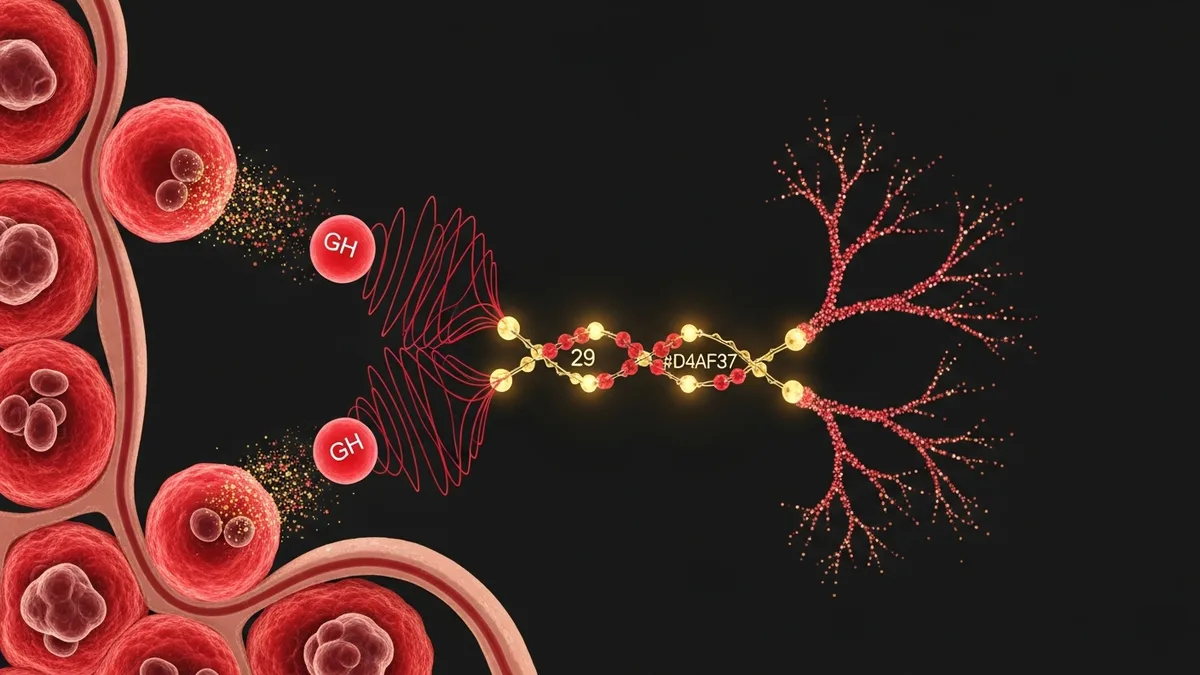
Sermorelin (GHRH 1-29-NH2) is a 29-amino acid synthetic peptide that mirrors the biologically active N-terminal segment of endogenous growth hormone-releasing hormone (GHRH). Researchers use sermorelin to study the hypothalamic-pituitary axis, particularly the mechanisms governing pulsatile growth hormone (GH) secretion from pituitary somatotrophs. Unlike recombinant human growth hormone, sermorelin acts upstream at the GHRH receptor, preserving the physiological feedback loop that governs GH release. This characteristic makes it a valuable tool for studying GH axis integrity in aging models, GH-deficient animal preparations, and neuroendocrine signaling research.
- Walker RF (2006) proposed that sermorelin offers a more physiological approach to GH axis modulation than exogenous GH administration, noting its action through the GHRH receptor preserves somatostatin-mediated feedback. (PMID 18043725)
- Rudman D et al. (1990) demonstrated that declining GH secretion correlates with age-related body composition changes in older men, establishing a basis for GHRH analog research in aging models. (PMID 2254895)
- Preclinical studies show sermorelin produces GH pulses within 30-45 minutes of administration in rodent models, with pulse amplitude varying by time of day and baseline somatostatin tone.
- Research comparing GHRH analogs indicates that sermorelin produces shorter-duration but more physiologically patterned GH pulses compared to long-acting analogs with albumin-binding modifications.
- In aged rodent models, repeated sermorelin administration has been associated with partial restoration of GH pulse frequency, a parameter reduced in aging populations according to multiple neuroendocrine studies.
Molecular Mechanism: GHRH Receptor Binding in Pituitary Research
Sermorelin exerts its effects by binding to the growth hormone-releasing hormone receptor (GHRHR), a G-protein coupled receptor expressed predominantly on pituitary somatotroph cells. Receptor activation triggers the Gs-adenylyl cyclase pathway, elevating intracellular cAMP and activating protein kinase A (PKA). PKA phosphorylates downstream targets that facilitate calcium influx through voltage-gated channels, triggering exocytosis of stored GH granules.
The 29-amino acid length of sermorelin represents the minimal sequence for full GHRHR binding. Studies comparing truncated GHRH fragments (1-28, 1-27) confirm that residues 1-29 are required for maximal receptor affinity and biological activity. The C-terminal amidation (-NH2) stabilizes the peptide against enzymatic degradation and is required for potent receptor activation, a design feature present in all clinically and research-relevant GHRH analogs.
This mechanism is distinct from growth hormone secretagogue receptor (GHSR) agonists such as ipamorelin or GHRP-6, which act on a separate receptor subtype. The GHRHR and GHSR pathways are synergistic, explaining why combinations of GHRH analogs with GHRPs are studied for enhanced GH pulse amplitude in research models.
Sermorelin vs. CJC-1295: Distinguishing Research Characteristics
Sermorelin is frequently compared to CJC-1295, a modified GHRH analog with a C-terminal lysine-drug affinity complex (DAC) that enables covalent albumin binding. The pharmacokinetic profiles of the two analogs differ substantially. Sermorelin has a biological half-life of approximately 10-20 minutes in research models, producing acute GH pulses that mirror the physiological release pattern more closely than long-acting analogs. Spartan does not carry sermorelin itself, but researchers studying the same GHRH analog class can review the CJC-1295 product page above as the closest available comparison compound.
CJC-1295 with DAC achieves a half-life of 6-8 days via albumin binding, producing a sustained GH elevation that researchers describe as a “GH bleed” rather than a pulsatile pattern. Each approach has different research utilities: sermorelin is preferred when researchers wish to study pulsatile GH physiology or acute GHRHR signaling responses, while CJC-1295 DAC is used in models requiring sustained GH elevation for body composition or anabolic signaling endpoints.
Tesamorelin, another GHRH analog used in visceral fat metabolism research, has an intermediate half-life of 20-30 minutes and includes a trans-3-hexenoic acid modification at the N-terminus that confers enhanced enzymatic stability compared to sermorelin.

Sermorelin in Aging Research: GH Axis Restoration Models
A central area of sermorelin research involves age-related GH decline. Pituitary somatotroph cells retain the capacity to produce GH throughout life, but hypothalamic GHRH output declines with age, while somatostatin tone increases. This creates reduced GH pulse frequency and amplitude. Researchers studying sermorelin in aged animal models examine whether GHRH receptor stimulation can partially restore the GH secretion patterns characteristic of younger subjects.
Animal studies have evaluated sermorelin in conjunction with other longevity-related compounds, including IGF-1 LR3, which represents the downstream GH-induced signal in peripheral tissues. The relationship between GH pulses from sermorelin administration and subsequent IGF-1 hepatic production is a central endpoint in GH axis research. Preclinical literature suggests that restored GH pulsatility via GHRH analogs may produce more physiological IGF-1 patterns than continuous GH administration.
The anti-aging peptide research space also explores sermorelin in combination with other compounds. Researchers studying the hexarelin combination with GHRH analogs have documented synergistic increases in GH pulse amplitude, consistent with the dual-receptor model of GH secretion in the pituitary.
Sermorelin Research Protocol Considerations
In preclinical research, sermorelin is typically administered via subcutaneous or intravenous injection. The short half-life (10-20 minutes) means peak GH response occurs within 30-45 minutes, with return to baseline within 2-3 hours in most animal models. Researchers studying circadian GH patterns often administer sermorelin at specific time points relative to light-dark cycles to assess GHRH sensitivity changes across the day.
Sample collection timing is critical in sermorelin research. Blood GH levels peak rapidly post-administration and decline quickly, making serial sampling at 15-30 minute intervals necessary for accurate characterization of the GH pulse. Researchers using rat or mouse models typically employ portal or jugular catheterization for serial sampling without repeated venipuncture stress artifacts.
For body composition endpoints in rodent research, studies have used dosing frequencies ranging from daily to three-times-weekly administration, measuring dual-energy X-ray absorptiometry (DEXA) and wet tissue weights at study termination. Researchers interested in ipamorelin and sermorelin stacking studies should note that the two compounds act on different receptors and have been combined in published research for synergistic GH pulse amplification.
Sermorelin Safety Profile in Research Models
Preclinical safety data for sermorelin across rodent and primate models shows a favorable tolerability profile at research doses. The most commonly observed effects are localized injection site reactions and transient facial flushing in primate models. No major organ toxicity has been documented in published animal studies at doses used in standard GH axis research protocols.
The physiological ceiling on GH release created by somatostatin feedback represents an intrinsic safety feature of GHRH analog research models. Unlike direct GH administration, sermorelin cannot produce supraphysiological GH levels beyond the pituitary’s secretory capacity within the somatostatin regulatory constraint. This characteristic is frequently cited in comparative pharmacology literature as a distinguishing safety feature of GHRH analogs.
Sermorelin and IGF-1 Axis Research
A key area of sermorelin research involves its downstream effects on insulin-like growth factor 1 (IGF-1), the primary mediator of many growth hormone actions at peripheral tissues. When GH is released from pituitary somatotrophs following GHRHR activation, it travels through the portal circulation to the liver, where it stimulates IGF-1 synthesis and secretion. Researchers use sermorelin as a tool to study this somatotropic axis because its short half-life allows controlled, time-limited GH pulse induction without the sustained IGF-1 elevation associated with direct GH administration.
Published neuroendocrine studies in rodent models have documented that sermorelin-induced GH pulses produce measurable, transient IGF-1 responses within 2-4 hours post-administration. The amplitude of the IGF-1 response is proportional to baseline GH axis integrity, making sermorelin a useful functional probe in models designed to assess GH axis responsiveness. Researchers studying age-related GH axis decline use sermorelin challenge protocols to characterize the degree of somatotroph responsiveness remaining in aged animals.
In research designs comparing GHRH analog types, sermorelin-driven IGF-1 responses show a distinct peak-and-decline pattern compared to the sustained IGF-1 elevation produced by long-acting analogs such as CJC-1295 with DAC. This kinetic difference is important when investigators are studying receptor desensitization, tachyphylaxis, or the consequences of intermittent versus sustained IGF-1 signaling on downstream pathways such as PI3K/Akt and MAPK cascades.
Investigators also note that GHRH receptor desensitization with repeated sermorelin dosing is modest compared to synthetic long-acting analogs, a characteristic that supports its use in chronic dosing study designs. Research in animal models suggests that pituitary somatotroph responsiveness to sermorelin is maintained over extended protocols, providing a stable pharmacodynamic baseline for longitudinal research projects.
Explore Spartan Peptides’ catalog of research-grade compounds: Browse Spartan Peptides Research Compound Catalog
Written by the Spartan Research Team
Our team of peptide researchers and biochemists reviews every article for scientific accuracy. Learn more about our team →