
AOD-9604 vs MOTS-C: Fat Metabolism Mechanism Comparison

Written bySpartan Research Team
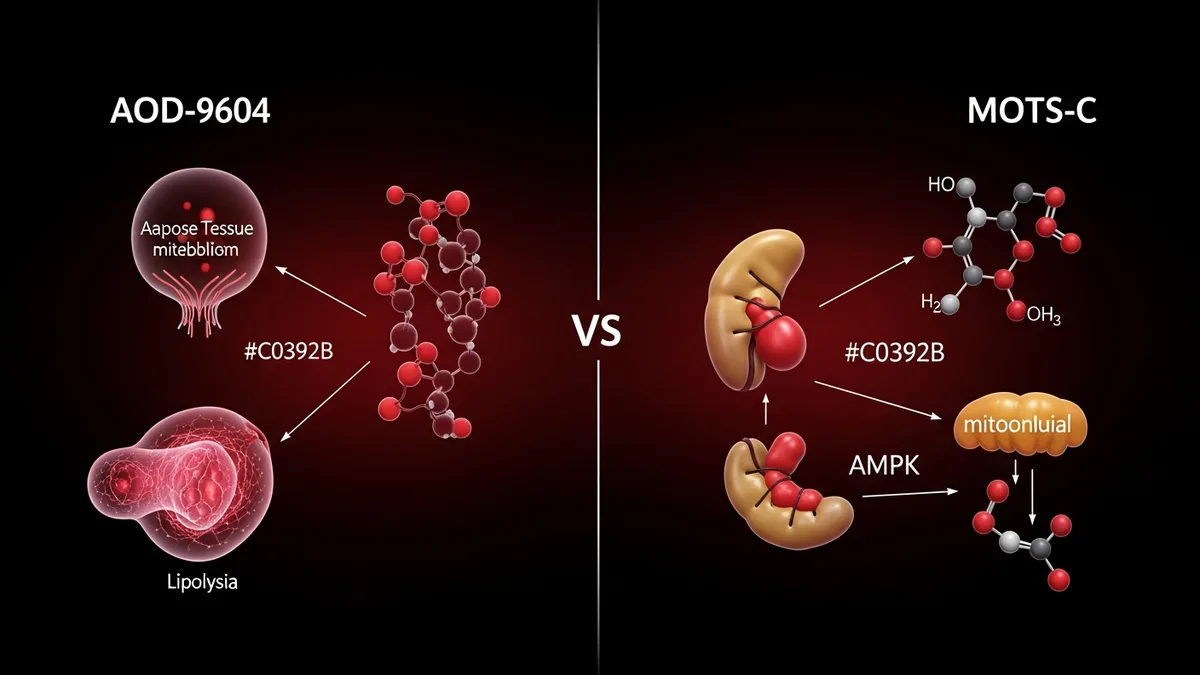
AOD-9604 and MOTS-C represent two fundamentally different approaches to fat metabolism research. AOD-9604 is a synthetic fragment of human growth hormone designed to isolate the lipolytic activity of hGH without affecting IGF-1 levels or insulin sensitivity. MOTS-C is a mitochondria-derived peptide encoded in the mitochondrial genome that activates AMPK and regulates substrate utilization at the cellular energy level. Both reduce fat mass in preclinical models, but they do it through machinery that has almost nothing in common. That makes them genuinely useful comparative tools for researchers trying to understand which metabolic lever drives which outcome.
- Heffernan et al. demonstrated that AOD-9604 reduced body fat in diet-induced obese mice without affecting IGF-1 levels, insulin sensitivity, or glucose homeostasis, distinguishing its metabolic profile from full-length hGH (PMID 11522566).
- Lee et al. (2015) identified MOTS-C as a mitochondrial-encoded peptide and showed it activates AMPK, improves insulin sensitivity, and reduces fat accumulation in high-fat diet mouse models through a mechanism involving the AMPK/FOXO1 axis (PMID 25738459).
- Both compounds show exercise-interaction effects in animal models, but the direction of these effects differs: AOD-9604 enhances lipolysis independent of activity level, while MOTS-C levels rise naturally with exercise, suggesting a physiological role as an exercise-responsive metabolic regulator.
AOD-9604: A Growth Hormone Fragment, Not a Secretagogue
AOD-9604 is the C-terminal fragment of hGH corresponding to amino acids 177-191, with a tyrosine added to the N-terminus for stability. Full-length growth hormone has two separable functional domains: the N-terminal region drives IGF-1 production and the anabolic effects, while the C-terminal region (including the 177-191 fragment) carries the lipolytic activity. The rationale for AOD-9604 as a research compound was to isolate that lipolytic activity from the growth-promoting and insulin-antagonizing effects of full hGH.
The separation largely holds up in preclinical data. In the Heffernan et al. studies from the early 2000s, AOD-9604 treatment in obese rodents produced dose-dependent reductions in fat mass without elevating IGF-1, and without producing the insulin resistance that full-length GH creates at high doses. The mechanism involves beta-3 adrenergic receptor activation in adipocytes, triggering hormone-sensitive lipase activity and triglyceride hydrolysis. It’s a direct lipolytic signal, not a systemic hormonal change.

AOD-9604 and MOTS-C are both available from Spartan Peptides for fat metabolism research. View AOD-9604 | View MOTS-C
MOTS-C: Mitochondria’s Own Metabolic Messenger
MOTS-C is a 16-amino acid peptide encoded within the 12S rRNA gene of the mitochondrial genome. When Changhan David Lee and colleagues at USC published the discovery paper in 2015 (PMID 25738459 in Cell Metabolism), it was among the first clear demonstrations that the mitochondrial genome encodes functional peptide signals that regulate metabolic processes. MOTS-C isn’t just produced locally in mitochondria: it’s secreted into circulation and acts as an endocrine-like messenger.
The primary metabolic effect in Lee’s original study involved improved insulin sensitivity and reduced fat accumulation in high-fat diet mice. The mechanism centers on AMPK activation. MOTS-C activates AMPK in skeletal muscle by modulating the AICAR-AMPK pathway (specifically through effects on the folate cycle and AICAR generation), which shifts cellular metabolism toward glucose and fatty acid oxidation. FOXO1 transcription factor activity is also modulated downstream of AMPK, contributing to reduced gluconeogenesis and enhanced lipid oxidation gene expression.
Lipolysis vs. Mitochondrial AMPK: How the Mechanisms Diverge
This is the core mechanistic comparison between the two compounds. AOD-9604 drives lipolysis: it activates adipocyte lipases to break down stored triglycerides. The fat leaves the adipocyte as free fatty acids and glycerol. What happens to those free fatty acids downstream depends on other metabolic conditions. If energy demand is low, they can be re-esterified or stored elsewhere. The lipolytic action is direct and localized to adipose tissue.
MOTS-C works at the oxidative level. By activating AMPK in skeletal muscle and liver, it increases the capacity for fatty acid oxidation and glucose utilization. It doesn’t directly trigger lipolysis from adipocytes in the same receptor-mediated way. Instead, it creates the metabolic sink conditions that favor fatty acid clearance: when AMPK is active and beta-oxidation is running hot, released fatty acids get consumed rather than re-stored.
The distinction matters for research design. If you want to study the lipolytic step specifically, AOD-9604 is the cleaner tool. If you want to study mitochondrial metabolic capacity, AMPK activation, or insulin sensitization, MOTS-C is more relevant. If you want to understand the full arc from fat mobilization to fat oxidation, both together provide the mechanistic pair that covers it.
Exercise Interaction Data
MOTS-C has a documented relationship with exercise physiology that AOD-9604 doesn’t have. Kim et al. (2022) showed that endogenous MOTS-C levels rise in plasma following acute aerobic exercise in both rodents and humans, and that this rise tracks with exercise-induced AMPK activation in skeletal muscle. The peptide appears to function as part of the muscle-to-adipose tissue communication system that coordinates fuel utilization during exercise. This exercise-mimetic profile has attracted interest in metabolic research contexts where exercise response biology is the focus.
AOD-9604 doesn’t show a similar exercise interaction profile in published data. Its lipolytic action occurs regardless of activity level and doesn’t appear to be modulated by exercise status in the studied models. That makes it a useful baseline tool in metabolic research: its effect on adipose tissue is more independent of the exercise variable, which can be a confound in studies that aren’t specifically controlling for activity.
Fat Mass Outcomes Compared Across Studies
Both compounds reduce fat mass in diet-induced obesity models in rodents. The magnitude and time course differ. AOD-9604 studies typically show fat mass reductions within 2-4 weeks in high-fat diet rodents, with the effect proportional to dose. Heffernan et al. (2001, PMID 11522566) reported approximately 20-50% reductions in fat mass compared to vehicle controls at various doses, with the effect plateauing at higher doses. Lean mass was preserved in all groups, which is one of the pharmacological advantages attributed to AOD-9604 over full hGH in obesity research contexts.
MOTS-C’s fat mass effects in Lee et al. (2015) were significant but perhaps less dramatic in raw percentage terms, partly because its effects were distributed across multiple metabolic parameters (insulin sensitivity, glucose tolerance, and fat mass) rather than being concentrated purely on adipose tissue. The broader metabolic improvement is arguably more relevant for studies modeling metabolic syndrome, while AOD-9604’s clean lipolytic effect is more relevant for studies specifically examining adipose tissue biology.
Research Applications and Sourcing
- AOD-9604: Best suited for studies examining direct adipocyte lipolysis, beta-3 adrenergic receptor signaling, or GH fragment pharmacology. Available from Spartan Peptides at AOD-9604.
- MOTS-C: Best suited for studies on mitochondrial signaling, AMPK pathway activation, insulin sensitization, or exercise biology. Available from Spartan Peptides at MOTS-C.
- Combination designs: Researchers studying the full fat metabolism arc from mobilization to oxidation can use both compounds in parallel-arm or sequential designs to separate mechanistic contributions.
- Related compounds: Tesamorelin provides a GHRH axis approach to fat metabolism research, particularly in visceral adiposity models, offering a third mechanistic reference point.
Frequently Asked Questions
Related Research Reading
- Best Peptides for Weight Loss 2026 | Spartan Peptides
- Peptides for Hormone Optimization: Beyond Testosterone
- What Is GLP-1 Sema? Research Peptide Basics Explained
- AOD-9604 for Sale: Research Sourcing Guide for the Fat Loss Peptide Fragment
- Epithalon: Telomerase Activation and Anti-Aging Research Guide
Written by the Spartan Research Team
Our team of peptide researchers and biochemists reviews every article for scientific accuracy. Learn more about our team →