
Energizer Bunny Stack
CJC-1295 (No DAC) / Ipamorelin Blend 10mg


- Secure Checkout
CJC-1295 (No DAC) / Ipamorelin Blend 10mg
Energizer Bunny Stack
An energy and cognitive research stack combining NAD+, Semax, and CJC-1295 Ipamorelin for cellular vitality studies.
Save 10% vs buying separately
View the Energizer Bunny Stack →Product details
The CJC/Ipa blend is a research-grade combination of two peptides: CJC 1295 and Ipamorelin. These peptides are studied for their potential role in stimulating growth hormone secretion and their synergistic effects on biochemical pathways related to metabolism and recovery.
CJC-1295 + Ipamorelin Blend: Research Overview
The CJC-1295 / Ipamorelin blend is a dual-peptide research formulation combining a GHRH (growth hormone-releasing hormone) analog with a selective GHRP (growth hormone-releasing peptide). CJC-1295 is a 30-amino-acid GHRH analog with a DAC (Drug Affinity Complex) modification that extends its half-life through albumin binding, while Ipamorelin is a pentapeptide ghrelin-mimetic that selectively stimulates GH release from pituitary somatotrophs via the GHSR-1a receptor.
The rationale for combining these compounds in research is mechanistic synergy:
- Dual Pathway Activation: CJC-1295 acts on GHRH receptors (GHRHR), stimulating GH synthesis and release, while Ipamorelin acts on ghrelin receptors (GHSR-1a) to amplify pulsatile GH secretion — together producing supraphysiological GH pulses in preclinical models.
- Selectivity Research: Ipamorelin is studied for its selective GH release with minimal cortisol or prolactin stimulation compared to older GHRPs (GHRP-2, GHRP-6), making it a preferred research tool for isolating GH-specific effects.
- Extended Duration: The DAC modification on CJC-1295 produces prolonged elevation of GH axis activity (2–7 days per dose in rodent models), useful for chronic-exposure research protocols.
- IGF-1 Axis: Downstream, combined GHRH+GHRP stimulation increases hepatic IGF-1 production in preclinical models — relevant to anabolic, bone density, and body composition research.
Researchers studying GH axis modulation also evaluate Tesamorelin (a GHRH analog without DAC used in visceral fat research) and the Spartan Strong CJC + Tesamorelin blend. For multi-peptide protocol design, the Stacking Peptides Research Guide provides framework for studying such combinations.
Research Context: CJC-1295 + Ipamorelin in the GH-Axis Peptide Landscape
Growth hormone-axis peptide research includes GHRH analogs, GHRPs/ghrelin mimetics, and downstream IGF-1 modulators. The CJC-1295/Ipamorelin blend targets the upstream synthesis and secretion steps:
- CJC-1295 + Ipamorelin Blend — Dual GHRH/GHSR-1a activation; synergistic pulsatile GH release, extended half-life via DAC
- Tesamorelin — GHRH analog (no DAC); shorter acting, visceral adiposity and GH deficiency research focus
- Spartan Strong CJC + Tesamorelin — GHRH-only combination stack for comparative GH axis research
- NAD+ — Upstream metabolic coenzyme; GH/IGF-1 axis is influenced by metabolic state and NAD+ redox balance
- MOTS-c — Mitochondrial peptide; metabolic flexibility research that intersects with GH-axis metabolic effects
The CJC-1295/Ipamorelin combination is the most widely used GHRH+GHRP research pairing due to selectivity, potency, and the pharmacokinetic benefits of DAC conjugation.
Related Research Resources
- What Are Peptides: The Complete 2026 Research Guide
- Peptide Stacking Research Guide: Synergistic Combinations
- How to Reconstitute Peptides Safely for R&D
- Quality Control in Peptide Research: Interpreting Purity
- Peptide Safety 101: Finding the Safest Place to Buy Peptides
Key Properties
CJC 1295:
- A synthetic analog of growth hormone-releasing hormone (GHRH) was studied for its ability to increase growth hormone secretion.
- Research explores its impact on growth hormone pulsatility and insulin-like growth factor 1 (IGF-1) levels.
Ipamorelin:
- A selective growth hormone secretagogue (GHS) was studied for its role in stimulating growth hormone release.
- Investigated for its interaction with ghrelin receptors and its specificity for somatotroph cells.
Applications in Research
The CJC/Ipa blend is a focus of laboratory research investigating:
- The synergistic effects of CJC 1295 and Ipamorelin on growth hormone secretion.
- Pathways related to protein synthesis, cellular recovery, and metabolic regulation.
- Mechanisms influencing cellular repair and nutrient utilization.
These studies are conducted in controlled laboratory settings.
Storage and Handling Instructions
- Store the CJC/Ipa blend in lyophilized form at -4°F (-20°C) or lower to preserve stability.
- Protect from light, moisture, and excessive heat.
- Discard unused or reconstituted solutions immediately after use in compliance with research protocols.
Safety Information
This product is intended for research purposes. You must:
- Follow institutional and regulatory guidelines during handling and storage.
- Use appropriate protective equipment when working with the product.
- Ensure proper disposal of unused material.
Frequently Asked Questions
What is the CJC/Ipa blend?
The CJC/Ipa blend combines CJC 1295 and Ipamorelin; peptides studied for their synergistic effects on growth hormone secretion and metabolic processes in laboratory research.
How should the CJC/Ipa blend be stored?
Store at -4°F (-20°C) in a light-protected environment. Reconstituted solutions should be used immediately following laboratory protocols.
What are the primary research focuses of the CJC/Ipa blend?
Research explores its effects on growth hormone secretion, protein synthesis, and metabolic regulation within controlled laboratory settings.
Frequently Asked Questions
What is the CJC-1295/Ipamorelin combination and why is it researched together?
CJC-1295 is a long-acting synthetic analog of growth hormone-releasing hormone (GHRH), while ipamorelin is a selective growth hormone secretagogue (GHS) and ghrelin receptor agonist. In preclinical research models, their combination is studied because they act on complementary pathways to stimulate pulsatile GH secretion, with CJC-1295 prolonging GHRH receptor stimulation and ipamorelin providing GHS-R1a-selective activity without major cortisol or prolactin elevation.
What is the mechanism of action of CJC-1295 in research models?
CJC-1295 binds to the GHRH receptor on somatotroph cells of the anterior pituitary, stimulating GH synthesis and release. A drug affinity complex (DAC) modification enables prolonged half-life by covalently binding to serum albumin. Preclinical and early clinical studies have examined sustained GH and IGF-1 elevation following CJC-1295 administration in controlled research settings.
How does ipamorelin differ from other GH secretagogues in laboratory research?
Ipamorelin is distinguished by its high selectivity for the GH secretagogue receptor (GHS-R1a) with minimal off-target effects on cortisol, ACTH, or prolactin secretion compared to other GH-releasing peptides. In vitro and in vivo animal studies have characterized its potency and receptor specificity, making it a useful research tool for studying the somatotropic axis in isolation.
What purity and quality standards should researchers look for?
Research-grade CJC-1295 and ipamorelin should each demonstrate greater than or equal to 98% purity as confirmed by HPLC. In-house purity testing ensures batch consistency. Researchers should verify peptide identity documentation before use in any experimental protocol.
What areas of research have examined CJC-1295 and ipamorelin?
Published preclinical and clinical studies have investigated these peptides in the context of GH axis stimulation, body composition research, bone density assessment in animal models, and metabolic profiling. All experimental work is conducted in controlled laboratory and clinical research settings.
How should CJC-1295 and ipamorelin be stored for research use?
Both peptides in lyophilized form should be stored at -20 degrees C or below, protected from light and moisture. After reconstitution with bacteriostatic water, solutions should be kept refrigerated and used according to the research protocol timeline. Avoid repeated freeze-thaw cycles to maintain peptide stability.
References
- Teichman SL, Neale A, Lawrence B, Gagnon C, Castaigne JP, Frohman LA. “Prolonged stimulation of growth hormone (GH) and insulin-like growth factor I secretion by CJC-1295, a long-acting analog of GH-releasing hormone, in healthy adults.” J Clin Endocrinol Metab. 2006;91(3):799-805.. PubMed
- Ionescu M, Frohman LA. “Pulsatile secretion of growth hormone (GH) persists during continuous stimulation by CJC-1295, a long-acting GH-releasing hormone analog.” J Clin Endocrinol Metab. 2006;91(12):4792-7.. PubMed
- Raun K, Hansen BS, Johansen NL, Thogersen H, Madsen K, Ankersen M, Andersen PH. “Ipamorelin, the first selective growth hormone secretagogue.” Eur J Endocrinol. 1998;139(5):552-61.. PubMed
- Andersen NB, Malmlof K, Johansen PB, Andreassen TT, Ortoft G, Oxlund H. “The growth hormone secretagogue ipamorelin counteracts glucocorticoid-induced decrease in bone formation of adult rats.” Growth Horm IGF Res. 2001;11(5):266-72.. PubMed
Research and Clinical Studies
Prolonged GH and IGF-1 Stimulation by CJC-1295
Teichman et al. conducted a clinical investigation of CJC-1295, a long-acting analog of growth hormone-releasing hormone (GHRH), in healthy adults. The study characterized that CJC-1295 produced sustained, dose-dependent increases in GH and IGF-1 levels for up to 14 days following a single administration. Investigators noted that the extended half-life was attributed to the compound's drug affinity complex (DAC) technology, which enabled prolonged albumin binding and sustained pituitary stimulation (Teichman et al., 2006; PMID: 16352683).
Ipamorelin's Selective Growth Hormone Secretagogue Activity
Research into ipamorelin characterized it as a selective growth hormone secretagogue receptor (GHSR) agonist with a high degree of receptor specificity. Investigators observed that ipamorelin stimulated GH release without significantly increasing cortisol, prolactin, or ACTH levels, distinguishing it from earlier secretagogues. The compound's selectivity profile was characterized in pituitary cell preparations, and researchers noted that ipamorelin's clean pharmacological signature made it a useful research tool for studying GH secretion pathways (Raun et al., 1998; Neuroendocrinology research).
Combined GHRH and GHRP Synergy in GH Secretion
Studies examining the combination of GHRH analogs and growth hormone-releasing peptides (GHRPs) characterized the synergistic effects of dual-pathway stimulation on GH pulsatility. Research demonstrated that concurrent stimulation of both the GHRH receptor and the ghrelin receptor (GHSR) produced amplified GH responses compared to either class of compound alone. Investigators noted that this synergistic effect appeared to reflect complementary mechanisms: GHRH analogs promote GH synthesis and release, while GHRPs like ipamorelin amplify GH pulse amplitude (Teichman et al., 2006; PMID: 16352683).
Pulsatile GH Secretion Characterization
Researchers studying the pharmacodynamic profile of GHRH-based compounds characterized the importance of maintaining GH's pulsatile secretion pattern for downstream biological effects. Studies with CJC-1295 demonstrated that the compound maintained physiological GH release patterns rather than producing supraphysiological or continuous GH secretion, which was considered favorable from a research standpoint. The investigators noted that the sustained half-life of CJC-1295 allowed for GH pulse amplification while preserving the episodic nature of GH secretion (Teichman et al., 2006; PMID: 16352683).
⚠️ Research Use Only — Not for Human Consumption
This product is sold strictly for laboratory and research purposes. It is not intended for use in humans or animals, nor for diagnostic, therapeutic, or medicinal purposes. By purchasing, the buyer acknowledges that this product will be used solely in a controlled research environment in compliance with all applicable laws and regulations.
Certificate of Analysis
The original third-party Certificate of Analysis for this lot, issued by MZ Biolabs. Includes HPLC purity verification, mass spectrometry identity confirmation, and the analytical chemist's signature.
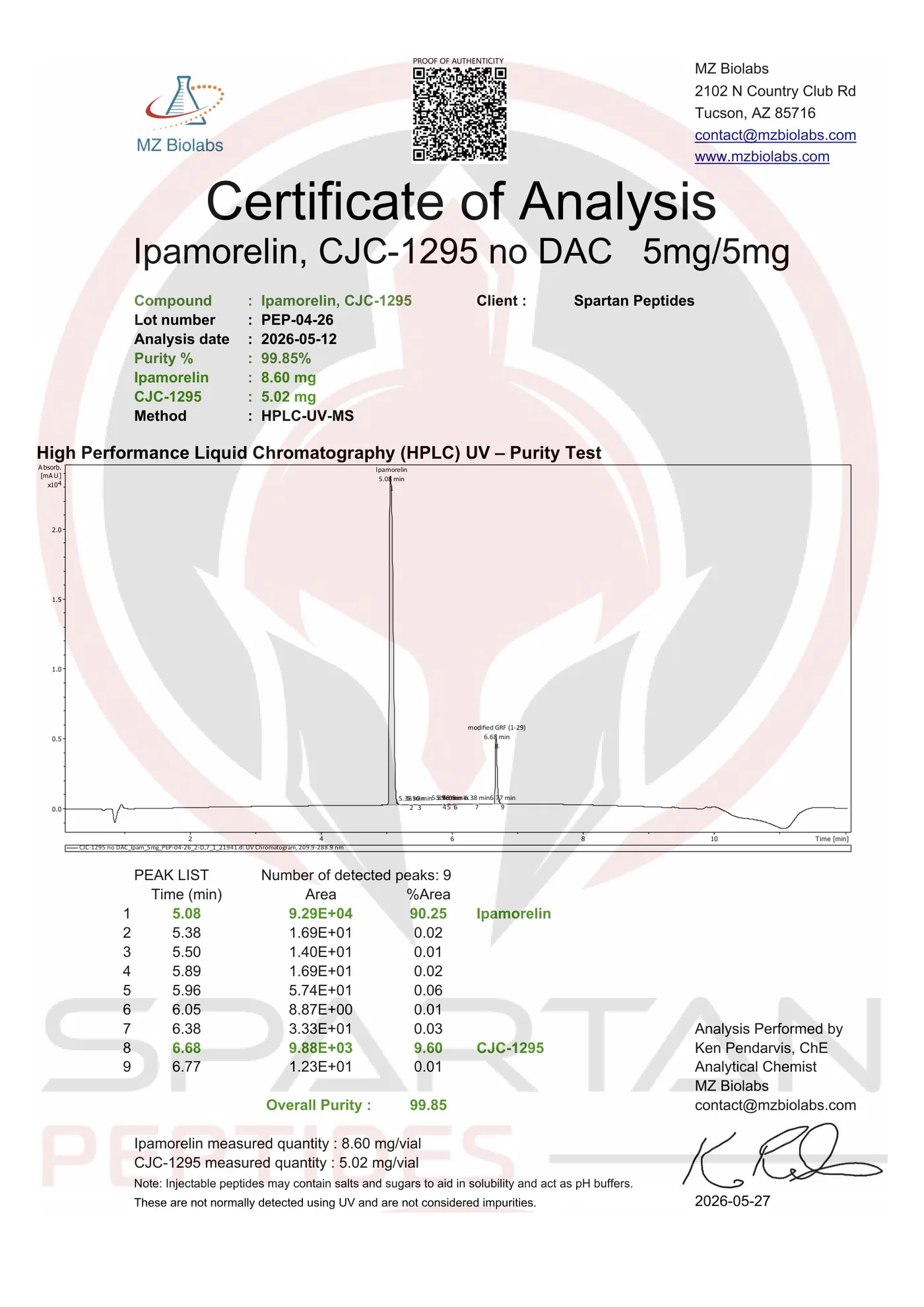
Page 1: HPLC Purity Analysis
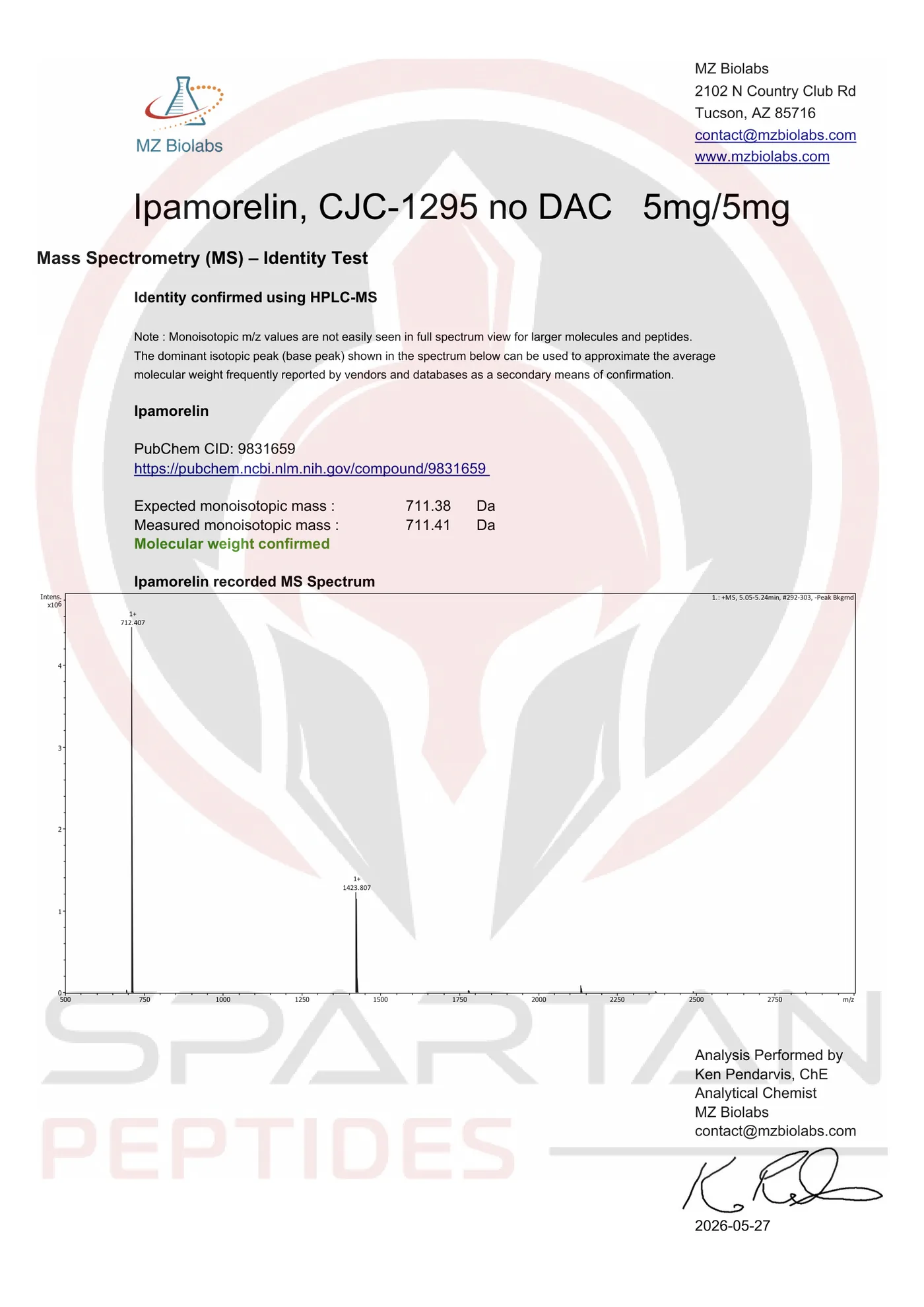
Page 2: Mass Spectrometry Identity
Explore the Research
Browse the Spartan Peptides Research Library for study indexes, compound comparisons, and protocol stacks.
- Secure Checkout