
Miami’s Anti-Aging Research Scene: Why Florida Has Become a Longevity Peptide Market

Written bySpartan Research Team
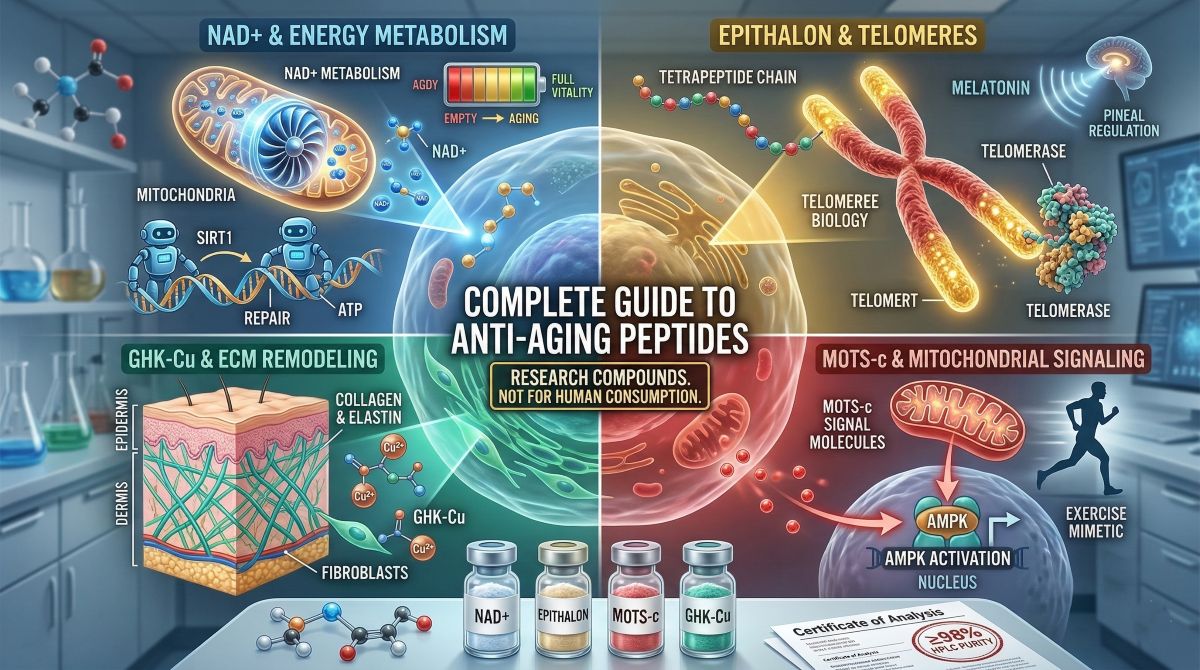
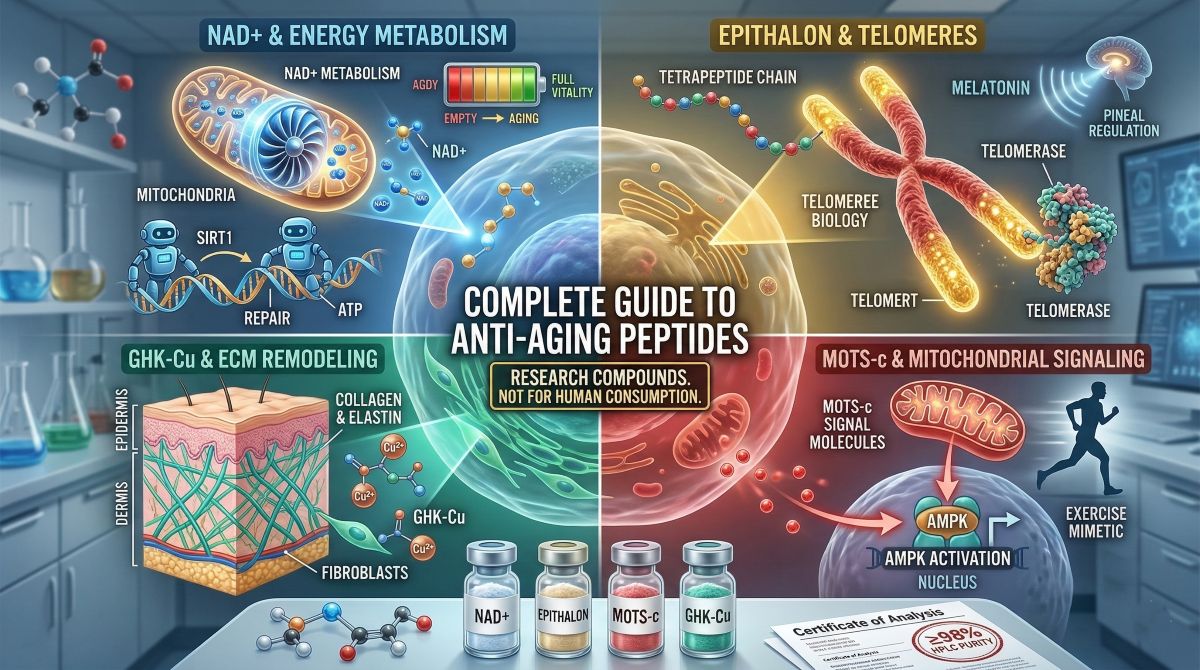
South Florida’s anti-aging research community is one of the most compound-literate in the country. Miami’s optimization-focused biohackers, wellness-forward professionals, and longevity-oriented researchers have built a peptide sourcing culture grounded in specific purity standards, domestic manufacturing preference, and a deep familiarity with the preclinical literature behind the compounds they work with. In 2026, the region has become one of the top peptide research markets in the United States — and the compounds driving that interest reflect the community’s specific focus: collagen synthesis, cellular energy, telomere biology, and recovery pathway research.
🔮 Key Research Findings
- GHK-Cu has been documented as a natural modulator of multiple cellular pathways in skin regeneration — collagen synthesis, antioxidant response, wound repair — making it the top-sourced compound among South Florida’s anti-aging research community (PMID: 26236730).
- NAD+ levels decline measurably with age; preclinical research identifies it as a regulator of mitochondrial metabolism, DNA repair, and sirtuin activation — the compound profile most frequently cited by longevity-oriented Florida researchers (PMID: 26785480).
- Epithalon’s proposed role in telomerase activation and telomere-length research has made it a consistent sourcing priority among Miami’s optimization-focused research community, frequently co-sourced with NAD+ and GHK-Cu.
- BPC-157’s broad preclinical profile in connective tissue repair, gut healing, and angiogenesis supports its position as a high-volume compound in South Florida’s wellness-adjacent research market.
Miami’s Position as a Longevity Research Hub
Miami has built its identity around aspiration and physical vitality. That culture has attracted the kind of optimization-focused professionals and biohackers who take the preclinical literature seriously — people who are not waiting for clinical approval cycles to study compounds with well-documented mechanisms in preclinical models. South Florida’s research community is compound-literate in a way that distinguishes it from more casually wellness-oriented markets.
The region’s medical infrastructure supports that orientation. Miami’s density of functional medicine clinics, integrative health practices, and concierge wellness providers has created a professional class of researchers who understand HPLC purity standards, can evaluate a certificate of analysis, and have clear preferences about domestic versus overseas manufacturing. The peptide compounds this community gravitates toward are not chosen at random — they are selected for the specificity and depth of their preclinical profiles.
The corridor extends north through Fort Lauderdale and into Boca Raton and Palm Beach. Boca Raton’s concentrated population of affluent, longevity-focused residents has made it a particularly active peptide research market, with sourcing patterns skewed heavily toward anti-aging and collagen-biology compounds. Palm Beach’s wellness community adds further depth. This South Florida corridor collectively represents one of the highest-value peptide research demographics in the US.
The Core Compounds: What South Florida Researchers Source and Why
South Florida’s anti-aging research community has developed clear compound preferences that map directly onto the preclinical literature most relevant to their research focus.
GHK-Cu (Copper Tripeptide-1) is sourced by Miami’s optimization-focused research community at a rate consistent with the compound’s exceptionally well-documented role in skin regeneration research. Preclinical models have documented GHK-Cu’s involvement in collagen and glycosaminoglycan synthesis, upregulation of antioxidant enzymes, modulation of matrix metalloproteinases, and wound repair acceleration. For researchers focused on the biology of dermal aging, GHK-Cu’s preclinical profile is unusually deep. Full coverage in our GHK-Cu complete research guide.
NAD+ (Nicotinamide Adenine Dinucleotide) is the flagship compound of longevity-oriented research programs globally, and South Florida’s community reflects that trend with particular intensity. Its documented role in mitochondrial function, sirtuin pathway activation, and DNA repair mechanisms — combined with its well-established decline with biological aging — makes it a core compound for researchers studying cellular aging pathways. NAD+ is frequently co-sourced with GHK-Cu and Epithalon by Miami researchers running multi-pathway longevity protocols. See our NAD+ research guide for the full preclinical overview.
Epithalon is a synthetic tetrapeptide with a preclinical focus on telomere biology and cellular aging pathways. Research has examined its proposed role in telomerase activation and telomere-length maintenance, positioning it as a compound of interest for researchers studying the mechanistic underpinnings of cellular longevity. Miami’s optimization-focused research community sources Epithalon at volumes consistent with a strong regional interest in multi-compound longevity stacks.
BPC-157 rounds out the core group. Its broad preclinical profile — tissue repair, gut healing, angiogenesis, and connective tissue recovery — makes it a consistent sourcing choice for South Florida researchers whose work spans recovery biology and systemic healing pathway research.
Florida’s Research Market: Latin American Networks and the Longevity Corridor
Florida’s unique geographic and cultural position gives its research community access to networks that few other US markets can match. South Florida researchers maintain active connections to academic and clinical institutions in Brazil, Argentina, Colombia, and Spain — markets where peptide research has a longer academic track record and where the published literature on compounds like Epithalon and GHK-Cu is both deeper and more widely read.
This gives Florida-based optimization-focused researchers a compound literacy that often exceeds what you find in other US peptide markets. They are sourcing based on specific preclinical data, not trend cycles. They know what purity standards they require, what formulation they need, and why domestic manufacturing matters to the integrity of their research outcomes.
The wellness clinic ecosystem reinforces this orientation. South Florida’s density of functional medicine practices and integrative health providers creates a professional research community that evaluates compounds seriously — a community that has clear preferences about where they source and why.
What South Florida’s Research Community Requires from Suppliers
Miami’s optimization-focused researchers have specific, non-negotiable requirements when it comes to peptide sourcing. The baseline is HPLC-verified purity at 98% or greater — the standard the research community treats as the minimum for compounds used in serious research applications. Below that threshold, compound purity introduces an uncontrolled variable that undermines research reliability.
USA manufacturing is strongly preferred. South Florida researchers who source for institutional or collaborative projects are particularly attentive to manufacturing origin. Overseas supply chains — especially those with undisclosed manufacturing facilities — carry contamination and adulteration risk that domestic sources do not. In a research context where compound identity matters, manufacturing provenance is not a secondary consideration.
Lyophilized powder form is the standard. In a climate like South Florida’s — where heat and humidity challenge storage conditions — the stability advantages of lyophilized compounds over pre-mixed solutions are practically significant. Researchers here have learned to insist on it.
Spartan Peptides: Supplying South Florida’s Research Community
Spartan Peptides ships research-grade compounds to Miami, Fort Lauderdale, Boca Raton, Palm Beach, and throughout Florida. All compounds are USA-manufactured, HPLC-verified to a minimum 98% purity, supplied in lyophilized form, and shipped with cold-chain packaging designed to maintain compound integrity from our facility to your research environment.
The compounds South Florida’s anti-aging research community sources most heavily are all available:
- GHK-Cu 50mg — Skin Repair and Cellular Research
- NAD+ 750mg — Cellular Energy and DNA Repair Research
- Epithalon 20mg — Telomere and Longevity Research
Frequently Asked Questions
What research peptides are most sourced by Miami’s anti-aging community?
South Florida’s optimization-focused research community sources GHK-Cu at a rate consistent with its well-documented role in collagen synthesis and dermal matrix repair in preclinical models. NAD+ is frequently co-sourced for its documented role in mitochondrial function and sirtuin pathway activation. Epithalon and BPC-157 round out the core compounds researched in this market.
Why do Florida researchers prioritize USA-manufactured research peptides?
Optimization-focused researchers in Florida prioritize domestic manufacturing because it reduces contamination risk and supports consistent HPLC purity verification at the 98% threshold the research community treats as standard. Overseas supply chains introduce variables — undisclosed manufacturing origins, inconsistent handling — that compromise research reliability.
Does Spartan Peptides ship research compounds to Miami and South Florida?
Yes. Spartan Peptides ships research-grade compounds to Miami, Fort Lauderdale, Boca Raton, Palm Beach, and throughout Florida. All compounds are shipped as lyophilized powder with cold-chain packaging. Intended for research purposes only.
What makes GHK-Cu a core compound in Miami’s longevity research community?
GHK-Cu (copper tripeptide-1) has a well-documented preclinical profile in skin regeneration research — specifically collagen and glycosaminoglycan synthesis, antioxidant enzyme upregulation, and matrix metalloproteinase modulation. South Florida’s anti-aging research community sources it at volumes consistent with that compound profile and the region’s strong orientation toward dermal and longevity-adjacent research.
References
For research purposes only. Not for human consumption.
Spartan Research Library
Go Deeper on the Science
Browse study indexes, compound comparisons, and protocol stacks in the Spartan Peptides Research Library.
Written by the Spartan Research Team
Our team of peptide researchers and biochemists reviews every article for scientific accuracy. Learn more about our team →