
CJC-1295 and Ipamorelin, Explained: The Lab Story Behind a Popular Research Pair

Written bySpartan Research Team
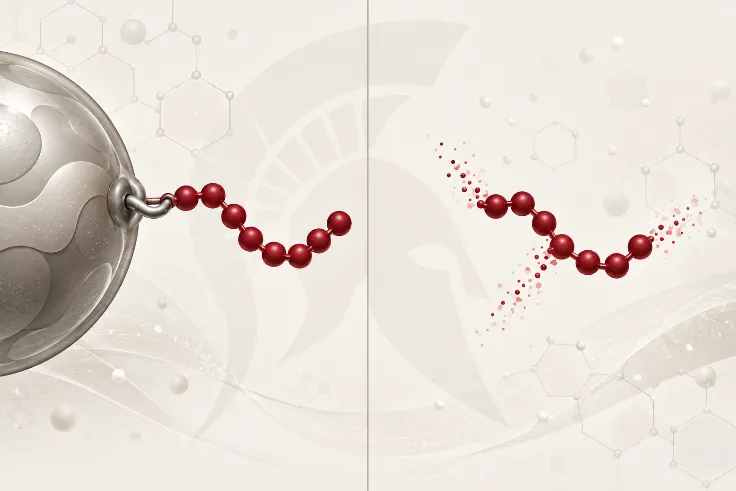
| CJC-1295 is a lab-made version of growth hormone-releasing hormone (GHRH), the signal that tells the pituitary gland to release growth hormone. Its DAC form latches onto the blood protein albumin, which lets it last far longer than natural GHRH. Researchers often study it alongside ipamorelin, a selective growth hormone secretagogue. For laboratory research use only. |
The short version
- It’s a tougher copy of a natural signal. CJC-1295 is built on the first 29 amino acids of GHRH, with four swaps that help it resist the enzymes that normally break GHRH down fast (Jetté et al., 2005).
- The DAC version hitches a ride. In rats, it latched onto blood albumin within 15 minutes and was still circulating days later (Jetté et al., 2005).
- It rescued growth in knockout mice. Mice born without their own GHRH grew normally with CJC-1295 (Alba et al., 2006).
- Ipamorelin is the picky partner. In swine, it released growth hormone without raising stress hormones the way older peptides did (Raun et al., 1998). It was never approved. CJC-1295 reached clinical testing in the mid-2000s but has no FDA approval for any use.
| The short versionIt’s a tougher copy of a natural signal. CJC-1295 is built on the first 29 amino acids of GHRH, with four swaps that help it resist the enzymes that normally break GHRH down fast (Jetté et al., 2005).The DAC version hitches a ride. In rats, it latched onto blood albumin within 15 minutes and was still circulating days later (Jetté et al., 2005).It rescued growth in knockout mice. Mice born without their own GHRH grew normally with CJC-1295 (Alba et al., 2006).Ipamorelin is the picky partner. In swine, it released growth hormone without raising stress hormones the way older peptides did (Raun et al., 1998).It was never approved. CJC-1295 reached clinical testing in the mid-2000s but has no FDA approval for any use. |
What is CJC-1295?
CJC-1295 is a synthetic peptide that copies growth hormone-releasing hormone, or GHRH. In mammals, GHRH is the messenger the brain sends to the pituitary gland to say it’s time to release growth hormone.
There’s a catch with the natural version, though. GHRH breaks down within minutes. The signal is gone almost as soon as it arrives.
CJC-1295 was designed to fix that. It keeps the first 29 amino acids of human GHRH, the part that does the work. Then it swaps four of them to make the molecule harder for enzymes to chew up (Jetté et al., 2005).
| At a glance | |
| What it is | A modified version of GHRH(1-29), the active part of growth hormone-releasing hormone |
| Two forms | With DAC (albumin-binding) and without DAC, also called Modified GRF (1-29) |
| Developed by | ConjuChem, a Montreal drug developer, in the early 2000s |
| Most-cited studies | Rats (2005), knockout mice (2006) |
| Often paired with | Ipamorelin, a selective growth hormone secretagogue |
| Spartan’s blend | CJC-1295 without DAC plus ipamorelin, 5 mg of each |
| Regulatory status | Not approved by the FDA for any use |
The growth hormone signal in 30 seconds
In mammals, growth hormone release works like a relay. The hypothalamus, a small region at the base of the brain, sends GHRH down to the pituitary gland sitting just beneath it.
The pituitary answers by releasing growth hormone into the blood. Growth hormone then prompts the liver to make IGF-1, a growth factor that carries much of the message onward, so researchers often measure both.
CJC-1295 steps in at the very first handoff. Everything downstream depends on how well it delivers that opening message.
The problem it was built to solve
Researchers had a timing problem. In one mouse study, even giving a standard GHRH analog twice a day wasn’t enough to restore normal growth in mice that couldn’t make their own GHRH (Alba et al., 2006).
If the signal fades that quickly, you can’t study what a steady GHRH signal does. Not for long, anyway. CJC-1295 was the attempt to make one that stuck around.
The albumin trick: how CJC-1295 with DAC lasts so long
This is the clever part. DAC stands for Drug Affinity Complex, a small chemical hook attached to the end of the peptide. Simple idea, big effect.
Albumin is the most common protein in blood, and it has one exposed attachment point that the hook is designed to grab. Once it latches on, CJC-1295 stops behaving like a tiny peptide that gets cleared fast. It rides along with a big, long-lived protein instead, like a hitchhiker who’s found a bus that isn’t stopping anytime soon.
A 2005 rat study showed it working. Within 15 minutes, CJC-1295 was attached to the rats’ albumin. It was still bound after 24 hours, and still detectable in their blood beyond 72 (Jetté et al., 2005).
It wasn’t just sticking around, either. Over the first two hours, the rats released about four times more growth hormone than they did with the unmodified GHRH fragment (Jetté et al., 2005). That’s the result that put CJC-1295 on the map.
The albumin-bound versions also held up better in lab tests against DPP-IV, an enzyme that normally chops GHRH apart (Jetté et al., 2005). So the hook did two jobs at once: it kept the peptide circulating, and it helped protect it.
The knockout mouse study
The most memorable CJC-1295 experiment used mice that were missing a single gene: the one that makes GHRH. Without it, their pituitary never gets the signal to release growth hormone, and they grow up noticeably small.
So researchers at Johns Hopkins asked a simple question. If CJC-1295 really works as a stand-in for GHRH, can it fill the gap in these mice?
It could. Knockout mice given CJC-1295 reached normal growth and normal body composition, including normal lean mass and fat stores (Alba et al., 2006). Their pituitary glands also showed more of the cells that make growth hormone, which suggests the signal was doing exactly what GHRH normally does.
One more detail stood out. How often the mice received it mattered, and less frequent schedules didn’t fully restore growth, which told the researchers something about how long each round of the signal lasted.
For researchers, the value is the proof of concept. It showed that CJC-1295 can do the job of GHRH in a living animal, even when the real thing is completely absent.
CJC-1295 with DAC vs no DAC
Here’s the part a lot of articles blur. Both the rat study and the mouse study used CJC-1295 with DAC, the version with the albumin hook.
CJC-1295 without DAC is the same modified GHRH(1-29) backbone with the hook left off. It’s often sold as Modified GRF (1-29), or Mod GRF 1-29, and without the hook it can’t hitch a ride on albumin.
| With DAC | Without DAC (Mod GRF 1-29) | |
| Backbone | Modified GHRH(1-29) | Modified GHRH(1-29) |
| Albumin hook | Yes | No |
| How long it lingers | Days, in the rat study | Much shorter, since there’s no albumin to ride on |
| Used in the famous studies | Yes | No |
So don’t read the DAC results straight onto the no-DAC version. Same backbone, different behavior. The feature that made those studies interesting is the one the no-DAC version doesn’t have.
That matters for Spartan’s blend, because it uses CJC-1295 without DAC. The certificate of analysis for the current lot lists it that way, so the albumin story above is background on the molecule’s history, not a description of what’s in the vial.
For the full side-by-side, see CJC-1295 with DAC vs no DAC.
Why CJC-1295 is paired with ipamorelin
The pituitary gland listens for more than one signal. GHRH works through one receptor, and a separate family of compounds called growth hormone secretagogues works through a different one. The research library’s overview of growth hormone secretagogue research maps out the whole family.
CJC-1295 acts on the GHRH receptor (Jetté et al., 2005). Ipamorelin, a five-amino-acid peptide, acts on the secretagogue receptor instead (Raun et al., 1998). Because they knock on two different doors, researchers pair them to study how the two signals interact.
Ipamorelin: the peptide that minded its own business
Ipamorelin came out of a chemistry program at Novo Nordisk in the late 1990s, and its claim to fame is being picky. Older secretagogues like GHRP-2 and GHRP-6 released growth hormone, but in swine they also pushed up the stress hormones ACTH and cortisol (Raun et al., 1998).
Ipamorelin didn’t. It released growth hormone without a meaningful bump in ACTH or cortisol, even at levels far above what it took to trigger growth hormone. Prolactin and thyroid-stimulating hormone stayed put too.
That’s why the paper called it the first selective growth hormone secretagogue. For researchers, a clean signal means fewer side conversations muddying the data. It’s one of several secretagogues studied today, alongside compounds like hexarelin.
Spartan’s CJC-1295 and ipamorelin blend 10mg combines the two for exactly this kind of research: 5 mg of no-DAC CJC-1295 with 5 mg of ipamorelin. For more on the second half of the pair, see the guide to ipamorelin, and for how combination studies are designed, the peptide stacking research guide.
Where CJC-1295 stands today
CJC-1295 was developed by ConjuChem, and company researchers are among the authors of both the rat and the mouse studies (Jetté et al., 2005; Alba et al., 2006). The company went on to run placebo-controlled clinical studies in the mid-2000s (Teichman et al., 2006).
It never made it to approval. CJC-1295 isn’t approved by the FDA for any use, and today it’s sold as a research compound for laboratory work only.
It also isn’t the only modified GHRH analog researchers study. Tesamorelin is another, and tesamorelin vs CJC-1295 walks through how the two compare. Spartan also carries CJC-1295 with tesamorelin as a combined research product.
What the research doesn’t tell us
The CJC-1295 story is a good one. It also has limits, and the headline results come from rats and mice, and the ipamorelin selectivity data comes from swine.
Most of the famous work also used the DAC version, and it came from the company developing the compound. That doesn’t make it wrong. Independent replication just counts for more.
And the studies above tested each compound on its own. Keep that in mind whenever the two are discussed together.
Buying CJC-1295 for research: what to check
Whatever you’re studying, start by confirming what’s actually in the vial. That matters doubly for CJC-1295, since the DAC and no-DAC versions look identical on a shelf.
- Which version it is. The label and the certificate of analysis should say clearly whether it’s CJC-1295 with DAC or without DAC.
- Identity. Mass spectrometry confirms each molecule matches its expected mass, which is also how the DAC and no-DAC versions are told apart.
- Purity. HPLC testing reports what share of the sample is the target compound.
- Batch match. The certificate’s batch or lot number should match your vial.
Spartan’s current lot, PEP-04-26, was tested independently by MZ Biolabs in Tucson, Arizona, at 99.85% purity by HPLC with mass spectrometry identity confirmation. You can read the full CJC-1295 ipamorelin COA before you buy.
Not sure what those numbers mean? This walkthrough on how to interpret peptide purity results breaks it down.
CJC-1295 in a nutshell
CJC-1295 took a signal that disappears in minutes and made it last for days, by teaching it to ride on albumin. In knockout mice, it filled in for missing GHRH well enough to restore normal growth.
Pair it with ipamorelin and you’ve got two signals hitting two different receptors on the same gland. That’s why the combination keeps showing up in research. Just remember which version you’re working with, and read the studies for what they are: a fascinating animal-model story.
Frequently asked questions
What is CJC-1295?
CJC-1295 is a synthetic version of growth hormone-releasing hormone (GHRH), modified to resist breakdown. Its DAC form binds to the blood protein albumin, which let it last for days in rat studies. It’s sold for laboratory research use only.
What does CJC-1295 do?
In animal studies, it acts like GHRH and signals the pituitary gland to release growth hormone. In rats it produced more growth hormone release than the unmodified GHRH fragment, and in mice lacking their own GHRH it restored normal growth.
What’s the difference between CJC-1295 with DAC and without DAC?
Both share the same modified GHRH(1-29) backbone. The DAC version carries a chemical hook that binds albumin and extends how long it lasts; the version without DAC, also called Mod GRF 1-29, doesn’t.
What is Mod GRF 1-29?
Modified GRF (1-29), or Mod GRF 1-29, is another name for CJC-1295 without DAC. It has the same modified backbone but no albumin-binding hook.
Why is CJC-1295 paired with ipamorelin?
They act on two different receptors that both influence growth hormone release. CJC-1295 works through the GHRH receptor and ipamorelin through the secretagogue receptor, so researchers pair them to study how the two signals interact.
What is ipamorelin?
Ipamorelin is a five-amino-acid peptide developed at Novo Nordisk. In swine studies, it released growth hormone without the rise in stress hormones seen with older peptides like GHRP-2 and GHRP-6.
Does Spartan’s CJC-1295/Ipamorelin blend use CJC-1295 with DAC?
No. Spartan’s blend uses CJC-1295 without DAC, also called Mod GRF 1-29, with 5 mg of it and 5 mg of ipamorelin per vial, as listed on the lot’s certificate of analysis.
Who developed CJC-1295?
CJC-1295 was developed by ConjuChem, a Montreal-based drug developer, in the early 2000s.
Is CJC-1295 FDA approved?
No. CJC-1295 reached clinical testing in the mid-2000s but was never approved by the FDA for any use. Research-grade CJC-1295 is sold for laboratory research only.
Research use disclaimer. All content published by Spartan Peptides is for educational and research purposes only. It is not medical advice and is not a recommendation for human use. Products sold on this site are research compounds intended for laboratory and in vitro applications only.
Written by the Spartan Research Team
Our team of peptide researchers and biochemists reviews every article for scientific accuracy. Learn more about our team →